

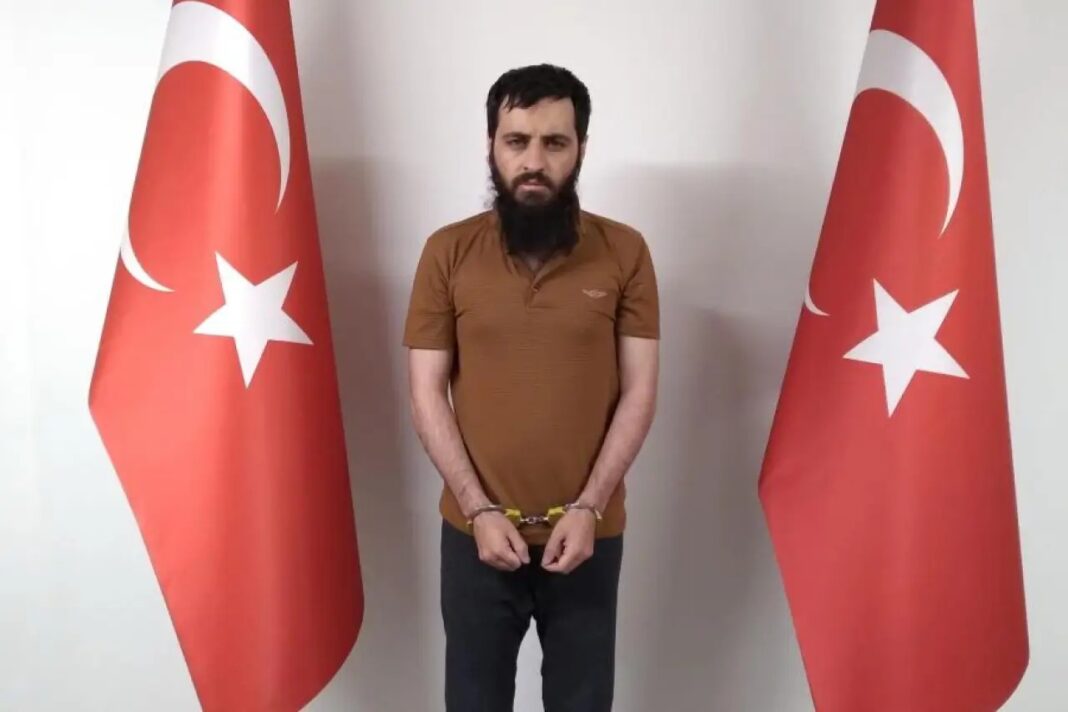
 suspect in the trial over Turkey’s deadliest terrorist attack said he had identified nearly 90 people linked to the extremist group but denied having direct information about the 2015 Ankara train station bombing, Deutsche Welle Turkish edition reported.)
An Islamic State in Iraq and the Levant (ISIL) suspect in the trial over Turkey’s deadliest terrorist attack said he had identified nearly 90 people linked to the extremist group but denied having direct information about the 2015 Ankara train station bombing, Deutsche Welle Turkish edition reported.
Ömer Deniz Dündar, a jailed ISIL defendant known by the code name “Ammar,” appeared before the Ankara 4th High Criminal Court on Tuesday in the case concerning the October 10, 2015, twin suicide bombings outside Ankara’s main train station, which targeted a Labor, Peace and Democracy rally and killed more than 104 people.
Relatives of the victims, survivors of the attack and lawyers for the complainants attended the hearing, which was held under tight security.
Despite claiming broad knowledge of ISIL’s structure and members, Dündar denied having direct information about the Ankara attack.
Dündar’s testimony angered victims’ families, who say the case has still failed to address who was responsible for allowing the attack to happen nearly 11 years ago.
“I have no direct knowledge,” he said. “Yunus Durmaz was responsible for the attacks. He received the necessary information from Syria and came to Turkey. The orders were given by ‘Ebu Zeynep,’” a code name used in the case for an alleged senior ISIL figure linked to attacks in Turkey.
Durmaz was identified in the case file as one of the planners of the Ankara bombing.
The indictment in the Ankara bombing case identified the suicide bombers as an unidentified Syrian national as well as Yunus Emre Alagöz, a Turkish national from the eastern province of Adıyaman whose brother, Şeyh Abdurrahman Alagöz, carried out another deadly bombing in the Suruç district of Şanlıurfa province in July 2015.
The Suruç attack killed 33 people, most of them young activists.
The two men traveled from a safe house in Gaziantep the night before the Ankara attack with help from ISIL operatives, according to summaries in the case file.
Dündar said he knew the Alagöz brothers and Orhan Gönder, who placed a bomb at a pro-Kurdish Peoples’ Democratic Party (HDP) rally in Diyarbakır in June 2015.
The presiding judge said Dündar had identified 21 people in a statement he gave to counterterrorism police under Turkey’s remorse law, which allows sentence reductions for suspects who cooperate with authorities. Dündar disputed the number.
“I told everything I knew with all good intentions and sincerity,” he said. “I did not identify 21 people but nearly 90.”
Mehtap Sakinci, who lost her husband, lawyer Uygar Coşkun, in the Ankara bombing, asked Dündar whether he had information about the unidentified Syrian suicide bomber.
“This court has been waiting for you for 11 years,” she said. “You keep saying you served in ISIL’s Syria structure, not its Turkey structure. If you are benefiting from remorse provisions, will you say this clearly?”
Dündar said he only knew that the suicide bomber was Syrian.
“You are facing someone who has understood his mistake, turned back from the path he took and is repentant,” he said.
His remarks prompted anger from the families of the victims.
“What about our children?” one of the victim relative said. “They are in the ground. Our 8-year-old child did not grow up.”
The presiding judge ordered the removal of relatives who reacted to Dündar’s remarks and suspended the hearing for five minutes.
After the break, İlke Işık, one of the lawyers for the complainants, criticized the court’s handling of the families.
“We have been waiting for justice for 11 years,” Işık said. “We waited 11 years to question this defendant. We were going to ask the questions that were never asked by the police and have him identify people. You cannot even tolerate listening to one of our clients. We will continue our struggle until all defendants are tried and punished.”
The families left the courtroom while applauding. The court adjourned the hearing until September 25.
Speaking outside the courthouse after the hearing, İshak Kocabıyık, co-spokesperson for the October 10 Peace Association, said the families had been humiliated after every hearing for 11 years.
“No matter what they do, they will not make us give up our struggle for justice,” he said.
Işık said four different panels of judges had handled the case over the past 11 years and criticized the court for removing families from the courtroom.
In an earlier police statement reported by the Evrensel daily last week, Dündar claimed that ISIL did not claim responsibility for the Ankara bombing because the group was in talks with the Turkish government at the time.
He also claimed that the attack was carried out on Durmaz’s initiative and without approval or funding from the group’s senior leadership.
The Ankara train station bombing remains one of the most painful unresolved cases for victims’ families, who have long accused Turkish authorities of failing to prevent the attack despite prior warnings received by police and intelligence agencies.
In the main trial, nine defendants were sentenced to aggravated life in prison on charges including attempting to overthrow the constitutional order, premeditated murder and attempted murder. Nine others received prison sentences on terrorism-related charges, while a number of suspects remain at large.
Turkey’s Supreme Court of Appeals upheld the life sentences of nine ISIL members in 2024 but confirmed that former intelligence and police officials would not face prosecution after the Ankara Governor’s Office refused to authorize an investigation.