

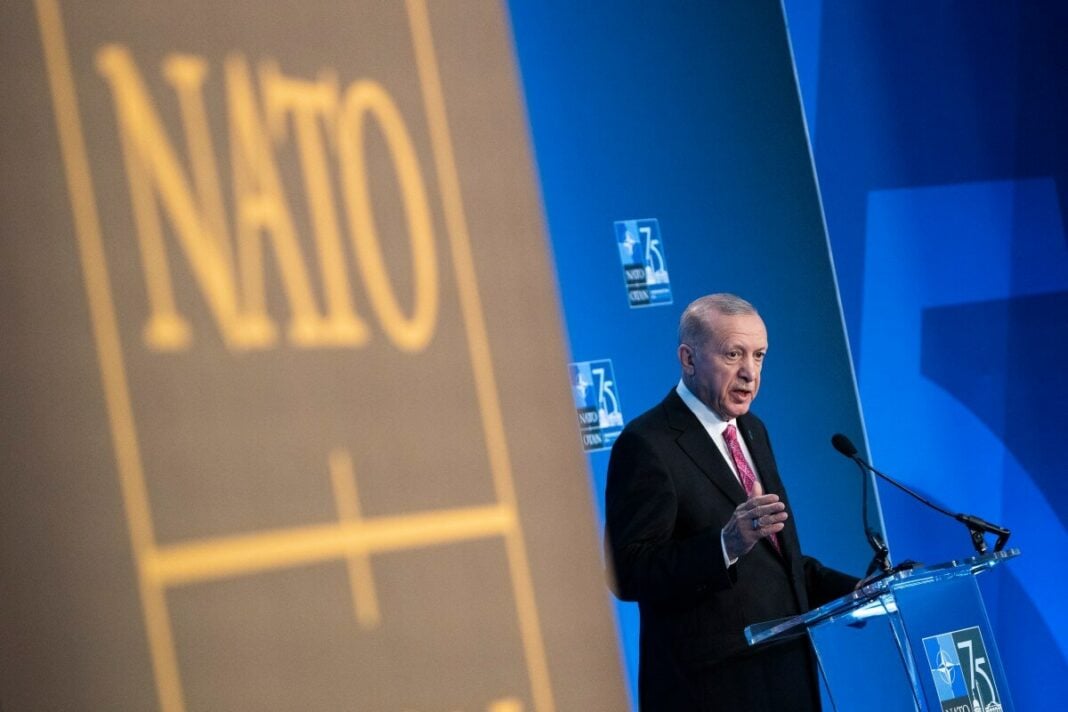

Turkish President Recep Tayyip Erdoğan will seek to use next week’s NATO summit in Ankara to raise Turkey’s international profile, analysts say, despite growing scrutiny of his government’s crackdown on political opponents ahead of the next presidential election.
Hosting the July 7-8 summit gives Ankara a chance to emphasize Turkey’s role as a key regional power and a bridge between the United States and Europe at a time of rising geopolitical tensions.
Analysts say Erdoğan wants to build on Turkey’s more visible role since the start of Russia’s war in Ukraine, as conflicts in the Middle East and strains inside the transatlantic alliance shift Western security priorities.
His goal is to position Turkey as “an indispensable actor in security and geopolitical processes in Europe and beyond,” foreign policy expert Serkan Demirtaş told Agence France-Presse.
NATO unity has been tested in recent months, particularly since the United States and Israel began attacking Iran on February 28, sparking a war.
European governments declined to take part in the military campaign, which Turkey also opposed, angering US President Donald Trump, who has lashed out at NATO.
Despite the dispute, Trump will attend the summit in Ankara along with more than 30 other world leaders.
A key NATO member, Turkey sits at the crossroads of Europe and the Middle East and has the alliance’s second-largest army.
“Holding the summit in Turkey will serve as a reminder to the rest of the alliance of the important role Ankara has played since joining NATO in 1952, not only inside the alliance but also across the broader region,” said Luke Coffey, a senior fellow at the Hudson Institute.
‘In the right direction’
A Turkish security source said hosting the summit is a “diplomatic success” that confirms Turkey’s role as a balancing power and underlines its growing importance to European defense.
Demirtaş said Turkey brings significant military capacity to the alliance, citing its participation in major NATO exercises and its role in missions, particularly in the Baltic region.
Still, relations have not always been smooth.
“There have been challenges in the US-Turkey bilateral relationship in recent years and at times these tensions have spilt over into NATO’s internal dynamics,” Coffey said.
In 2022 Turkey initially blocked Sweden and Finland’s bids to join NATO after Russia’s invasion of Ukraine, although both countries were eventually admitted.
Ankara also angered Washington by purchasing Russian S-400 missile defense systems, a move that led to its removal from the F-35 fighter jet program and prompted NATO concerns over compatibility with alliance systems.
Even so, Trump’s good rapport with Erdoğan has helped keep dialogue open between the two sides.
“On balance, the relationship is trending in the right direction. It is in everyone’s interest that next month’s summit goes smoothly,” Coffey said.
Muted concerns
Aaron Stein, head of the Foreign Policy Research Institute, said NATO membership remains “Turkey’s ultimate deterrent,” allowing Ankara to manage its complex ties with Russia without facing Moscow alone.
That gives Turkey more room to engage Russia, he said.
Analysts say keeping Turkey anchored in NATO is important because Ankara can operate across several areas of concern to the alliance, from Ukraine to the Middle East.
Since the start of the war in Ukraine, Turkey has tried to maintain a careful balance, hosting rounds of talks between Kyiv and Moscow while keeping open channels with both sides.
“Turkey has supported Kyiv, sometimes quietly, with key munitions and equipment, while also maintaining channels with both sides in an effort to pursue a diplomatic solution,” Coffey said.
Pragmatism
The summit comes amid domestic turmoil after a court ruling ousted Turkey’s main opposition leader, a decision critics describe as the latest judicial move by Erdoğan to weaken his rivals ahead of the 2028 presidential election.
European governments have kept their concerns muted, moving carefully to avoid damaging ties with Ankara, Demirtaş said.
With Turkey’s EU accession bid largely stalled, cooperation has moved toward practical areas such as defense, where Ankara has expanded its industrial capacity and signed deals with European partners.
The Turkish security source said Ankara expects allies to ease restrictions on its defense sector and deepen industrial cooperation.
For Erdoğan, the summit also offers a domestic political boost, giving him a chance to reinforce his image as “the leader who defends Turkey’s interests most forcefully on the international stage,” Demirtaş said.
As for Western tolerance of Ankara’s increasingly authoritarian turn, Stein suggested it was largely kept separate from security ties.
“NATO isn’t a club exclusively for democracies,” he said.
© Agence France-Presse