


Adem Yavuz Arslan*
I was in the courtroom Tuesday as one of the most consequential legal sagas in modern US-Turkey relations came to an end.
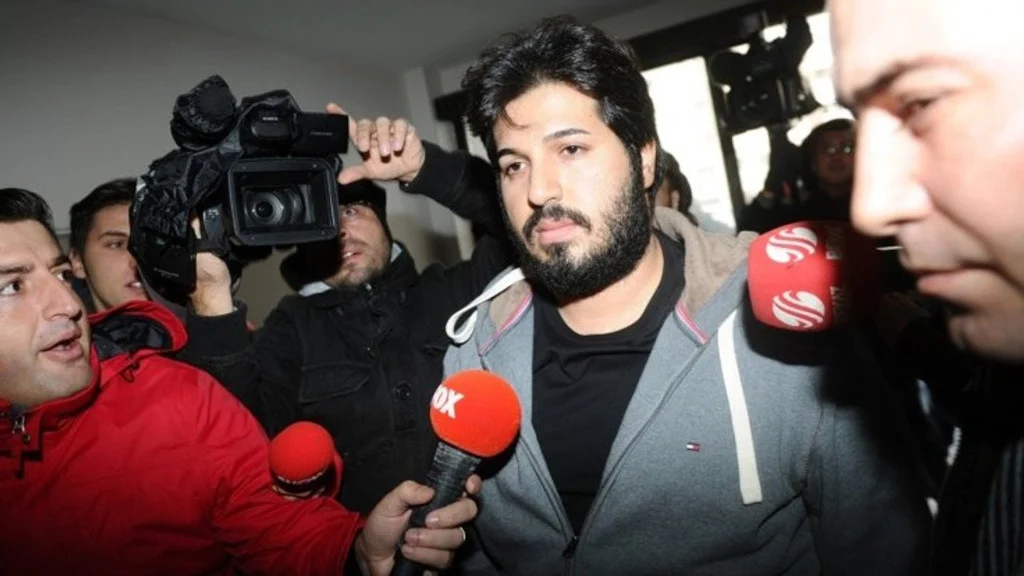
In a packed courtroom at the US District Court for the Southern District of New York, Judge Richard M. Berman sentenced Turkish-Iranian gold trader Reza Zarrab to time served, concluding his prosecution nearly 10 years after his arrest.
The case shaped Turkish politics, strained US-Turkey relations and tested the boundaries between law and geopolitics.
As Zarrab walked out of the courthouse a free man, smiling and relieved, one question stayed with me:
Who, in the end, paid the price for one of the largest sanctions-evasion and corruption scandals of the century?
The answer lies far beyond Tuesday’s sentence.
The man who admitted the crimes walked free
For readers outside Turkey, the Zarrab case requires some context.
In 2016 US authorities arrested Zarrab in Miami, accusing him of masterminding a multibillion-dollar scheme to evade US sanctions on Iran. According to prosecutors, the network relied on fraudulent gold and food transactions and involved Turkey’s state-owned Halkbank.
After initially pleading not guilty, Zarrab became a key cooperating witness in US sanctions enforcement.
He pleaded guilty to seven federal offenses related to sanctions evasion, bank fraud, money laundering and bribing a prison guard.
He testified under oath.
He described in federal court how senior Turkish officials allegedly received millions of dollars in bribes to facilitate the operation.
His own role in the scheme was no longer an allegation. It was established through his guilty plea and accepted by a federal court.
A jury later convicted former Halkbank executive Mehmet Hakan Atilla on five charges, confirming that the conspiracy extended beyond Zarrab. The accusations against the Turkish politicians named in Zarrab’s testimony, however, were never adjudicated.
Time served did not mean that Zarrab had faced no punishment.
He spent 22 months in custody, followed by five months under strict home confinement and 95 months under restrictive bail conditions. He also forfeited a boat and cash worth nearly $377,000.
His lawyers said Turkey seized assets valued at $172 million in retaliation for his cooperation.
Prosecutors credited Zarrab with assistance they described as truthful, complete and reliable. They also cited threats against his life that followed his decision to cooperate.
Yet after admitting crimes that carried the possibility of decades in prison, Zarrab left court without another day in custody, an additional fine, restitution or further supervision.
When law collided with politics
The legal story soon became inseparable from politics.
The investigation put pressure on relations between Washington and Ankara.
Turkish President Recep Tayyip Erdoğan repeatedly described the case as a politically motivated attack against Turkey.
Inside Washington evidence emerged that members of the first Trump administration sought to intervene in the Halkbank prosecution.
Former national security adviser John Bolton wrote in his memoir that Erdoğan repeatedly pressed President Donald Trump to resolve the case. Bolton recounted Trump promising Erdoğan that he would “take care of things” once prosecutors inherited from the Obama administration were replaced.
Geoffrey Berman, the former US attorney in Manhattan, later wrote that Attorney General William Barr pressed his office to give Halkbank a deal that would end the prosecution.
Congressional inquiries and reporting documented Erdoğan’s lobbying, Trump’s referral of the matter to the Treasury and Justice departments and meetings between senior US and Turkish officials.
Whether improper personal or political intervention determined the final outcome has never been established in court.
The role of geopolitics, however, is not speculation.
The Justice Department acknowledged that its agreement with Halkbank arose from Turkey’s assistance in securing the 2025 Israel-Hamas ceasefire, the release of hostages and the return of victims’ remains. The State Department considered resolution of the Halkbank case an important part of those diplomatic discussions.
Halkbank ultimately secured dismissal of the charges without admitting wrongdoing and without paying a fine, forfeiture or restitution.
Now Zarrab himself has left the courthouse without further punishment.
These outcomes show how a criminal prosecution became intertwined with diplomatic bargaining, even if they do not prove that improper intervention determined the result.
The forgotten victims
Yet the greatest irony lies elsewhere.
Zarrab is free.
Halkbank escaped the financial penalties and criminal conviction it once faced.
The corruption allegations did enter Turkey’s justice system in 2013. But no senior politician implicated by the evidence was prosecuted or tried before an independent court.
Erdoğan’s government removed the police officers and prosecutors conducting the investigations. Newly appointed prosecutors closed the cases in 2014, and the ruling party’s parliamentary majority voted in 2015 against sending four former ministers to the Supreme State Council for trial.
Another group paid the price.
Police officers who opened the original corruption investigations were arrested and prosecuted after the government dismantled the probes.
Turkish courts sentenced 15 defendants, including former police chiefs Yakub Saygılı, Kazım Aksoy, Yasin Topçu and Nazmi Ardıç, to aggravated life in prison for allegedly attempting to overthrow the government through the corruption investigation.
Some have spent more than a decade behind bars.
Prosecutors were removed from the cases, dismissed from the profession and subjected to arrest warrants. Some fled Turkey and remain in exile.
In its July 2026 sentencing submission, the US government stated that most of the investigators and prosecutors were either arrested on “false charges” or forced to flee the country.
This reversal remains one of the least understood aspects of the affair outside Turkey.
Zarrab’s guilty plea and Atilla’s conviction established the core sanctions-evasion conspiracy.
The principal architect admitted his crimes.
Yet in Turkey the investigators who uncovered the alleged corruption were imprisoned or driven into exile.
When truth survives but justice changes
In her 1967 essay “Truth and Politics,” political philosopher Hannah Arendt argued that facts must inform political opinion and warned about the conflict between factual truth and political power.
Few modern cases illustrate that conflict more clearly than the Zarrab affair.
The evidence did not disappear.
The guilty plea did not disappear.
Atilla’s conviction did not disappear.
The testimony remains part of the public record.
What changed were the consequences.
Zarrab’s cooperation allowed him to leave court without further punishment after 22 months in custody.
The prosecution of Halkbank ended without an admission of wrongdoing or a dollar in financial penalties.
The Turkish political figures implicated in the evidence never faced an independent trial.
The investigators who pursued the allegations lost their freedom or their country.
Leaving the courthouse
As I walked out of the federal courthouse in lower Manhattan, two images remained fixed in my mind.
One was Reza Zarrab, smiling as he left the building a free man after years of cooperating with US authorities.
The other was the memory of Turkish police officers who have spent more than 10 years in prison for conducting the investigations that exposed a criminal conspiracy later established through a guilty plea and a jury verdict in the United States.
That is why the most important question raised by Tuesday’s sentencing is not about Reza Zarrab.
It is about justice itself.
When a criminal scheme is established through a guilty plea and a jury verdict, confessed by one of its principal architects and preserved in the public record, yet the people who investigated it become the ones who spend years behind bars, can we honestly say that justice has prevailed?
*Adem Yavuz Arslan is a journalist with over two decades of experience in political reporting, investigative journalism and international conflict coverage. His work has focused on Turkey’s political landscape, including detailed reporting on the 2016 coup attempt and its aftermath, as well as broader issues related to media freedom and human rights. He has reported from conflict zones such as Bosnia, Kosovo and Iraq, and has conducted in-depth research on high-profile cases, including the assassination of Turkish-Armenian journalist Hrant Dink. Arslan is the author of four books and has received journalism awards for his investigative work. Currently living in exile in Washington, D.C., he continues his journalism through digital media platforms, including his YouTube channel, Turkish Minute, TR724 and X.
Disclaimer: The views expressed in this opinion piece are those of the author and do not necessarily reflect the editorial stance of Turkish Minute.