

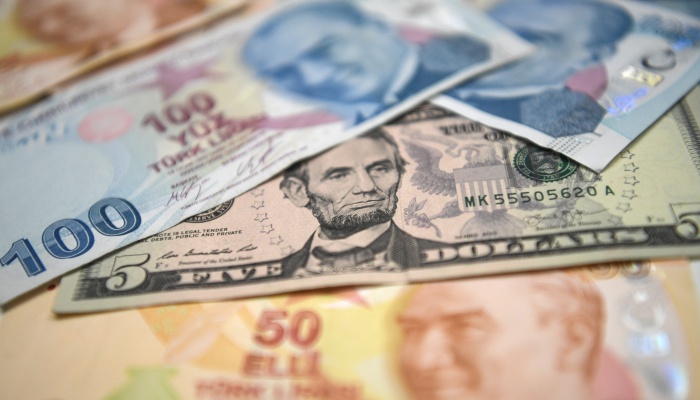

Turkey’s current account deficit increased to $9.67 billion in March, the highest monthly shortfall since January 2023, central bank data showed on Wednesday, as portfolio outflows and a drop in reserves indicated pressure on the country’s external finances after the US-Iran war shook markets.
The current account measures the flow of goods, services, investment income and transfers between Turkey and the rest of the world. A deficit means the country is spending more foreign currency abroad than it earns, leaving it dependent on capital inflows, borrowing or central bank reserves.
The Turkish Central Bank said the balance of payments-defined foreign trade deficit reached $9.52 billion in March. Excluding gold and energy, the current account still posted a $3.89 billion deficit, a sign that the pressure was not limited to oil, gas or the gold trade.
The 12-month current account deficit expanded to $39.72 billion, up from $34.96 billion in February and $30.17 billion at the end of 2025.
The goods trade deficit was the main drag on the external balance. Services, one of Turkey’s main sources of foreign currency, limited the gap with a $2.59 billion surplus.
Transport services brought in a net $1.63 billion, while travel, which includes tourism, generated a net $2.25 billion, according to the central bank.
March data also showed a shock on the financing side. Portfolio investments recorded a net outflow of $14.8 billion, reflecting investor withdrawals from Turkish assets.
Foreign investors sold a net $1.08 billion in Turkish equities and $6.4 billion in domestic government debt securities. They also sold $3.09 billion in investment fund shares.
The official reserve assets of the central bank fell by $43.42 billion in March. Annualized data showed a $52.5 billion decline in net reserves, underlining the pressure on the lira during the month.
The balance of payments figures cover a period in which the US-Iran conflict triggered investor concern over energy prices, inflation and Turkey’s need for foreign financing. Turkey imports most of its energy, making its economy sensitive to oil and natural gas prices.
Finance Minister Mehmet Şimşek said in April that Turkey was ready to take new economic measures if the shock from the conflict persisted.
Direct investments produced a net outflow of $212 million in March. Foreign direct investment into Turkey rose by $1.02 billion, while Turkish residents’ direct investment abroad increased by $1.23 billion.
In real estate, foreigners made net purchases of $243 million in Turkey, while Turkish residents bought $187 million in property abroad.
Banks and companies continued to borrow from abroad. Banks recorded $1.03 billion in net foreign loan use, while other sectors recorded $1.19 billion. The general government made $22 million in net repayments.
The data came as Turkey’s economic program, led by Şimşek and Central Bank Governor Fatih Karahan, seeks to rebuild investor confidence after years of inflation, lira weakness and reserve losses.
Authorities have used high interest rates, credit controls and foreign exchange management to restore stability since President Recep Tayyip Erdoğan won another term in office in 2023 and appointed a team that shifted away from his earlier low-rate policy.
But the March figures showed that the current account remains a weak point. A larger deficit can increase the need for external financing and make the lira more vulnerable when global or regional shocks reduce investor appetite.