

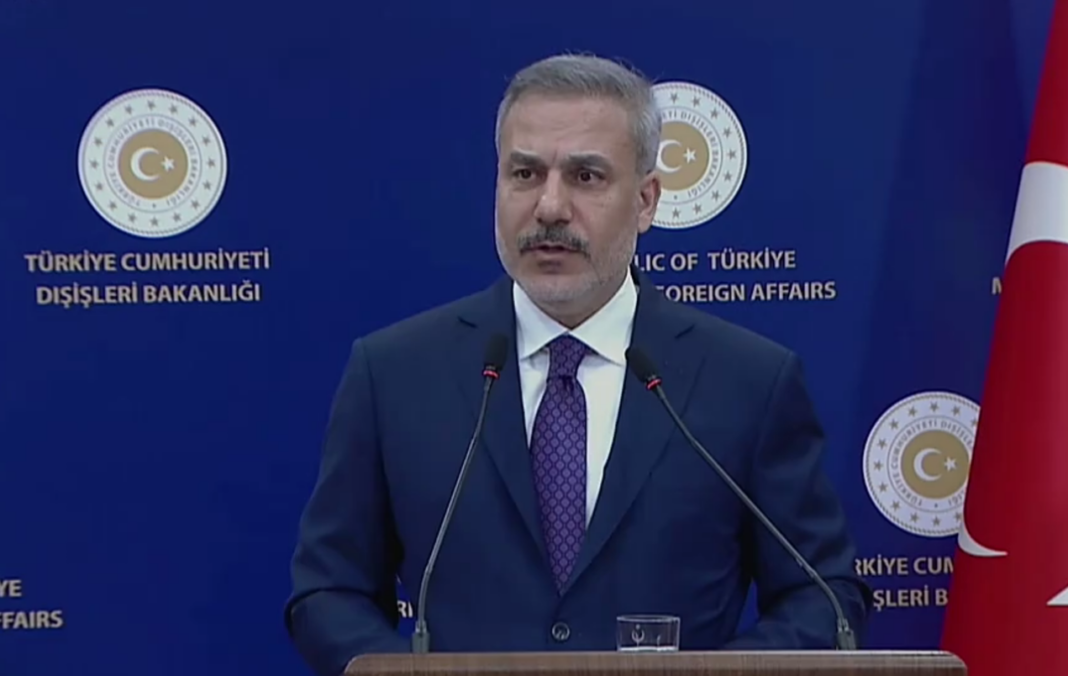

Turkish Foreign Minister Hakan Fidan said Ankara supports restoring free passage through the Strait of Hormuz as it existed before the US-Iran conflict and would consider providing technical assistance only after Washington and Tehran reach a diplomatic agreement.
Fidan made the remarks in an interview with Al Jazeera while he was visiting Qatar for talks on regional security, saying Turkey is not proposing its own mechanism for the strait but is responding to proposals from other countries.
At a time of mounting regional tensions and growing uncertainty in global politics, I sat down with Turkish Foreign Minister Hakan Fidan for an in-depth conversation on the key geopolitical challenges shaping the region and beyond.
Our discussion focused on the Iran–US… pic.twitter.com/ivmwXxaJxk
— Resul Serdar (@ResulSerdarAtas) May 12, 2026
“We are not suggesting any mechanism,” Fidan said when asked what Turkey would be willing to contribute to an international effort, including demining, in the Strait of Hormuz. “We are responding [to] some proposals to form some mechanism addressing the problems of the Strait of Hormuz.”
The Strait of Hormuz, a narrow waterway between Iran and Oman, connects the Persian Gulf to the Gulf of Oman and the Arabian Sea. It is a key passage for oil and liquefied natural gas exports from Gulf countries, meaning any disruption can affect energy prices and supply chains worldwide.
Fidan said Turkey supports the status quo that existed before the fighting because it allowed free passage for ships.
“We certainly support what the majority actually would like to see, because the status quo before the war was the way that everybody was enjoying,” he said.
Fidan warned that imposing a new maritime arrangement without broad acceptance could create a new conflict and set a precedent for other straits and chokepoints.
“We want to see a free passage of all the ships, just like it was happening before the war,” he said.
Fidan said proposals for a mechanism on Hormuz have included separate French and British initiatives that were later merged. He said Turkey had attended the meetings and reviewed “ideas and proposals, counter proposals.”
But he said Ankara’s priority is for Iran and the United States to conclude their talks and reach an understanding.
“Then if additional assistance is needed, we can be there,” he said. “But without any agreement, without any diplomatic result, I think our engagement will not be meaningful or will not be positive.”
Fidan said Turkey is not heavily dependent on the Strait of Hormuz for its own energy supply because oil and gas reach the country through pipelines from Central Asia, Iran, Russia and Azerbaijan. But he said Turkey, like other countries, is affected by energy prices.
“We are not affected in terms of energy security, but we are badly affected in terms of energy prices, just like everybody has been affected,” he said.
Fidan said Turkey’s most urgent concern is that the ceasefire between the US and Iran holds, warning that the alternative is a return to fighting that would damage the world economy and energy security.
“The alternative of the ceasefire is going back to war, which nobody would like to see,” he said.
He said the talks had seen “ups and downs” and described the latest disagreement as part of the nature of negotiations, adding that proposals can be revised and reworded.
Fidan said Turkey has kept channels open with Tehran and Washington and is working with regional countries, including Qatar, to support mediation led by Pakistan.
He said regional coordination remains uneven, but that Turkey, Qatar and Saudi Arabia coordinate while other regional countries, including Egypt and Jordan, remain in contact.
“There is a meaningful communication and consultations between the regional countries,” he said.
This report was updated to remove remarks that appeared in a transcript published by Turkey’s state-run Anadolu news agency but were not included in the interview published by Al Jazeera.