

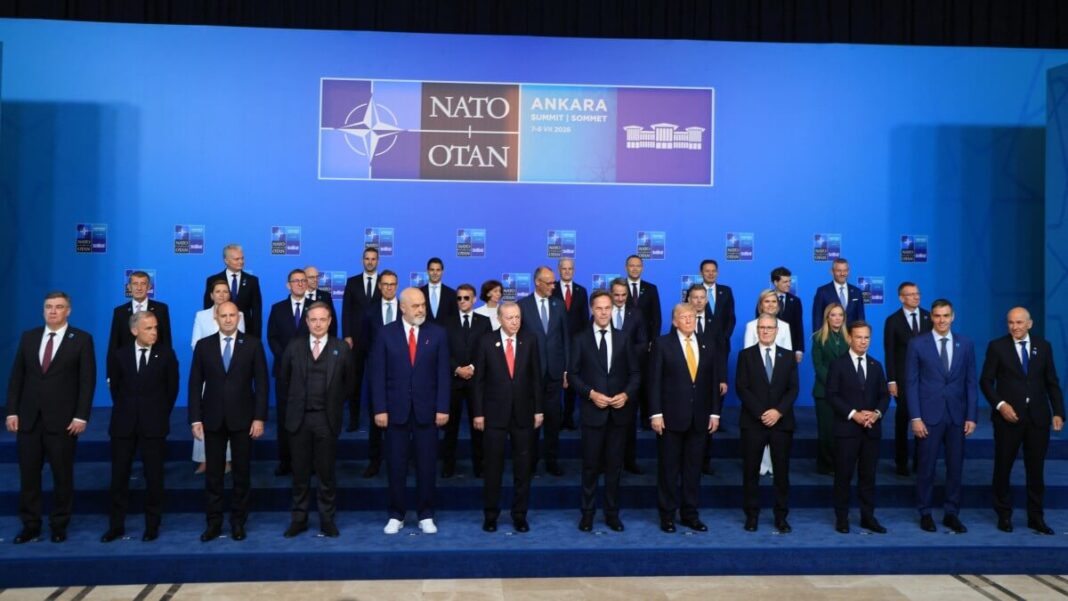

Turks are divided over whether NATO would support their country in a potential confrontation with Israel, despite widespread agreement that membership in the alliance benefits national security, according to a survey released by the İstanbul-based IstanPol think tank.
The survey found that 40.2 percent of respondents believed NATO would side with Turkey in a crisis involving Israel, while 34.3 percent disagreed. Another 25.4 percent were neutral or expressed no opinion.
Expectations of NATO support were highest among voters of President Recep Tayyip Erdoğan’s ruling Justice and Development Party (AKP) and its ally, the Nationalist Movement Party (MHP). Republican People’s Party (CHP), İYİ (Good) Party and pro-Kurdish Peoples’ Equality and Democracy Party (DEM Party) voters were more skeptical.
The findings come as relations between Turkey and Israel have deteriorated sharply over the war in Gaza and competing regional interests.
Erdoğan has accused Israel of committing genocide in Gaza and describes Hamas as a resistance organization. Israel denies the accusation and has criticized Ankara for maintaining ties with Hamas.
Turkey suspended direct trade with Israel in May 2024 and later imposed additional restrictions on transportation and commercial links.
Tensions have also spread to defense policy. Shortly before the July 7–8 NATO summit in Ankara, Israeli Prime Minister Benjamin Netanyahu urged US President Donald Trump not to allow Turkey to rejoin the F-35 Joint Strike Fighter program or approve engines for its domestically developed fighter aircraft.
The survey’s findings may be influenced by Israel’s close relations with several NATO members. Israel is not part of the alliance but is designated by Washington as a major non-NATO ally and receives extensive US military and diplomatic support.
Several European NATO members, particularly Germany, have also provided Israel with weapons and other defense assistance, although European governments have become increasingly divided over Israel’s conduct in Gaza.
NATO’s collective defense clause requires allies to assist a member subjected to an armed attack, but it does not compel every member to respond with military force. The nature and circumstances of a Turkey-Israel confrontation would therefore affect how individual allies responded.
Despite uncertainty over Israel, 64.3 percent of respondents said NATO membership benefits Turkey’s security, while 16.4 percent disagreed.
Just over half, 51.1 percent, agreed that NATO membership provided Turkey with a protective shield during the US-Israeli war on Iran. However, only 43.1 percent believed the alliance would defend Turkey if it came under direct attack, while 32.1 percent disagreed.
That perception followed a series of interceptions during the war. Between March 4 and 30, NATO air and missile defense systems intercepted four ballistic missiles launched from Iran that entered or approached Turkish airspace.
Debris from an interceptor fell in Hatay province after the first incident, but no casualties were reported. NATO subsequently deployed additional Patriot systems to Malatya and Adana provinces to strengthen Turkey’s air defenses.
The survey also showed support for greater autonomy from NATO. A total of 41.7 percent said Turkey should act independently of the alliance in its foreign policy, compared with 30.3 percent who disagreed.
The interviews were conducted before the Ankara summit, from June 22 to 29. At the time 55.1 percent of respondents believed hosting the upcoming meeting would enhance Turkey’s international standing.
Another 40.1 percent attributed Trump’s planned attendance to Erdoğan’s personal diplomacy, while 32.8 percent disagreed.
IstanPol interviewed 1,773 people in 21 provinces and 57 districts by telephone, using quotas based on age, gender, education and voting preferences in the 2023 elections.
The survey was supported by the Turkey office of the Heinrich Böll Foundation.
Turkey joined NATO in 1952 and has the alliance’s second-largest armed forces by personnel after the United States.