

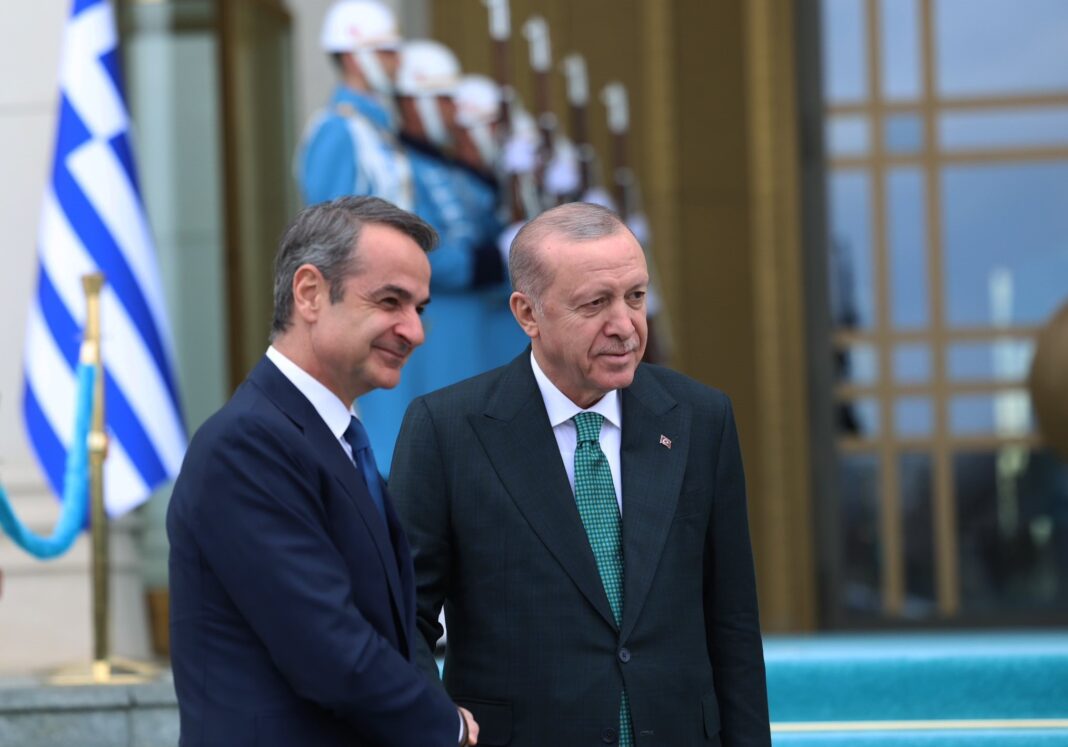

Greek Prime Minister Kyriakos Mitsotakis and Turkish President Recep Tayyip Erdoğan pledged to keep channels open and expand practical cooperation during talks in Ankara on Wednesday, even as long-running disputes in the Aegean Sea and the eastern Mediterranean continue to divide the two NATO allies.
The leaders met under the Turkey-Greece High Level Cooperation Council, a framework revived to stabilize relations after years of brinksmanship over maritime boundaries, airspace and energy exploration rights.
Mitsotakis said Greece and Turkey have been trying to advance relations since 2023 through political dialogue, a “positive agenda” of cooperation and confidence-building measures, arguing that disagreements should be handled “with composure and responsibility” so they do not turn into crises.
Erdoğan said disputes in the Aegean and the eastern Mediterranean, “while complex, are not unsolvable” if there is a willingness for dialogue.
The meeting came as tensions have risen again over Greece’s stated right under international law to extend its territorial waters in parts of the Aegean from six nautical miles to 12, a move Turkey has long warned would sharply limit its access to the sea. Turkey’s parliament in 1995 declared such an expansion in the Aegean a casus belli, a cause of war, a position Greece says violates international maritime law.
Migration was also on the agenda, with Greece under pressure after a shipwreck off the Greek island of Chios last week killed 15 migrants when their boat collided with a Greek coast guard vessel and sank near the Turkish coast.
Officials from both sides signed a package of agreements aimed at expanding cooperation beyond the political disputes, including steps to promote bilateral investment, improve connectivity and coordinate on disaster response.
Among the initiatives were encouragement of a new ferry route linking Thessaloniki and İzmir, a cultural cooperation memorandum, coordination between the two foreign ministries within the Organization of the Black Sea Economic Cooperation and joint action on earthquake preparedness and response.
A separate deal launched a research and technology cooperation program signed by Greece’s development minister and Turkey’s industry and technology minister, with both sides also discussing work related to small and medium-sized enterprises and future cooperation on standards and startup development.
Cyprus also surfaced in Mitsotakis’s remarks. He said he discussed the latest developments on the Cyprus problem with Erdoğan and argued that United Nations Secretary-General António Guterres’ efforts have created a “window of opportunity” to restart substantive talks from where they left off in 2017, adding that any process must remain within UN Security Council resolutions.
Cyprus has been divided since 1974, when Turkey invaded following a coup backed by Greece. The internationally recognized Republic of Cyprus controls the island’s south, while a breakaway Turkish Cypriot administration controls the north and is recognized only by Turkey.
The Ankara meeting was held in a climate of lowered rhetoric compared to the 2020 standoff in the eastern Mediterranean, when competing naval deployments over energy exploration brought the neighbors close to confrontation, but officials on both sides have signaled that they do not expect quick progress on the core disputes.