

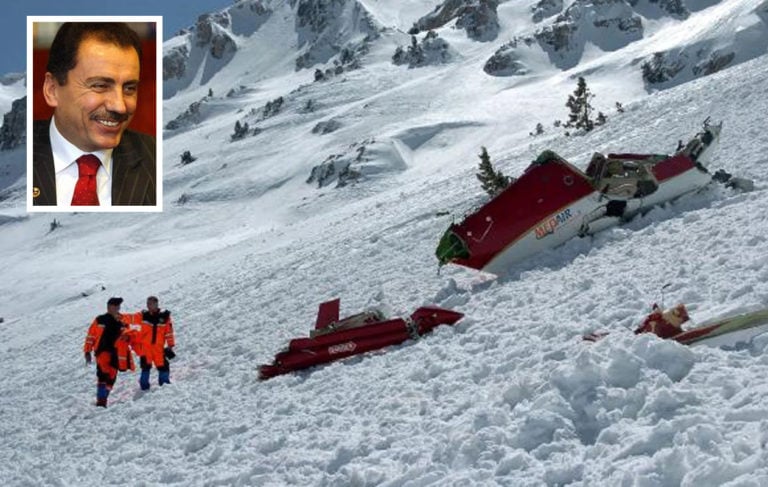

A Turkish court has jailed 19 people pending trial in a renewed investigation into the 2009 helicopter crash that killed nationalist politician Muhsin Yazıcıoğlu and five others, the state-run Anadolu news agency reported Friday, citing the Ankara Chief Public Prosecutor’s Office.
The court released eight other suspects under judicial supervision. All 27 had been referred to court with requests for their arrest after questioning by prosecutors.
Prosecutors allege that the suspects participated in premeditated murder in connection with the activities of the faith-based Gülen movement, which the Turkish government designates as a terrorist organization. The movement strongly denies involvement in the crash, a failed coup in 2016 or any terrorist activity.
Twenty-five suspects were detained in simultaneous raids at 30 locations in 10 provinces on Monday, while two others were already in prison in connection with separate cases. Two additional suspects are abroad and remain at large, bringing the total number of suspects to 29.
Justice Minister Akın Gürlek said Monday that they were being investigated on charges of establishing, leading or belonging to an armed terrorist organization and involvement in premeditated murder.
Gürlek did not identify the suspects or disclose what evidence had prompted prosecutors to investigate the crash as a possible deliberate killing.
The investigation was transferred from the Kahramanmaraş Chief Public Prosecutor’s Office to prosecutors in Ankara on June 12. Gürlek said the case was being examined from all angles in an effort to establish the circumstances surrounding the deaths.
Yazıcıoğlu, the founder and leader of the far-right, nationalist-Islamist Grand Unity Party (BBP), was traveling between campaign events ahead of Turkey’s March 2009 local elections when his chartered helicopter crashed near Göksun in the southern province of Kahramanmaraş on March 25, 2009.
The crash killed Yazıcıoğlu, three BBP officials, pilot Kaya İstektepe and İhlas News Agency reporter İsmail Güneş.
The case has been the subject of controversy for more than 17 years due to failures in the search-and-rescue operation, the removal of GPS navigation equipment from the wreckage and allegations that public officials interfered in the subsequent investigation.
Güneş contacted emergency services after the crash and said he was seriously injured, but rescue teams did not locate the wreckage for approximately 47 hours. His body was found separately five days later.
Yazıcıoğlu’s family and political associates have long argued that his death should be investigated as a possible assassination rather than treated solely as an accident. No court has conclusively established that the crash was deliberately caused.
The Anka news agency previously reported that former police chief Dursun Özmen was among those detained. Özmen was sentenced to two years in prison for abuse of office over a false information note prepared after the crash claiming that Yazıcıoğlu had survived with a broken leg and was being taken to a hospital.
Anka identified the two suspects already in prison as Davut Uçum and Aydın Özsıcak, who were convicted over alleged links to the Gülen movement.
Several public officials have previously been prosecuted over failures in the rescue operation, the handling of evidence and alleged interference in the investigation. Separate proceedings examined the removal of navigation equipment from the wreckage and allegations that Gülen-linked officials attempted to steer the inquiry through irregular procedures and fabricated evidence.
No final court ruling has established a direct link between the Gülen movement and either the crash or the deaths.
President Recep Tayyip Erdoğan accuses the movement of orchestrating a coup attempt on July 15, 2016, an allegation it denies.
The Turkish government has also linked the movement to a range of high-profile crimes and controversial incidents, including cases in which the alleged connection has not been established by a final court ruling.
Critics accuse the government of using such allegations to reinforce public hostility toward the group and justify a decade-long crackdown.
More than 720,000 people have faced legal proceedings over alleged links to the movement since the coup attempt, according to a recent statement from Gürlek.
The latest investigation is the first to directly examine whether Yazıcıoğlu and the five others were deliberately killed. Prosecutors have yet to publicly explain each suspect’s alleged role.
Yazıcıoğlu was a prominent figure in Turkey’s ultranationalist movement and formerly headed the Grey Wolves youth organization. He spent five-and-a-half years in prison following the 1980 military coup before being acquitted and later entering politics.
He founded the BBP in 1993 as a nationalist-Islamist alternative to the far-right Nationalist Movement Party (MHP).