

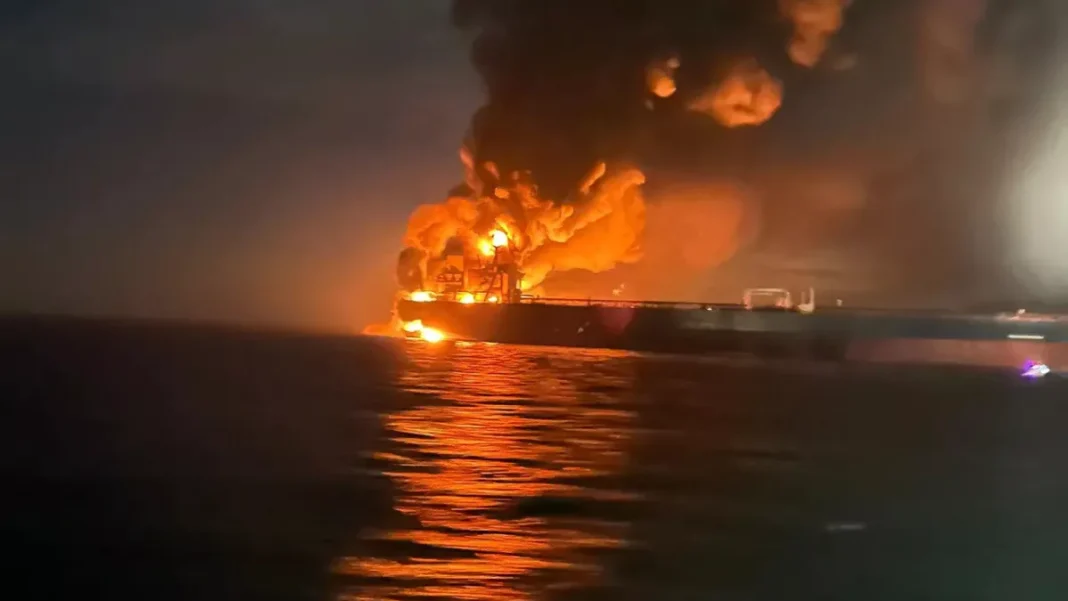

A series of attacks on tankers in and near Turkish waters is pulling Ankara deeper into the maritime front of the war between Russia and Ukraine, as naval and security experts warn that the Black Sea is becoming an active battle space that Turkey can no longer hold at arm’s length.
In less than a week drones or explosives hit three tankers in the Black Sea in areas where Turkey has search and rescue responsibility, including one case in its exclusive economic zone, and damaged a Turkish-owned ship off Senegal. The targets all had recent links to the Russian oil trade, which Ukraine says is part of its effort to cut Moscow’s war revenue.
Turkey’s maritime authority said the Russia-flagged MIDVOLGA 2 reported an attack on Monday about 80 miles off the northern province of Sinop, in a zone where Turkey coordinates rescue operations, while sailing with sunflower oil from Russia to Georgia. The ship continued under its own power and its 13 crew members were not hurt.
The MIDVOLGA 2 incident followed explosions and fires on the Kairos and Virat tankers late last week in the southern Black Sea. Both ships were in ballast and heading toward the Russian port of Novorossiysk when they were hit in Turkey’s exclusive economic zone. Ukrainian officials have said the security service used locally produced Sea Baby unmanned surface craft in those strikes and described the tankers as part of Russia’s “shadow fleet” that carries oil under flags of convenience to bypass sanctions.
In a separate case off West Africa, the Turkish-owned Mersin tanker suffered four external blasts near Dakar and took on water in its engine room. Maritime security companies say the ship had recently called at a Russian port and see that blast as part of a wider pattern of hits on tankers that move Russian oil, although no state has claimed responsibility.
President Recep Tayyip Erdoğan said attacks on commercial ships in Turkey’s exclusive economic zone are “unacceptable” and a “worrying escalation.” The foreign ministry said the incidents create serious risks for navigation, life, property and the environment in the Black Sea and that Ankara is in contact with “all related sides” to prevent the war from spreading across the sea.
According to retired Rear Adm. Cem Gürdeniz, the pattern of strikes is not only about Russian oil but also about pressure on Turkey. In a long statement on X he argued that repeated attacks on tankers in Turkey’s continental shelf and search and rescue zone show that “Ukraine wants to make the Black Sea resemble its own chaotic reality” and to pull Ankara into a wider Western strategy.
Gürdeniz called on Turkey to review military support for Ukraine, to underline that sanctions without a United Nations mandate do not bind Ankara and to remind Kyiv that two Ukrainian warships remain held in Turkey.
“Unless Ankara takes the necessary step,” Gürdeniz wrote, Ukraine under United States, British and European influence “will not hesitate to turn the Black Sea into a war laboratory.” He presents this as a direct challenge to Turkey’s policy of “active neutrality” under the 1936 Montreux Convention, which gives Ankara control over the Bosporus and Dardanelles straits and allows it to restrict warship traffic during war.
International maritime security specialists reach different conclusions about Ukraine’s intent but share the view that the conflict at sea has entered a sharper phase that raises risks for Turkey.
Arran Kennedy, a maritime analyst at the London-based Control Risks, told industry outlet Lloyd’s List that the strikes on the Kairos and the Virat, along with an earlier drone attack on an oil terminal in Novorossiysk, represent a surge in the intensity of Ukrainian operations against Russian energy assets. He said Russia is likely to answer with heavier fire on Ukrainian ports and possibly against ships that sail to them in the Black Sea, as long as they are outside the territorial waters of NATO states.
Kennedy said that kind of action would push more of the war at sea toward the southern Black Sea and the approaches to the Turkish Straits, which carry traffic between the Black Sea and the Mediterranean.
Frederik Van Lokeren, a former Belgian navy officer and naval analyst, described the Kairos and Virat strikes as “a new phase in the maritime war” in an article for Naval News. He notes that Sea Baby drones reached their targets about 30 miles off the Turkish coast near the main route to the Bosporus and says Ukraine is “testing the waters” by hitting shadow fleet tankers so close to a NATO country.
According to Van Lokeren, if those attacks continue and owners begin to insist on naval protection, Russia may send more Black Sea Fleet units out of port to escort tankers, which would create more contact points between Russian warships, Ukrainian drones and waters where Turkey, Bulgaria and Romania have jurisdiction. That, he writes, would increase the chance of incidents near Turkish coasts and force Ankara to make harder choices about patrols, intelligence-sharing and air defense.
Ukrainian naval analyst Andrii Ryzhenko, a former deputy chief of staff in Ukraine’s navy, told Reuters that the Kairos and Virat incidents are the first known cases in which non-Russian-flagged commercial ships were hit in international waters as part of Ukraine’s campaign against tankers. He said Russia already attacks ships near Ukrainian ports and that the main new risk lies in a wider band of sea where Ukraine may operate drones and Russia may seek ways to respond.
Inside Turkey, some analysts link the tanker hits to a broader debate about NATO strategy and Montreux.
Writer Yiğit Günay, who follows Black Sea politics for the left wing outlet soL, said the back-to-back strikes on commercial ships off Turkey “may mark a new threshold” for the region. He points to recent comments by NATO Military Committee chair Adm. Giuseppe Cavo Dragone, who spoke about more “proactive” responses to Russian hybrid threats and asks whether new sea operations reflect a shift in Western doctrine.
Günay warns that if the Black Sea starts to function in practice as an open theatre for that kind of action, the current balance under the Montreux Convention could fray, which would in turn put new pressure on Turkey’s role as gatekeeper of the straits and as a self-declared neutral state in the naval dimension of the war.
Other Turkish maritime experts view the strikes as more calibrated but still serious. Master mariner and maritime lawyer Cahit İstikbal notes that both the Kairos and the Virat sailed empty, which he sees as a sign that the planners tried to avoid a huge spill on Turkey’s coast while still sending a strong signal to Russia and to the owners of sanctioned vessels. He says the use of unmanned surface craft against large tankers in Turkey’s exclusive economic zone is itself a serious precedent for sea safety.
Maritime risk companies say the attacks already change how ships and insurers treat the region.
War risk premiums for calls at Russian Black Sea ports have risen. Some owners now avoid Novorossiysk and nearby terminals entirely, while others continue to sail and accept higher costs. Analysts who track tanker movements say at least seven ships that recently visited Russian ports have suffered blasts from suspected limpet mines or drones since late last year in the Black Sea, the Mediterranean and off West Africa.
Turkey has tried since 2022 to keep a balance. It closed the straits to most new warships of the warring parties under Montreux, did not join United States and European Union sanctions and helped broker a grain corridor for Ukrainian exports that moved through a narrow lane to and from the Bosporus. At the same time Turkish arms makers have supplied combat drones to Ukraine and energy firms have deep trade with Russia.
The tanker strikes now bring that balance into sharper focus. Security experts in Ankara have floated the idea of “security corridors” for commercial ships in the Black Sea with escorts or heavier patrols, using experience from the grain deal. Maritime specialists call for better radar coverage and electronic countermeasures on the Turkish coast to detect and deflect unmanned craft before they reach busy shipping lanes.
Ukraine said it will continue to target tankers that support Russia’s oil trade and says it does not seek confrontation with Turkey. Russia called the hits piracy and has threatened to cut Ukraine’s access to the sea. Between them sits Ankara, which controls the only route between the Black Sea and the open ocean and now must decide how to protect that role as the war at sea moves closer to its shores.