


Ömer Murat*
The relationship between US President Donald Trump and Turkish President Recep Tayyip Erdoğan has shifted markedly since Trump returned to the White House. Warm public exchanges, a swift invitation for Erdoğan to visit Washington and positive signals from the administration on several longstanding bilateral disputes stand in sharp contrast to the friction that marked Trump’s first term. This change merits closer examination of what is driving the two leaders’ interaction.
The two men’s shared populist political styles and Erdoğan’s willingness to adjust Turkish foreign policy to align with Washington’s priorities are often cited as explanations. However, these explanations alone do not fully account for the dramatic shift that has occurred. After all, the relationship appears much closer now than during Trump’s first presidency. During that period Trump sent his infamous, highly unconventional “don’t be a fool” letter; Turkey was removed from the F-35 Joint Strike Fighter program after acquiring Russia’s S-400 air-defense system; and the United States imposed sanctions on Turkey under the Countering America’s Adversaries Through Sanctions Act (CAATSA).
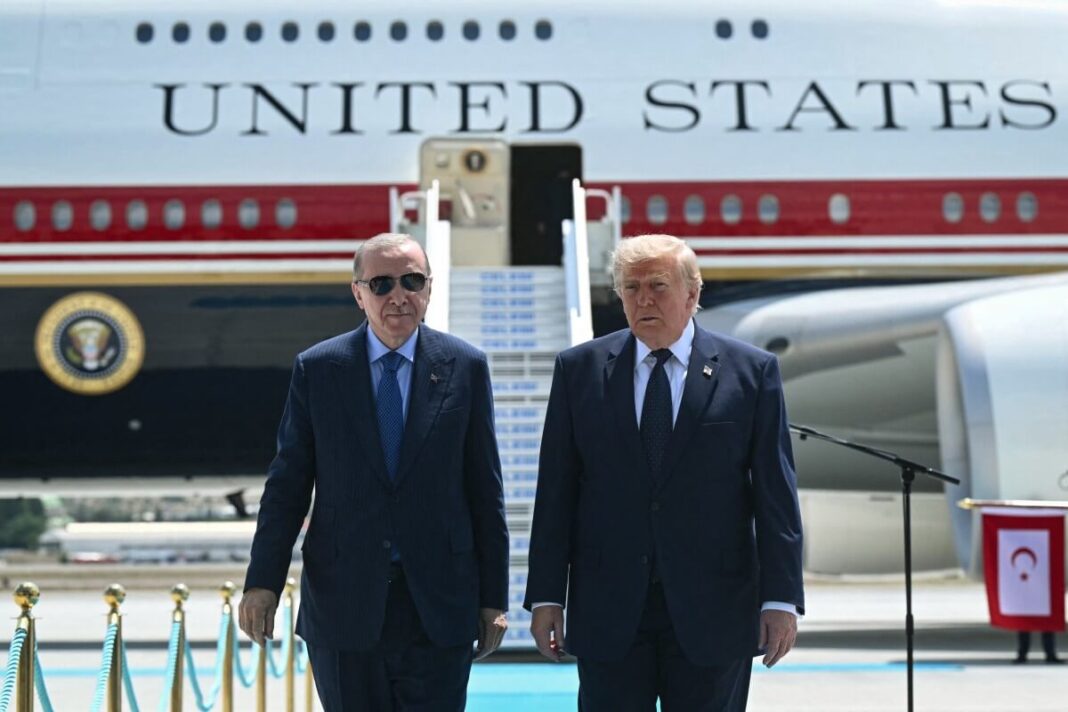
By contrast Trump’s second term has been marked by an almost immediate effort to improve ties with Ankara. One of the earliest indications of this shift was the rapid organization of Erdoğan’s long-awaited White House visit, which did not materialize during the previous US administration. The NATO summit in Ankara last week featured notably cordial scenes and public expressions of goodwill from Washington regarding issues that had previously caused friction.
To understand what lies beneath this sudden diplomatic warmth, an important domestic development in Washington could offer a critical lens. Trump recently released a legally mandated asset disclosure running several hundred pages long. The documents reveal that corporate profits for the Trump family’s businesses, which are actively managed by his sons, tripled after he took office again.
Commentators in major US media outlets have noted that business arrangements between foreign governments or state-linked entities and Trump family companies could create conflicts of interest. Particular attention has focused on large-scale investments from Gulf states and certain Central Asian countries in cryptocurrency ventures and real estate projects involving the president’s sons. Critics have described these arrangements as channels through which foreign actors might indirectly shape US policy by funding Trump family enterprises. Some observers are concerned that financial partnerships could become a means for foreign governments to seek political access or favorable treatment from the White House.
Could a comparable dynamic of private transactional access be shaping relations between Trump and Erdoğan? The first concrete evidence suggesting such a parallel came from disclosures by Özgür Özel, the ousted leader of Turkey’s main opposition Republican People’s Party (CHP).
Özel revealed details of an unpublicized meeting at Dolmabahçe Palace in Istanbul between the Turkish president and Donald Trump Jr., the executive vice president of the Trump Organization. According to the opposition leader the closed-door discussions centered on a potential large-scale purchase of Boeing aircraft in connection with securing a White House meeting. (Özel was ousted as party leader following a highly controversial court ruling in May, but he was serving as CHP chairman when he made these disclosures.) Turkish officials did not deny that the meeting took place, but they characterized it as a routine courtesy call.
During Erdoğan’s subsequent official visit to Washington, public messaging had suggested that the Gaza conflict would dominate the agenda. In practice, the joint press conference and subsequent developments indicated that resolution of the long-running Halkbank case was his central priority.
For years the case had been a significant source of concern for Erdoğan due to the possibility of substantial financial penalties and broader political repercussions. Following the visit, the Trump administration quickly resolved the multibillion-dollar sanctions evasion case, ensuring that Halkbank escaped what was expected to be a ruinous financial penalty.
The speed and nature of the outcome inevitably fueled speculation that political or commercial considerations may have played a role. Whether the matter was resolved solely through diplomatic engagement or through understandings that remain hidden from public view is unlikely to become clear while the principal actors remain in office.
Notably, no comparable breakthrough has occurred regarding Turkey’s efforts to rejoin the F-35 program. During his visit to Ankara, Trump made comments that encouraged optimism among the Turkish public. Yet, less than a day later, the US president signaled that no final decision had been made and the matter remained unresolved.
The contrast between the two issues is striking. The F-35 program directly affects Turkey’s long-term defense capabilities and strategic position amid growing instability in the Middle East. In contrast the Halkbank case carries implications more closely connected to Erdoğan’s political circle and inner network of power. While Turkey remains outside the F-35 program amid ongoing regional conflicts, it appears that the primary diplomatic energy in dealings with the current US administration has been directed toward the Halkbank matter in an attempt to bury a corporate corruption probe.
The symbolism surrounding Trump’s visit to Ankara also attracted attention. The US president landed at the newly opened airport in the Turkish capital and received an unusually elaborate welcome. During his visit Trump remarked that a dedicated terminal had been built specifically to accommodate his arrival and that one of its buildings now bore his name.
The Turkish government did not publicly challenge these remarks. Turkish citizens only learned of this through Trump’s public comments, which illustrates a persistent lack of institutional transparency. Instead of projecting the image of a sovereign, self-assured regional power, the spectacle surrounding the summit conveyed an anxious attempt to win Washington’s favor, highlighting a profound geopolitical vulnerability.
From Erdoğan’s perspective the summit served an important domestic political purpose. By hosting Western leaders in Ankara despite growing international criticism of democratic backsliding in Turkey, he sought to demonstrate that he remained a legitimate and indispensable partner on the global stage.
However, Europe appears to be operating according to a more pragmatic calculation. The continent’s primary concern is the war between Russia and Ukraine and the broader challenge posed by Russian President Vladimir Putin. European governments are focused on preventing a Russian victory and limiting Moscow’s ability to threaten European security in the future.
In that context European leaders have little appetite for opening an additional confrontation with Ankara. Their approach appears to be one of managing relations with Erdoğan while maintaining existing positions on fundamental disagreements.
Evidence of this can be seen in the continued stagnation of Turkey’s accession process to the European Union. Discussions concerning the modernization of the customs union have likewise failed to produce meaningful progress, despite the economic advantages that such an agreement could provide. The manufacturing alignment process, “Made in Europe,” has stalled due to Ankara’s refusal to reform its domestic public procurement laws. Turkish companies also continue to face obstacles in accessing the European Union’s Security Action for Europe (SAFE) program, through which the EU plans to mobilize substantial financial resources to strengthen the continent’s defense industrial base.
In short, cordial summit diplomacy has not translated into meaningful progress on the most important issues in Turkey’s long-term relationship with Europe. While public interactions between Erdoğan and European leaders may appear warm, there is little evidence that European governments have fundamentally altered their assessment of Turkey’s political direction under the current administration.
While such transactional arrangements may deliver short-term diplomatic gains and shield the ruling elite from certain external pressures, they do not address Turkey’s broader strategic needs. The deeper challenge for Erdoğan may not be securing the goodwill of foreign leaders but reversing the domestic political and institutional erosion that makes such personal diplomacy appear increasingly necessary.
* Ömer Murat is a political analyst and a former Turkish diplomat who currently lives in Germany.
Disclaimer: The views expressed in this opinion piece are those of the author and do not necessarily reflect the editorial stance of Turkish Minute.