

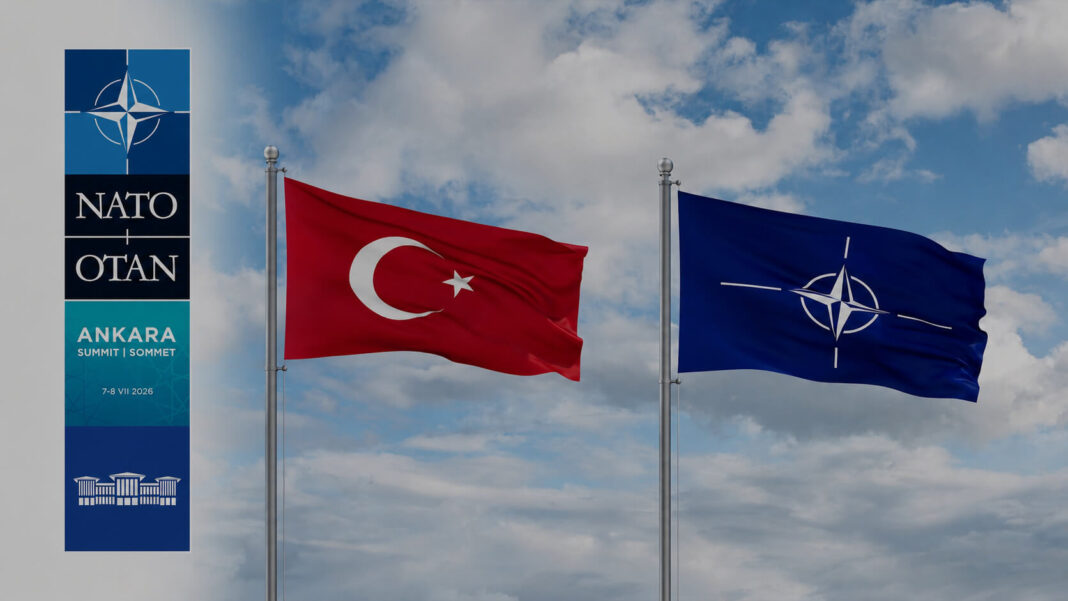

Fifteen press freedom, freedom of expression and human rights organizations have in a letter urged NATO Secretary General Mark Rutte to reverse the denial of accreditation to independent Turkish media outlets and journalists seeking to cover next month’s NATO summit in Ankara, saying the decisions risk giving cover to Turkey’s restrictions on the press.
The letter came after some Turkish media outlets and journalists announced this week that their applications to cover the July 7-8 summit had been rejected by NATO without explanation.
The rejected applicants included outlets known for critical coverage of the government of President Recep Tayyip Erdoğan as well as journalists who had previously covered NATO summits.
In the letter sent to Rutte on Friday the groups said accreditation requests from outlets including Halk TV, Sözcü TV, Nefes, BirGün, Cumhuriyet, the Anka news agency, Medyascope and T24 had been rejected by NATO’s Office of Strategic Communications in recent days.
The signatories said the affected outlets operate in “an already severely restricted press environment” and that some of the rejected journalists had previously covered NATO summits.
The rejection notices said the reasons for the decision could not be discussed and that the decisions were final, according to the letter.
The dispute has put NATO under pressure to explain whether Turkish authorities played a role in excluding critical outlets from a major international summit hosted by Turkey.
NATO spokesperson Allison Hart said in a statement on X on Thursday that NATO relies on host countries for assessments of local journalists at summits held outside its headquarters.
“We are in contact with Turkish authorities on accreditation for the NATO Summit in Ankara,” Hart said, adding that it was “very important for NATO that media can attend major events in person.”
Press freedom groups say the lack of reasons, the absence of an appeals process and NATO’s reliance on host-country assessments raise concerns that domestic pressure on Turkish media has affected the alliance’s accreditation process.
The organizations said in their letter that NATO’s explanation raised particular concern because Turkey’s Directorate of Communications, which operates under the presidency, has repeatedly been criticized by international press freedom organizations for using press accreditation to pressure critical journalists.
“NATO’s reliance on an institution with the Directorate’s track record gives rise to serious concerns: that the accreditation decisions for the upcoming summit were influenced by the editorial or political orientation of the rejected media organizations,” the letter said.
The signatories said the rejected applications limited publicly available information and deprived both Turkish and international audiences of independent perspectives from Turkey.
“In view of the NATO Spokesperson’s announcement that NATO is in contact with the Turkish authorities on accreditation for the Summit, we urge you to ensure the ability of independent media to cover the summit by reconsidering the rejected accreditation requests and restoring meaningful press access before the gathering opens,” the signatories added.
The letter was signed by the International Press Institute, ARTICLE 19 Europe, the European Centre for Press and Media Freedom, the European Federation of Journalists, the Foreign Media Association Turkey, Human Rights Watch, the International Federation of Journalists, the Media and Law Studies Association, the Norwegian Helsinki Committee, Italy-based Osservatorio Balcani Caucaso Transeuropa, PEN Norway, the Progressive Journalists Association, the P24 Platform for Independent Journalism, the South East Europe Media Organization and the Journalists Union of Turkey.
Turkey has long been criticized by local and international watchdogs for using accreditation, court cases, broadcast fines and online access blocks to pressure independent and opposition media.
The Directorate of Communications, which issues press cards, has faced repeated criticism over delays, denials and cancellations affecting journalists from critical outlets.
Reporters for opposition and independent media have frequently been excluded from official events, presidential programs and government briefings.
Press freedom groups say most mainstream outlets in Turkey are owned by companies close to the government, while independent journalists face lawsuits, arrest and pressure over their reporting.
Turkey was ranked 163rd out of 180 countries in the 2026 World Press Freedom Index published by Reporters Without Borders, down from 159th place the previous year, with RSF warning that media pluralism in the country is increasingly under threat.
According to Communications Director Burhanettin Duran, nearly 3,000 journalists, television crews, photojournalists, digital media representatives and international broadcasters from around the world applied for accreditation to cover the summit.
Duran said the accreditation process was being carried out by NATO, while Turkish authorities had arranged hotels, transportation and a media center in Ankara for accredited foreign journalists.