

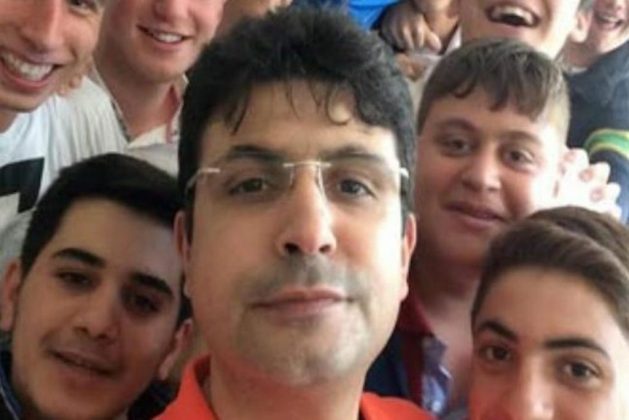

Turkey’s Constitutional Court ruled last year that Turkish authorities violated the right to life and the prohibition of torture and ill-treatment in the case of teacher Gökhan Açıkkollu, who died in police custody in 2016 after being detained over alleged links to the faith-based Gülen movement, with the court notifying his wife nine months after the verdict was issued, the Stockholm Center for Freedom reported.
In a ruling issued on July 30, 2025, and communicated to his wife, Tülay Açıkkollu, this week, the court said the authorities had failed to provide a satisfactory explanation for injuries he sustained in detention and concluded that they bore responsibility for the death.
It was not immediately clear why the decision was communicated almost a year after it was issued. In Turkey, court decisions may be formally served to the parties or published after the date on which they are adopted.
The court also said the prosecutor had limited their investigation to Açıkkollu’s immediate cause of death and prior medical conditions, without adequately investigating allegations that he had been subjected to physical and psychological violence by law enforcement officers.
The Constitutional Court found that the state had violated Açıkkollu’s right to life and the ban on torture and ill-treatment in two ways: by failing to protect his life and physical integrity, and by failing to conduct an effective investigation into the circumstances of his death.
The ruling requires prosecutors to reopen the investigation to remedy the violations identified by the court.
However, the case raises questions about institutional independence and accountability because court documents show that Can Tuncay, the İstanbul prosecutor who investigated Açıkkollu’s case, was appointed deputy justice minister in February 2026.
The court referred the ruling to the İstanbul Chief Public Prosecutor’s Office for action to remedy the violations identified in the case.
Açıkkollu’s wife, Tülay Açıkkollu, is expected to demand a new investigation in line with the Constitutional Court ruling.
The court rejected the complaint concerning the right to liberty and security as inadmissible, saying Açıkkollu’s wife did not have indirect victim status to pursue that claim on his behalf.
Açıkkollu died of a heart attack on August 5, 2016, after spending 13 days in police custody during a sweeping crackdown that followed a coup attempt in Turkey. Witnesses alleged that he had been subjected to physical and psychological torture.
Following his death the İstanbul Chief Public Prosecutor’s Office issued a decision of non-prosecution on December 20, 2016, saying there was no evidence indicating that an external factor had caused his death.
An additional autopsy report prepared on January 18, 2017, by forensic expert and chair of the Human Rights Foundation of Turkey (TİHV) Professor Şebnem Korur Fincancı, concluded that Açıkkollu died of a heart attack as a result of the torture he was subjected to in detention.
Based on that report Tülay Açıkkollu challenged the initial non-prosecution decision, which was overturned seven months later. The prosecutor’s office nevertheless issued a second decision of non-prosecution in May 2020, prompting her to apply to the Constitutional Court on June 16, 2020.
The United Nations Human Rights Committee had previously found in October 2022 that Turkey violated Açıkkollu’s rights under several articles of the International Covenant on Civil and Political Rights. The committee also assessed the suffering caused to his wife and children, ruling that the prohibition of torture and ill-treatment had been violated with respect to them as well.
Turkish President Recep Tayyip Erdoğan has targeted followers of the Gülen movement, inspired by the US-based cleric Fethullah Gülen, who died in 2024, since corruption investigations in December 2013 implicated him as well as some members of his family and inner circle. He dismissed the probes as a Gülenist conspiracy and later designated the movement as a terrorist organization in May 2016, intensifying a sweeping crackdown after the coup attempt in July of the same year that he accused Gülen of orchestrating. The movement denies involvement in the coup attempt or any terrorist activity.
According to the latest figures from the justice ministry, more than 126,000 people have been convicted of alleged links to the movement since 2016, with 11,085 still in prison. Legal proceedings are ongoing for over 24,000 individuals, while another 58,000 remain under active investigation nearly a decade later.
Torture and ill-treatment in police custody and prisons in Turkey have remained a persistent concern since the aftermath of the July 15, 2016, coup attempt. The widespread and systematic torture in Turkish detention centers was evidenced by the UN special rapporteur on torture and other cruel, inhuman, or degrading treatment or punishment in a report based on his mission to Turkey in November 2016.
The Council of Europe’s Committee for the Prevention of Torture also reported that allegations of police ill-treatment remained at a worrying level following visits in 2017 and 2019, although Turkey has blocked publication of the committee’s report on its 2016 post-coup visit.