


A Latin America expert said the US prosecution of Alex Saab, a close ally of former Venezuelan President Nicolás Maduro, could become a new source of pressure on Turkish President Recep Tayyip Erdoğan because of Turkey’s past role in a gold-for-food trade linked to Venezuela’s state-run food program.
İmdat Öner, a former Turkish diplomat and Latin America analyst, said in a post on X on Tuesday that Saab’s return to a federal courtroom in Miami could expose the Turkish leg of a network that moved Venezuelan gold abroad and supplied food to the Maduro government.
“This file will appear as another card in the hands of the US administration to use against Ankara,” Öner said in a post on X.
2018 yılının sonları. Ankara ile Washington arasında iplerin gerildiği, atara atar, gidere gider retoriklerinin havada uçuştuğu, Erdoğan ile Trump’ın aralarının epeyce limoni olduğu bir dönem.
Diğer tarafta da, Trump’ın köşeye sıkıştırmaya çalıştığı Maduro liderliğindeki… pic.twitter.com/lKUbBD4vGy
— Imdat Oner (@imdat_oner) May 19, 2026
Saab, 55, appeared in federal court in Miami on Monday after being deported to the United States by Venezuela’s acting President Delcy Rodríguez, according to the US Justice Department and news agencies.
US prosecutors charged Saab with conspiracy to launder money in connection with Venezuela’s Local Committees for Supply and Production (CLAP), a government food distribution program created under Maduro at a time of shortages and hyperinflation.
The indictment says Saab and his co-conspirators paid bribes to Venezuelan officials to obtain CLAP contracts and used fake companies, false invoices, falsified shipping records and other documents to skim hundreds of millions of dollars that were supposed to be used to buy food for Venezuelans.
The Justice Department said Saab is also accused of using proceeds from illegal Venezuelan oil sales to promote and conceal the CLAP scheme. He faces up to 20 years in prison if convicted.
The visible five-page indictment does not name Turkey. It refers to imports from Colombia and Mexico and says the conspiracy later expanded into Venezuelan oil sales after US sanctions strained Caracas’s finances.
But Turkey’s role in an earlier gold and food route has been documented by the US Treasury Department, Reuters and investigative outlets.
In 2019 the US Treasury sanctioned Saab and a network of people and companies it said had profited from overvalued CLAP food contracts. The Treasury said Saab helped create a structure for Venezuela to sell gold to Turkey and that gold was flown to destinations including Turkey and the United Arab Emirates.
The Treasury also named Mulberry Proje Yatırım Anonim Şirketi, a Turkey-registered company, as part of Saab’s network. It said Mulberry bought goods in Turkey for Venezuelan clients, marked up the prices and sold them back to Venezuela.
Mulberry was “used to facilitate payments made as a part of Saab’s CLAP corruption network for the sale of gold in Turkey,” the Treasury said.
The Turkey route expanded after Maduro and Erdoğan deepened ties while both governments were facing tension with Washington.
Reuters reported in 2018 that Venezuela exported $779 million in gold to Turkey in the first five months of that year, after previously sending none in 2017. Venezuelan officials said at the time that the gold was being refined in Turkey because of concerns over sanctions.
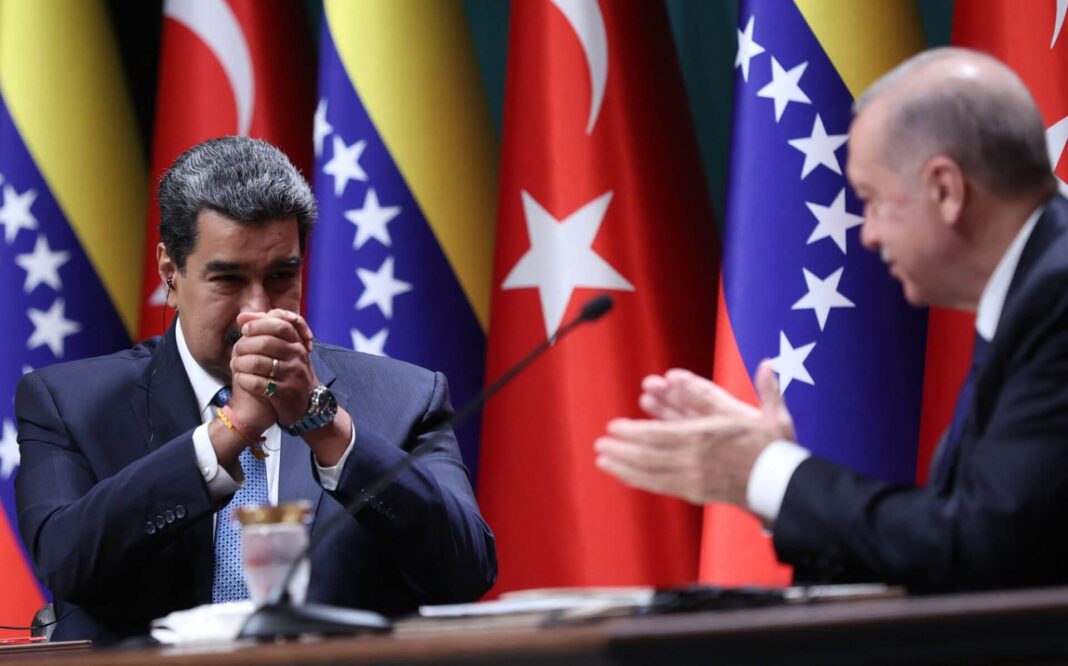
By the end of 2018 trade data showed Turkey had imported about $900 million in gold from Venezuela, Reuters reported. Erdoğan, standing with Maduro in İstanbul in December 2018, criticized US sanctions and said Turkey rejected measures that “ignore the rules of global trade.”
The Turkish connection also included food shipments. Reuters reported in 2019 that proceeds from Venezuelan gold sales were used to buy Turkish consumer goods and that 54 containers of Turkish powdered milk arrived at Venezuela’s La Guaira port in December 2018.
Spanish daily El País reported in March that Saab was central to the Turkish gold route because the metal was used to pay for food and that Mulberry sent powdered milk, pasta, flour, legumes, rice, oil, meat and canned tuna from Turkey for CLAP food boxes.
The same report said Turkish commercial registry records linked Mulberry and another Turkey-based company, Marilyns Proje Yatırım, to people connected to Saab’s family and business circle.
Öner compared the Saab case to the prosecution of Reza Zarrab, the Turkish-Iranian gold trader who pleaded guilty in New York in 2017 and testified that he helped Iran evade US sanctions through a scheme involving Turkish banks, ministers and gold trades.
The Zarrab case led to charges against Halkbank, Turkey’s state lender, and became one of the most sensitive disputes between Ankara and Washington.
Erdoğan personally raised the case with US presidents, and after a September 2025 meeting with President Donald Trump, said the US president had told him the “Halkbank problem” was finished for Washington.
The case was resolved in March 2026 through a deferred prosecution agreement that required no admission of wrongdoing and no fine, a result prosecutors linked in part to US foreign policy interests and Turkey’s role in Gaza-related diplomacy.
Öner is suggesting that the Saab case could become a similar source of leverage if US prosecutors obtain testimony or documents about the Turkey-based gold-for-food network tied to Venezuela.
Saab was first charged in the United States in 2019 in a separate case involving an alleged bribery scheme connected to Venezuela’s currency controls. He was arrested in Cape Verde in 2020 and extradited to Miami in 2021.
Former president Joe Biden granted Saab clemency in 2023 as part of a prisoner exchange with Venezuela. US authorities later pursued new allegations not covered by the clemency, according to AP.
Saab had previously cooperated with the Drug Enforcement Administration and forfeited more than $12 million in proceeds from business dealings. His return to US custody raises the possibility that prosecutors could seek testimony on Maduro-era corruption networks.