


A Cypriot member of the European Parliament has called for European Union sanctions on Turkey if Ankara passes a planned maritime jurisdiction law that would put its disputed “Blue Homeland” naval doctrine into domestic law, the Cyprus Mail reported Tuesday.
Costas Mavrides, a member of Cyprus’s Democratic Party and the Socialists and Democrats group in the European Parliament, made the call during a plenary session in Strasbourg late Monday.
The government of Turkish President Recep Tayyip Erdoğan “is planning to give institutional status to the so-called ‘Blue Homeland’ doctrine, and this will be the beginning of a new invasion of the Aegean and of the eastern Mediterranean,” Mavrides said, according to the Cyprus Mail.
Mavrides said the doctrine violates the United Nations Convention on the Law of the Sea (UNCLOS) and is directed “against the European Union itself, and not simply against Greece or Cyprus.”
He called on the EU to “react in practice” and impose sanctions on what he described as Turkish expansionism.
Mavrides also referred to Turkey’s 1974 military intervention in Cyprus, which followed a Greek-backed coup aimed at uniting the island with Greece. Cyprus has remained divided since then between the internationally recognized Republic of Cyprus in the south and the Turkish Republic of Northern Cyprus (KKTC) in the north, which is recognized only by Turkey.
His remarks followed a warning from Cypriot President Nikos Christodoulides, who said Monday that any Turkish move to pass the bill should provoke a European response.
“It affects Cyprus, it affects Greece, it also [affects] other European states, but it also affects the United States, which has interests in this particular region,” Christodoulides said, according to the Cyprus Mail. He said those interests were based on international law and UNCLOS.
Christodoulides said he had discussed the issue with Greek Prime Minister Kyriakos Mitsotakis during a visit to Athens last week and had raised it with European leaders.
“We are monitoring developments. I hope Turkey will not proceed with any illegal actions. If it proceeds with any actions, the reaction should be European,” he said.
Turkey’s defense ministry said last week that work was continuing on a Maritime Jurisdiction Areas Law, describing it as a framework that would define responsibilities in Turkey’s maritime jurisdiction areas and address gaps in domestic law.
State broadcaster TRT Haber reported on May 13, citing sources from Erdoğan’s ruling Justice and Development Party (AKP), that the bill would codify Turkey’s exclusive economic zone and continental shelf boundaries into law.
TRT said the draft would also address the legal status of islands, islets and rocks in the Aegean Sea that Turkey describes as “gray zones,” a term Ankara uses for formations whose sovereignty it disputes.
The bill is expected to be submitted to the Turkish Parliament after the Eid al-Adha holiday, Turkish media reported.
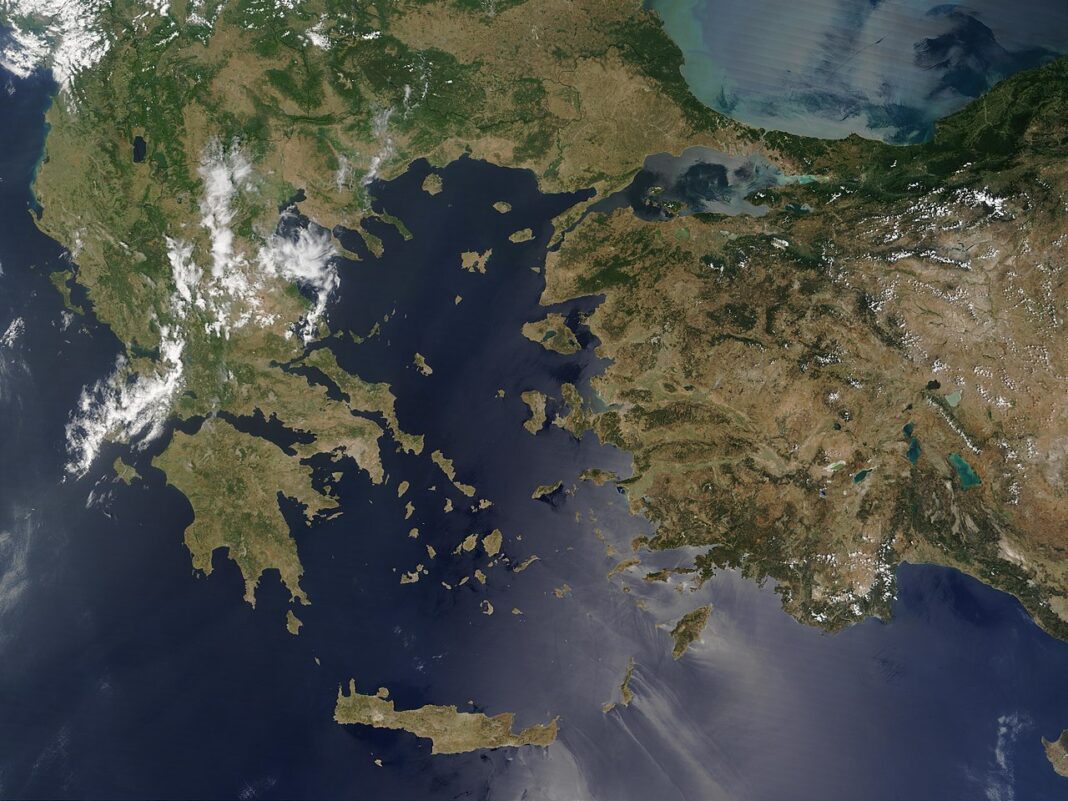
“Blue Homeland” is a maritime doctrine that asserts broad Turkish rights and jurisdiction in the Black Sea, the Aegean and the eastern Mediterranean. Supporters in Turkey frame it as a defense of Turkish sovereignty and access to energy resources, while Greece and Cyprus view it as a challenge to their maritime rights.
The dispute centers in part on whether islands generate their own exclusive economic zones and continental shelves. Greece and Cyprus say they do under UNCLOS. Turkey, which is not a party to the convention, argues that islands close to the Turkish mainland should not create maritime zones that cut off Turkey’s access to large areas of surrounding seas.
Greek Foreign Minister George Gerapetritis said last week that any unilateral attempt to impose maritime claims outside international law would fail. He said domestic laws could not create international legal rights in disputed maritime areas.
The European Union already has a sanctions framework related to Turkey’s unauthorized drilling activities in the eastern Mediterranean. The Council of the European Union adopted the framework in 2019, allowing travel bans and asset freezes against people and entities involved in drilling activity not authorized by Cyprus.
The debate over the bill comes as Turkey and Greece have sought to manage tensions after years of disputes over maritime boundaries, airspace, energy exploration and Cyprus. Passage of the bill could reopen a front in the Aegean and eastern Mediterranean at a time when United Nations efforts to revive talks on the island’s division are underway.