

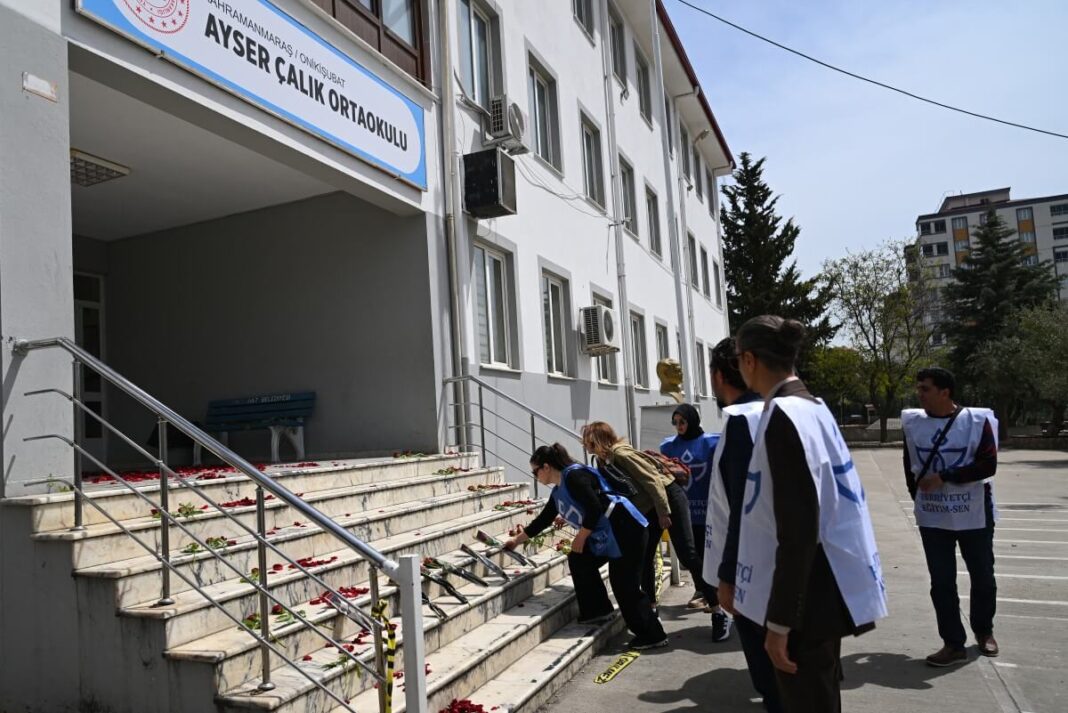

More than 95 percent of İstanbul residents say they are worried about recent school attacks in Turkey, according to a survey by the İstanbul Planning Agency, following back-to-back shootings in Kahramanmaraş and Şanlıurfa provinces that triggered nationwide concern over school safety.
The concerns followed an April 15 shooting at a school in southern Turkey’s Kahramanmaraş province, where a 14-year-old student opened fire, killing nine students aged 10 and 11 and one teacher. An 11-year-old girl who was wounded in the attack died in the hospital more than two weeks later, bringing the death toll to 10 in early May. The young attacker died at the scene.
Authorities said the boy brought five firearms to the school and was the son of a former police inspector, who was later arrested.
In a separate incident the previous day in the southeastern province of Şanlıurfa, a former student opened fire at his former high school, wounding 16 people, before taking his own life when confronted by police.
The findings were included in the April edition of the “İstanbul Barometer,” published by the İstanbul Planning Agency (İPA), which operates under the İstanbul Metropolitan Municipality.
Asked whether recent incidents at schools had worried them, 88.8 percent of respondents said they were “very worried,” while 6.5 percent said they were “partly worried.” Only 4.7 percent said they were not worried.
The survey found that concern was higher among women than men, with 96.3 percent of women saying they were very worried, compared to 81.2 percent of men.
The April survey identified the school attacks in Kahramanmaraş and Şanlıurfa as the most important issue on the public agenda, with İPA opening a separate section to measure İstanbul residents’ perceptions of security and their expectations following the incidents.
Respondents were also asked about the possible role of social media and digital content in triggering such attacks. A total of 57.6 percent said social media and digital content had a “very large effect,” while 31.4 percent said they had an effect but were not the main cause. Eight percent said they had no effect.
When asked about the causes of school violence, 63.2 percent of respondents cited a lack of communication within families. Another 39.3 percent pointed to structural problems in the education system and a lack of policy, while 36.1 percent cited the influence of social media and harmful digital content.
The survey also found that 20.6 percent of respondents blamed inadequate security measures at schools, 14.1 percent cited socioeconomic inequalities, 11.5 percent pointed to peer bullying and 7.4 percent indicated a lack of psychological support and preventive programs for children.
Following the attacks, Turkey tightened security at schools nationwide. Police were deployed outside schools across the country, with officers assigned to campuses and additional teams placed on standby during school hours.
Stricter entry controls were also introduced, including identity checks and appointment requirements for parents, while some schools banned mobile phones, smartwatches and tablets.
School administrations also introduced additional internal rules. In some schools, students were required to wear uniforms to enter, while parents were no longer allowed to wait in schoolyards.
Early student pickups had to be coordinated with school management, and items brought from outside were to be left at security checkpoints rather than taken directly into classrooms.
The attacks also led to a broad crackdown on online threats. The Security Directorate General said on April 17 that 411 people had been detained over posts about the Şanlıurfa and Kahramanmaraş attacks that authorities described as misleading, threatening or inciting hostility.
Police said 307 account administrators had been identified, 1,866 internet addresses had been blocked and 111 Telegram channels linked to a group called “C31K” had been shut down.
The shootings also triggered nationwide protests by teachers, with thousands calling for stronger safety measures and the resignation of Education Minister Yusuf Tekin. Demonstrators said schools had become increasingly unsafe despite previous warnings and incidents of violence.