

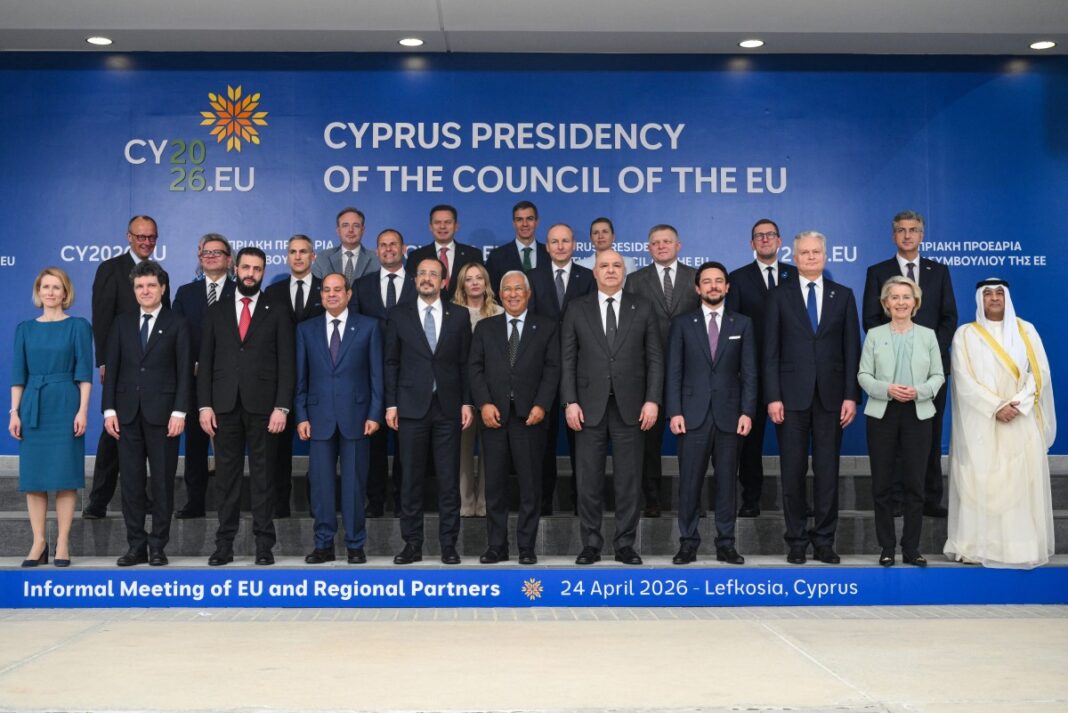

Turkey was left out of an informal summit that wrapped up Friday in Cyprus, where EU leaders courted Middle Eastern partners for talks on Iran, regional security, defense, energy and maritime security.
The summit, held April 23 and 24 in Nicosia and Agia Napa, brought together EU leaders and representatives from Egypt, Jordan, Lebanon, Syria and the Gulf Cooperation Council for talks on the Middle East, the conflict involving Iran, freedom of navigation, energy prices and Europe’s defense architecture.
Turkish President Recep Tayyip Erdoğan did not attend. An EU official told Euractiv that Erdoğan had not been invited, although EU statements on the summit did not publicly frame Turkey’s absence as a point of discussion.
The absence drew criticism from some journalists, analysts and commentators, who said the EU had made a strategic mistake by discussing the Middle East and Iran without Turkey, a NATO member that borders Syria, Iraq and Iran and has influence across the Black Sea, the eastern Mediterranean and the Caucasus.
Critics also pointed to the summit venue. Cyprus, an EU member state, has been divided since 1974, when Turkey intervened militarily following a coup by supporters of union with Greece. Turkey recognizes only the breakaway Turkish Republic of Northern Cyprus (KKTC), which is not internationally recognized, and does not recognize the Republic of Cyprus.
That made Erdoğan’s participation in an EU summit hosted by the Cypriot government politically difficult, if not impossible. Supporters of the EU’s approach said Turkey’s exclusion reflected the unresolved Cyprus dispute rather than a simple diplomatic snub.
The controversy came days after European Commission President Ursula von der Leyen warned against Europe falling under “Russian, Turkish or Chinese influence,” a remark that prompted criticism from Turkish officials and commentators, who said it put Turkey, an EU candidate country and NATO member, in the same category as strategic rivals.
Turkish Foreign Minister Hakan Fidan later called von der Leyen’s remark “unfortunate” but said the issue had been addressed through contacts with EU officials. Ankara did not appear to issue a direct public protest over Erdoğan’s absence from the Cyprus summit.
The debate drew attention to a recurring contradiction in EU-Turkey relations. Brussels depends on Ankara in areas ranging from migration and energy to NATO security and regional diplomacy, while political ties remain strained over the Cyprus dispute, democratic backsliding in Turkey, maritime claims in the eastern Mediterranean and Ankara’s stalled EU accession process.