


US Ambassador to Turkey Tom Barrack has said any deal to restore Turkey’s participation in the F-35 Joint Strike Fighter program will require Ankara to fully comply with US law by verifiably ending possession and use of its Russian S-400 air defense system.
“Any resolution will fully satisfy Section 1245 of the NDAA,” Tom Barrack said in an interview with Fox News Digital, referring to the National Defense Authorization Act.
He said the process will include formal certification by the US secretaries of defense and state that the S-400 poses no risk to sensitive F-35 technology.
The dispute dates back to US President Donald Trump’s first term, when Washington removed Turkey from the multinational F-35 consortium in 2019 after Ankara took delivery of the Russian missile system despite objections from its Western allies.
The purchase triggered sanctions under the Countering America’s Adversaries Through Sanctions Act (CAATSA), which Turkey remains subject to.
Barrack said the requirement will entail a clear, verifiable cessation of both possession and operability of the Russian system, addressing longstanding US concerns that it could compromise the stealth capabilities of the fifth-generation fighter jet.
His comments come amid renewed signals from the Trump administration that it is seeking to resolve the years-long dispute with Ankara.
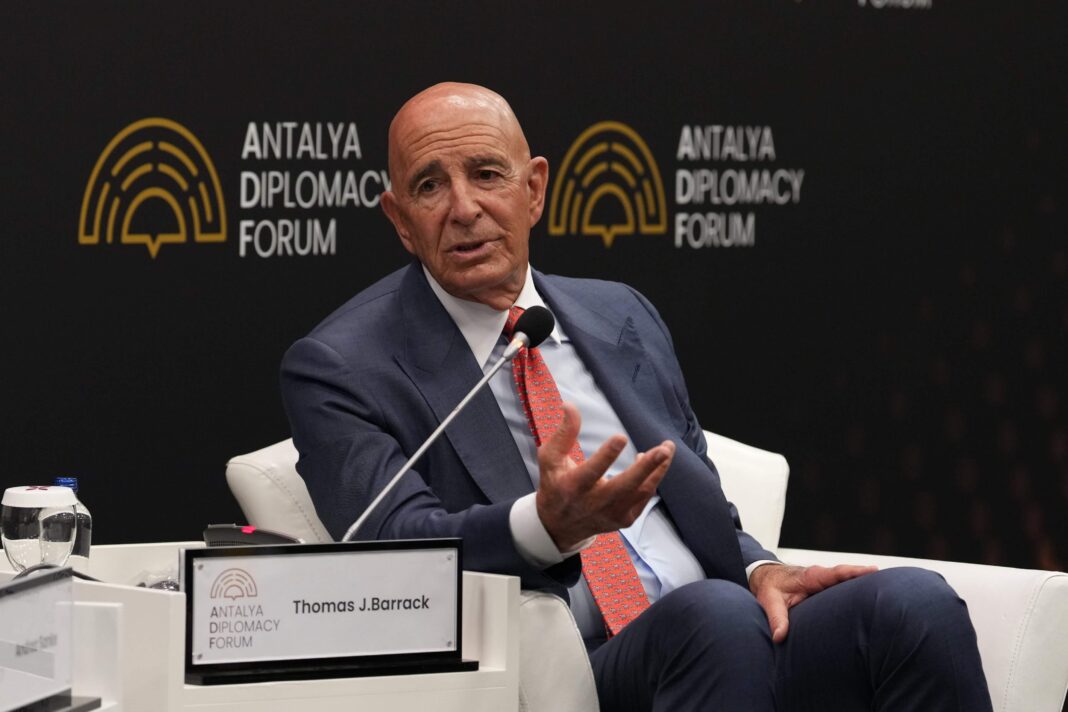
Speaking at the Antalya Diplomacy Forum last week, Barrack said he expected the issue to be resolved soon, suggesting the Trump administration is open to Turkey’s return to the F-35 program.
“I think you are going to see the S-400 situation solved soon. From my boss’s point of view, acceptance into an F-35 program is fine,” he said, according to Turkey’s state-run Anadolu news agency.
Under Section 1245 of the NDAA, Turkey cannot rejoin the program unless the US president certifies to the US Congress that Ankara no longer possesses or operates the system and that it poses no threat to the F-35.
Barrack said that any agreement would strictly adhere to these legal requirements, saying there would be “no shortcuts” on US security standards.
At the same time, he suggested that a breakthrough may be near, describing the current impasse as unnecessarily damaging to NATO unity and beneficial to Russia.
“What I am signaling is that real breakthroughs are imminent: restoring Turkey’s role in the F-35 ecosystem, strengthening NATO interoperability, boosting US industry and denying Russia leverage,” he said.
However, prospects for a deal face political resistance in Washington. Some members of Congress have threatened to block any future transfer of F-35 jets or even upgrades to Turkey’s existing F-16 fleet, citing concerns over Ankara’s regional policies and its past defense cooperation with Russia.
Barrack did not directly address individual lawmakers’ criticism but described the administration’s approach as part of a broader effort to reinforce alliances while maintaining strict safeguards on US military technology.
In the same interview, Barrack also offered a wider assessment of governance in the Middle East, claiming that strong centralized leadership has often produced greater stability than attempts to rapidly implement Western-style democratic systems after the Arab Spring.
He cited Turkey as an example of a presidential system with regular elections that has delivered stability, economic development and regional influence, while acknowledging that critics describe it as having authoritarian characteristics.
Barrack said such observations do not reflect a shift away from US support for democracy and human rights but rather a pragmatic view of how stability can be achieved in a volatile region.
The US ambassador, who assumed his post in May 2025, has also attracted criticism in Turkey over his remarks on governance in the region and Turkey.
Opposition figures have accused him of legitimizing authoritarianism after he said “powerful leadership regimes” have been the most effective systems in the Middle East, with some calling for him to be declared persona non grata.