

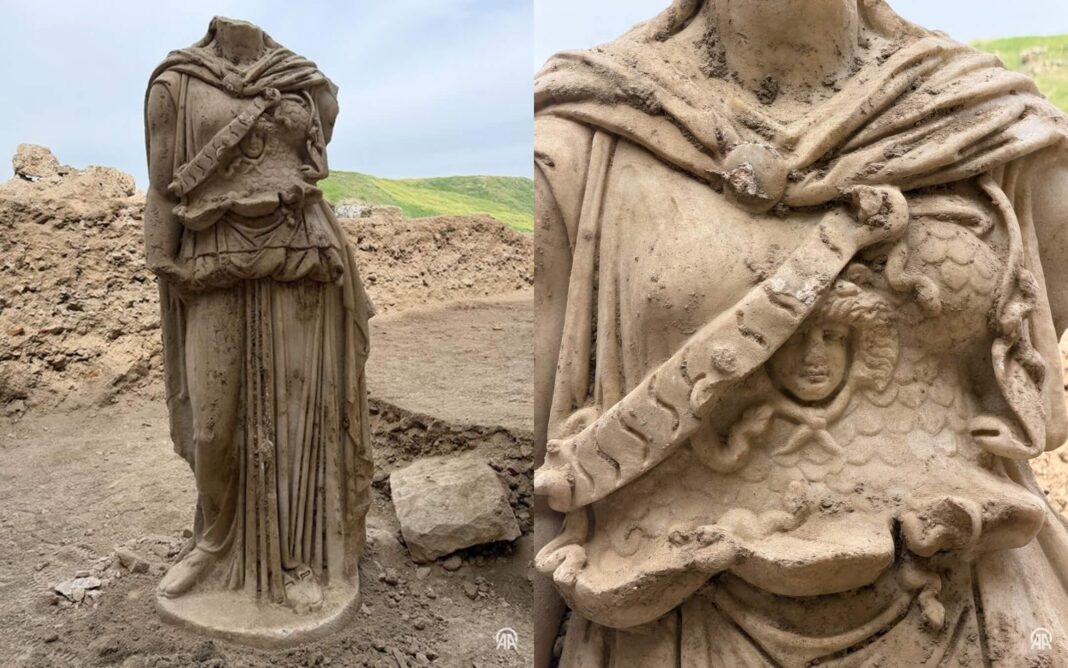

A nearly 2-meter-tall marble statue of Athena has been discovered during excavations in the ancient city of Laodicea in western Turkey, the culture minister announced on Thursday.
Minister of Culture and Tourism Mehmet Nuri Ersoy said the statue was discovered on March 31 in the stage building of the West Theater at Laodicea, an archaeological site in Denizli province.
“We have made another significant discovery in Laodicea,” Ersoy said in an X post, adding that the white marble statue reflects the classical style of the Augustan period and stands out for its high artistic quality.
Laodikeia’da önemli bir keşfe daha imza attık!
Antik kentte yeni bir buluntu daha gün yüzüne çıktı… ⛏️
Laodikeia Batı Tiyatrosu’nda yürüttüğümüz çalışmalar, geçmişin izlerini gün yüzüne çıkarmayı sürdürüyor.
Sahne binasında, yaklaşık 2 metre uzunluğunda, beyaz mermerden… pic.twitter.com/fjGHyjSxxv
— Mehmet Nuri Ersoy (@MehmetNuriErsoy) April 23, 2026
The statue was found lying on its front in a rubble fill along the outer wall of the stage building, in an area known as the postskene, a term from ancient Greek theater architecture referring to the area or structure behind the stage building. Its head has not yet been located, a statement released by the ministry said.
Athena, one of the most important deities in ancient Greek mythology, was associated with wisdom, warfare and crafts and was often depicted wearing armor and a helmet. In cities like Laodicea, which was known in antiquity as a major textile center, she was also linked to weaving and craftsmanship.
Founded in the Hellenistic period and later flourishing under Roman rule, Laodicea was an important commercial and cultural hub in western Anatolia, known for its wealth, theaters and monumental architecture.
The West Theater, dating to the second century BC, is a multi-tiered structure where statues once decorated the spaces between columns, suggesting it served not only for performances but also as a setting for cultural storytelling.
Excavations in recent years have uncovered sculptures depicting scenes from the Odyssey, an ancient Greek epic poem, including the Laestrygonians, Polyphemus and the sea monster Scylla.
Experts said the statue depicts Athena standing on a round base, wearing a sleeveless peplos and a cloak, with an aegis on her chest featuring the head of Medusa, a mythological figure whose gaze was said to turn people to stone, along with serpent motifs.
The back of the statue was left roughly finished, suggesting it was intended to be placed between columns.
Scholars say the statue reflects the classical style of the Augustan period (27 BC–AD 14). in Laodicea.
Excavation director Prof. Dr. Celal Şimşek also commented on the discovery on social media, referring to Turkey’s National Sovereignty and Children’s Day on April 23.
“The magnificent Athena statue from the Laodicea West Theater has greeted us in 2026. It is a gift to all children on April 23,” he wrote on X.
Laodikeia Batı Tiyatrosu’ndan muhteşem Athena heykeli 2026 yılında bizleri selamladı. 23 Nisan’da tüm çocuklarımıza bizden armağan @TCKulturTurizm @MehmetNuriErsoy @yazgi_gokhan @birolincecikoz @pauedutr @issanat #23NisanUlusalEgemenlikveÇocukBayramı pic.twitter.com/p4EQNg0FQz
— Celal Şimşek (@celal1964) April 23, 2026