

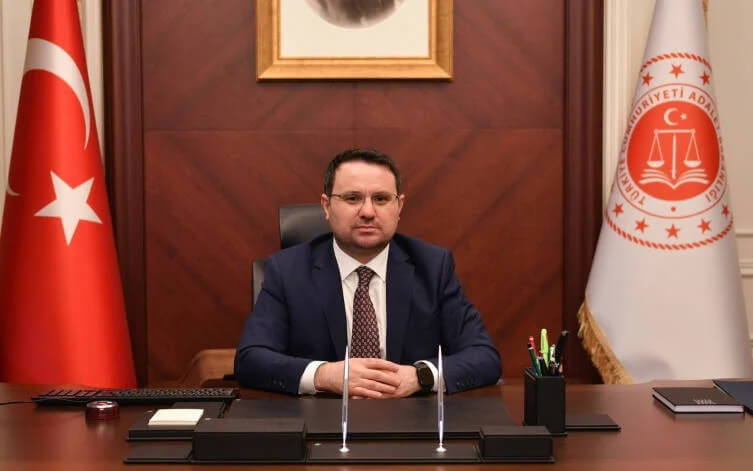

Turkey’s justice minister said the government is considering new legislation that could allow minors convicted of serious crimes such as murder to receive penalties similar to those imposed on adults, the T24 news website reported.
Justice Minister Akın Gürlek said the proposal is being discussed as part of Turkey’s planned 12th Judicial Reform Package, which aims to speed up court proceedings and introduce a range of legal changes.
Speaking during a fast-breaking dinner with Ankara representatives of several media outlets, Gürlek said he considers current penalties for crimes committed by minors “insufficient.”
He added that minors who commit serious offenses such as murder could receive aggravated life sentences if the crime warrants it. “If aggravated life imprisonment is necessary for adults, we will ensure that they receive it as well.”
Gürlek said discussions on the issue are ongoing in a parliamentary committee working on legislation concerning children involved in crime.
The minister also said the government plans additional measures targeting criminal networks that use minors to commit offenses, noting that penalties for such cases were increased in the 11th Judicial Reform Package and could be raised further in the upcoming bill.
“Children are entrusted to us. We are responsible for protecting their future,” Gürlek said.
Gürlek also outlined other planned reforms aimed at reducing the heavy caseload in Turkey’s judiciary. He said Turkish courts are currently handling around 12.5 million cases, a figure he described as extremely high by international standards.
Among the proposed measures is a new mechanism allowing contested divorce cases to be finalized through mediation if the spouses agree to end their marriage, even if disputes over alimony, custody or compensation remain unresolved.
Under the proposal, once both parties confirm they agree to divorce, a judge could record the decision and send the case to a mediator. The divorce would then become legally final once the mediator’s report is approved and registered with civil authorities.
Gürlek said the reform aims to prevent divorce cases from dragging on for years, noting that some proceedings currently last eight to 10 years, preventing people from rebuilding their lives.
Gürlek also said the government is considering introducing a “skip appeal” mechanism in the upcoming reform package to accelerate judicial proceedings, under which cases would no longer pass through both the regional appeals courts and the Supreme Court of Appeals.
Debate over youth crime in Turkey
The proposal to toughen penalties for minors comes amid growing concern over youth-related violence in Turkey.
Earlier this week teachers across İstanbul staged a one-day strike after a 17-year-old student fatally stabbed a teacher at a high school in the city’s Çekmeköy district, intensifying debate over safety in schools.
The attack occurred at Taşdelen Borsa İstanbul Vocational and Technical Anatolian High School, where the student allegedly attacked biology teacher Fatma Nur Çelik, another teacher and a 15-year-old student with a knife brought onto campus. Çelik later died from her injuries.
The killing drew national attention and renewed calls for stronger measures to address violence among teenagers.
Earlier this year, 17-year-old Atlas Çağlayan was fatally stabbed in İstanbul during a dispute between teenagers. Last year, the stabbing death of 15-year-old Turkish-Italian teenager Mattia Ahmet Minguzzi in broad daylight in an İstanbul marketplace sparked widespread outrage and renewed debate over juvenile justice laws.
In May 2024 thousands of teachers staged protests after İstanbul high school principal İbrahim Oktugan was shot dead by a former student, prompting nationwide calls for legislation aimed at preventing violence in schools.
Official figures show that the number of minors coming into contact with law enforcement as suspects has risen by more than 50 percent over the past nine years, with offenses linked to organized crime, including murder and drug trafficking, among the fastest-growing categories.
Rights advocates say many teenagers lured into criminal networks come from disadvantaged neighborhoods, have weak ties to education or employment and are vulnerable to gangs that promise money, protection or online notoriety.