


Doğan Ertuğrul*
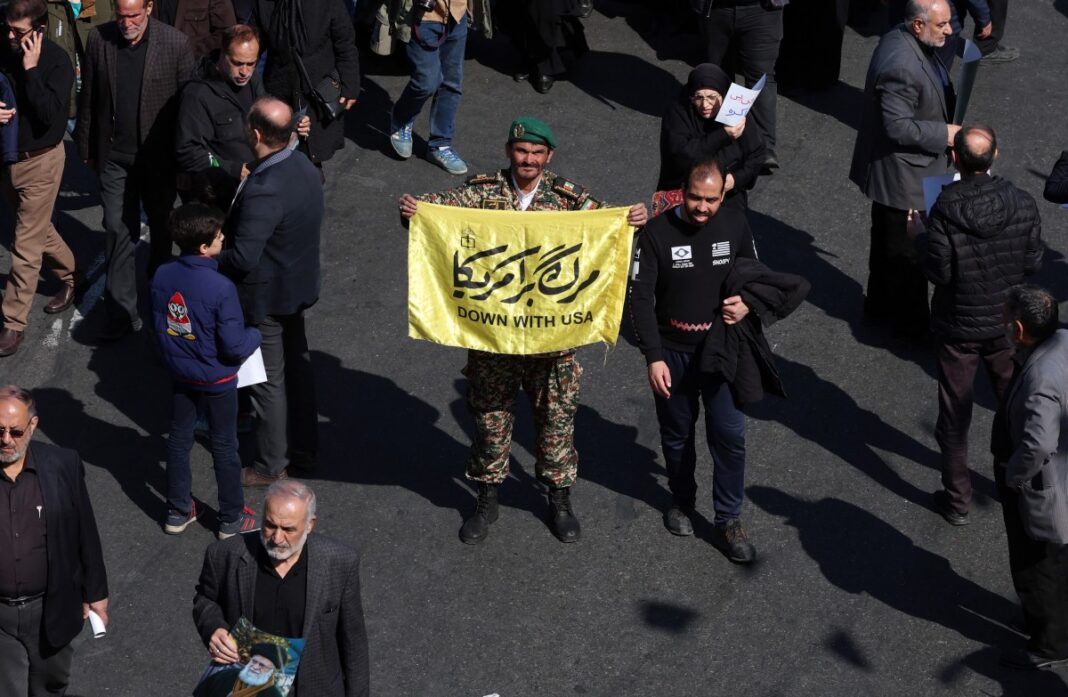
On a quiet Sunday in Vienna, while riding tram number 5 on my way home, I saw on X that a protest was being organized against the killing of Iran’s Supreme Leader Ali Khamenei in the US-Israeli attack. As far as I know, or at least as far as I noticed, this was the first pro-regime demonstration by Iranians in Vienna.
While thinking about whether to go to Stephansplatz to observe this unusual event, I noticed a young woman sitting directly across from me. She was holding a poster of the son of the deposed shah of Iran.
Most likely, she too was heading to another demonstration, this time one supporting the US-Israeli attacks and the killing of Khamenei.
And these two demonstrations were going to take place almost in the same square.
Will the Islamist regime finally fall?
“Well,” I said to myself, “this contrast and simultaneity are exactly what one would expect from Iran.”
On one side stood supporters of the radical Islamist regime that has ruled the country since 1979, perhaps taking to the streets for the first time. On the other side were supporters of the shah’s family, which was overthrown by the Islamic Revolution and whose followers, though not large in number, are often seen protesting in the diaspora.
This picture reminds us that there is another Iran, one different from the one we think we know.
Yet most of the time, we see Iran through the eyes of that young woman holding the shah’s photograph.
Perhaps that is the Iran we prefer to see.
However, beyond the image promoted by the pro-monarchy diaspora, there is another Iran, one that attracts far less attention in Western public debate, both socially and politically.
Every time Iran faces a domestic or international crisis, the same questions arise:
Will the Islamist regime finally collapse this time?
If it collapses, will a pro-Western government replace it?
The war that began on February 28 has once again pushed these questions onto the global agenda. And many of the answers suggest that the regime’s days are numbered.
Yet these expectations are based on faulty assumptions and serious miscalculations. They rest on three core beliefs: that Iran’s military capacity could be neutralized within days, that killing Supreme Leader Ali Khamenei would trigger the collapse of the regime and that internal divisions could be exploited to spark civil war.
It has now become clear that the assumption that Iran’s military capacity could be neutralized within a few days was wrong.
Another mistaken assumption is that the killing of Supreme Leader Khamenei and other military and political leaders would lead to the collapse of the Iranian regime.
The Iranian regime does not consist of a single individual, the supreme leader. Since the revolution, power has been distributed through councils and institutions, creating a broad structure of governance.
The Islamic Revolutionary Guard Corps (IRGC), which the US and Europe designate as a terrorist organization, is not merely a military force. It is also a powerful structure that shapes Iran’s economy, society and political institutions. Many influential political figures, including Ali Larijani, who is often described as the regime’s “hidden power,” come from the ranks of the IRGC.
Moreover, the regime still maintains social bases from which it draws legitimacy and support. Even in what we often call the “mullah regime,” the clerical class existed long before the Islamic Republic. Even if clerics are not the only ruling elite in a post-regime scenario, their presence is likely to continue.
The third belief is that internal divisions can be created within the regime, that a popular uprising can be organized and that a civil war can be triggered.
Having realized that the first two assumptions were misleading, the US-Israeli axis now appears to be investing heavily in this third scenario.
But we may not have to wait long to see that this assumption, too, could prove misleading.
Given the vast intelligence capabilities available to decision-makers in Washington and Tel Aviv, it is striking that they appear to be acting on assumptions that are either wrong or at least untested.
Unless, of course, they are doing so knowingly.
Khomeini was the architect of the revolution, but Khamenei was the architect of the regime
What happened after the Twelve-Day War and the mass protests that cost thousands of lives?
The Iranian regime did not collapse under short military operations and nationwide protests. On the contrary, it managed to reconsolidate itself.
The US-Israeli operation of February 28 was likely based on the assumption that a larger and more comprehensive military intervention could quickly produce results.
Moreover, on the first day of the war, Khamenei, the man widely seen as the architect of the Iranian state system, was assassinated.
Khomeini was the architect of the revolution, but the architect of the state and the regime was undoubtedly Khamenei.
Yet just one day later, a Guidance Council was formed to assume the supreme leader’s powers. New military and political officials were appointed to replace those who had been killed. The Assembly of Experts, composed of clerics, is now preparing to select a new leader.
At the same time, Iran dramatically expanded its attack capacity, far beyond anything seen during the Twelve-Day War.
It struck Gulf states hosting US military bases, including the United Arab Emirates, Kuwait, Oman and Saudi Arabia, as well as Israel, using drones and ballistic missiles.
There are still no signs that Iran intends to surrender easily.
Despite uncertainty about its missile stockpiles and launch platforms, Iran continues to strike targets, including Tel Aviv.
Iran is playing for time. It is turning the war into a test of endurance for the United States and Israel.
Is Iran’s missile campaign aimed at defeating the US and Israel militarily?
Certainly not.
Its objective is to send a message to the world: “The regime has not collapsed. It is still standing.”
How long can Iran sustain this war?
Even US and Israeli intelligence may not have a clear answer.
For precisely this reason, Donald Trump has signaled the possibility of a ground operation involving Marines and proxy fighters, aimed at triggering internal divisions within the regime and potentially igniting a civil war.
When “proxy fighters” are mentioned, who comes to mind?
Unfortunately, and perhaps inevitably, the Kurds.
‘If I speak Persian, they call me Iran’s man’
Trump is known to have spoken directly with the coalition partners of the Kurdistan Regional Government in Iraq, the Kurdistan Democratic Party (KDP) and the Patriotic Union of Kurdistan (PUK). He has even reportedly contacted Hicri, the leader of the Democratic Party of Iranian Kurdistan.
But the results appear far from what he expected.
Western media reported that Kurdish groups armed by the Central Intelligence Agency had launched attacks along the Iranian border. Yet so far, almost all Kurdish organizations have denied these claims.
The exception is the Kurdistan Free Life Party (PJAK), widely seen as the Iranian branch of the Kurdistan Workers’ Party (PKK). There are indications that PJAK may be negotiating for an autonomous structure similar to the one in Syria.
Still, Trump’s plan to use Iraqi Kurds as proxy fighters against Iran does not align well with regional realities. Iranian intelligence maintains deep influence in Iraqi Kurdistan, particularly in Sulaymaniyah and within the PUK.
I once heard a telling anecdote from a leader in the PUK: During a visit by former Iraqi President Jalal Talabani to Tehran, Khamenei reportedly asked him, “You speak Persian very well. Why do you speak Arabic with me instead?”
Talabani’s answer was revealing:
“Because if I speak Persian with you, they say I am Iran’s man.”
This anecdote matters because alliances and balances on the ground can shift rapidly.
But Trump’s plan to turn Iraqi Kurds into proxy fighters against Iran may simply fail.
Indeed, the Kurdistan Regional Government has already declared its neutrality through Kubat Talabani.
The Iran war will likely last longer than the United States and Israel anticipated. It may already have exceeded the expected timeline.
It appears that decision-makers in Washington and Tel Aviv built their strategy on the assumption of a rapid regime collapse.
Yet the regime has not collapsed.
And now the only remaining scenario appears to be civil war.
But what if there is no split within the Revolutionary Guards, and no civil war?
In conclusion
Even before this war, Iran was already undergoing a process of transformation due to deep economic and political crises. After the Mahsa Amini protests, changes visible in everyday life suggested that Iranian society had made important gains in its struggle for freedom.
Despite severe repression and thousands of deaths in the streets, Iranian citizens had begun pushing the regime toward change.
Now, however, the war initiated by the United States and Israel risks reversing these gains.
There is even speculation that a leader more radical than Khamenei, most notably his son Mojtaba Khamenei, could come to power.
That possibility has even been mentioned by Donald Trump himself.
And that is precisely why this war may ultimately put the hard-won achievements of the Iranian people at risk.
*Doğan Ertuğrul is a journalist and Middle East expert. He worked as a foreign correspondent in Bulgaria, Bosnia, Greece and Cyprus from 1994 to 2000.
He also worked for Aktüel and Tempo, two Turkish current affairs magazines, where he covered Kurdish matters and the Middle East and traveled to both Iran and northern Iraq as part of that reporting. He lived and worked in Lebanon from 2012 to 2014.
He has written for various newspapers on Iran’s political system and regional relations. He also edited the books “Doğunun Kadın Mirası” (The Heritage of the Women of the East) and “Doğulu Yazarlar Gözüyle İstanbul” (Istanbul in the Eyes of Eastern Writers).
Ertuğrul currently lives and works in Europe.
This article was first published in Turkish on the Kronos news website.
Disclaimer: The views expressed in this opinion piece are those of the author and do not necessarily reflect the editorial stance of Turkish Minute.