


Orhan Sait Berber
Turkey’s strategic importance within NATO is increasing as the post-Cold War security order weakens, speakers at a panel discussion this week in Washington, D.C., said, citing Ankara’s expanding defense industry and more assertive regional policies.
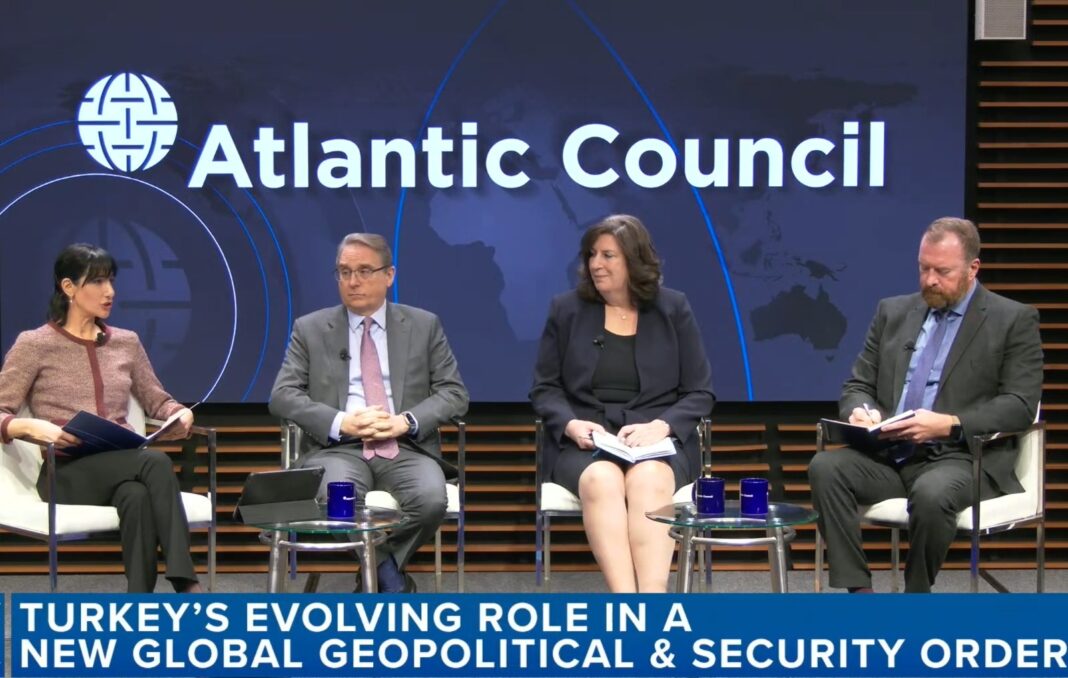
The discussion, titled, “Turkey’s evolving role in a new global geopolitical and security order,” was held on February 17 at the Atlantic Council in Washington.
It took place days after this year’s Munich Security Conference, an annual gathering of global political and security leaders, where several participants questioned the durability of the post-1945 international system, the US-led global order created after World War II.
In his opening address in Munich, German Chancellor Friedrich Merz said the post-1945 consensus “no longer exists,” while US Secretary of State Marco Rubio, speaking to reporters en route to the conference, said that “the old world is gone, frankly,” adding that “we live in a new era in geopolitics.”
Defne Arslan, senior director of the Atlantic Council’s Turkey Program, said Turkey’s position in the alliance is becoming more significant as global power balances shift, noting that 2026 marks the 74th anniversary of Turkey’s NATO membership.
Turkey joined NATO in 1952 during the early years of the Cold War, reinforcing the alliance’s southeastern flank against the Soviet Union.
Despite tensions in recent years, relations between Washington and Ankara are showing signs of stabilization, said Rich Outzen, a nonresident senior fellow in the Turkey Program and a former US defense official. Still, key disputes remain unresolved.
One of the main sticking points is US sanctions imposed under the Countering America’s Adversaries Through Sanctions Act (CAATSA), a 2017 law mandating penalties on countries that make significant defense purchases from Russia, Iran or North Korea.
Tensions escalated after Ankara acquired the Russian-made S-400 air defense system in 2019, a move Washington said could compromise NATO systems and alliance interoperability.
In response the United States imposed sanctions on Turkey in 2020 and removed it from the F-35 fighter jet program, a multinational fifth-generation aircraft project in which Ankara had been both a manufacturing partner and a prospective buyer.
Turkish companies were set to produce more than 1,000 components as part of Ankara’s $1.4 billion investment in the program before its removal.
Outzen said that despite these disputes, cooperation continues in certain areas.
He noted that Turkey’s production of 155mm artillery shells and armed drones has gained relevance as European countries increased defense spending following Russia’s invasion of Ukraine.
Turkey’s domestically produced Bayraktar TB2 drones have been widely used in several conflict zones, including Ukraine and have become a symbol of the country’s growing defense exports.
Brenda Shaffer, a nonresident senior fellow at the Atlantic Council’s Global Energy Center, said the United States is not retreating from global affairs but is adjusting how it works with partners, expecting regional actors to assume greater responsibility.
Her remarks reflect a broader debate in Washington about burden-sharing within NATO, particularly as the United States faces growing strategic competition with China.
She said the war in Ukraine has disrupted global energy markets and that Russia has limited oil flows through the Black Sea region, including exports from Kazakhstan, affecting global supply and prices.
Turkey, she added, has reduced its energy vulnerabilities by expanding liquefied natural gas imports, increasing storage capacity and diversifying supply sources.
Will Wechsler, senior director of the Atlantic Council’s Rafik Hariri Center, said Turkey has taken a more active role in Azerbaijan, Libya, Syria and Ukraine in recent years, expanding its influence in both the Middle East and the Caucasus.
Turkey provided military support to Azerbaijan during the 2020 Nagorno-Karabakh conflict and has maintained a military presence in northern Syria and Libya.
He said Turkey and Israel are playing a larger role in shaping regional dynamics, a development that has raised concern in parts of the Gulf.
During the question-and-answer session, Turkey’s ambassador to the US, Sedat Önal, described Ankara’s approach as based on what he called “regional ownership.”
He said Turkey cannot ignore instability in neighboring countries and characterized its policies in Syria, Gaza, Ukraine and the South Caucasus as efforts to promote stability.
Ankara has frequently used the term “regional ownership” to argue that countries in a given region should take primary responsibility for resolving conflicts rather than relying solely on outside powers.
Panelists also addressed Iran’s regional position. Shaffer said Tehran is facing serious economic and energy challenges that may constrain its regional reach, claiming that its continued gas exports to Turkey appear driven largely by financial necessity.
Iran has long relied on energy exports as a key source of hard currency amid US sanctions.
Wechsler said Iran’s influence in Syria and Lebanon has declined in recent years.
The Atlantic Council is a Washington-based think tank focused on international security and economic policy.