


Turkey’s deputy parliament speaker said Tuesday he believes the legislature will take the necessary steps before President Recep Tayyip Erdoğan’s current tenure expires in order to allow him to seek another term in office.
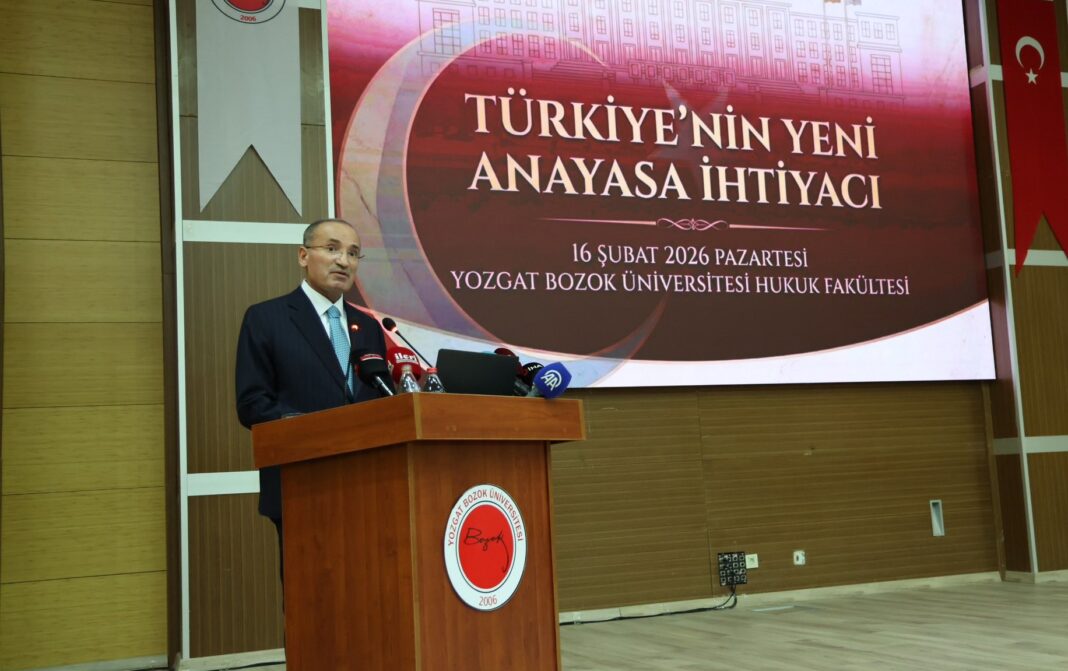
Bekir Bozdağ, a senior member of Erdoğan’s ruling Justice and Development Party (AKP) who serves as one of parliament’s deputy speakers, made the statement at a provincial party meeting in the central province of Yozgat. His remarks reflect a growing debate within the ruling party about how to keep the 71-year-old president in power beyond 2028, when his term legally expires and he is constitutionally barred from running again.
“If the parliament decides to renew parliamentary [and presidential] elections before the second term expires, it is the constitutional right of our president to run again and be elected,” Bozdağ said. “This discretion belongs to the parliament. When it decides to exercise this right, no one can say ‘this does not comply with the constitution, this is unconstitutional.'”
He added that he believes the parliament will open the door for Erdoğan to run again.
Turkey’s constitution limits presidents to two five-year terms. Under the current system, in place since Erdoğan pushed through a constitutional overhaul converting Turkey from a parliamentary to a presidential system of governance in a 2017 referendum, Erdoğan is serving the second and final term he is allowed to complete in full. The next presidential election is scheduled for May 2028 at the latest.
However, Article 116 of the constitution contains an exception. If parliament votes to call early elections while a president is still in their second term, that president may run again, since the snap election technically opens a new electoral cycle. The threshold for parliament to call early elections is 360 votes out of 600 seats, a three-fifths supermajority.
Erdoğan’s AKP and its key ally, the far-right Nationalist Movement Party (MHP), together control roughly 321 seats, well short of the 360 needed. That gap is why the debate exists. For the snap election path to work, Erdoğan would need to peel off dozens of additional votes from smaller parties or from within the ranks of the main opposition Republican People’s Party (CHP), which has been under pressure since the March 2025 arrest of its most prominent figure, İstanbul Mayor Ekrem İmamoğlu.
Constitutional amendment alternative
A parallel route involves rewriting the constitution to remove or modify the two-term limit outright. That would require either 360 parliamentary votes to send a constitutional amendment to a public referendum, or 400 votes to pass the change directly without a referendum, both thresholds Erdoğan currently cannot reach.
MHP leader Devlet Bahçeli publicly called for a constitutional amendment to allow Erdoğan to run again as far back as late 2023. The AKP’s own spokesperson said in January 2025 that enabling Erdoğan’s re-election was “on our agenda.” Erdoğan himself, however, has periodically said he intends to step down in 2028, though he made similar statements before both the 2018 and 2023 elections and ran in each.
A November survey by pollster Metropoll found 66 percent of respondents opposed amending the constitution to allow a third term.
Succession scenario
A third scenario circulating in Ankara political circles involves Erdoğan backing his son, Bilal Erdoğan, 44, as a successor candidate rather than seeking re-election himself. Bilal Erdoğan holds no elected office and has no formal role in the AKP or the government. He has a bachelor’s degree in political science from Indiana University and a master’s degree in public administration from Harvard University’s Kennedy School of Government.
His public profile has surged sharply in recent weeks. Pro-government media published at least 16 separate items about him in the first six weeks of 2026, roughly four times the coverage he received during the same period in 2025, according to a media monitoring analysis published last week. A February 10 Bloomberg report described him as an emerging potential heir, saying senior AKP figures see him as capable of maintaining the party’s “delicate social balance” and mobilizing conservative support.
Bülent Arınç, one of the AKP’s co-founders and a former deputy prime minister, rejected the succession idea in an interview last month, saying a father-to-son transfer of power “would not gain general acceptance” in Turkey, where such arrangements have no democratic precedent.
A December poll by Refleks Data and Research placed Bilal Erdoğan third in hypothetical succession scenarios within AKP circles, well behind Foreign Minister Hakan Fidan and former interior minister Süleyman Soylu.
What this means for the opposition
The arithmetic of any snap election or constitutional amendment puts extraordinary pressure on the opposition. The CHP, Turkey’s oldest party and the main opposition force, has been weakened over the past year. İmamoğlu, the İstanbul mayor who was widely seen as the strongest presidential challenger and who received 15.5 million votes in a CHP primary held on the day of his arrest in March 2025, remains in İstanbul’s Marmara Prison on corruption charges that the CHP calls politically motivated. A court-ordered cancellation of his university degree has raised questions about whether he would even be legally eligible to run for president under Turkish law, which requires a university diploma.
Without İmamoğlu, analysts say the CHP lacks a candidate of comparable national appeal heading into 2028, or earlier, if a snap vote comes.
Erdoğan has governed Turkey since 2003, first as prime minister, then as president, making him the longest-serving leader in the history of the Turkish Republic.