

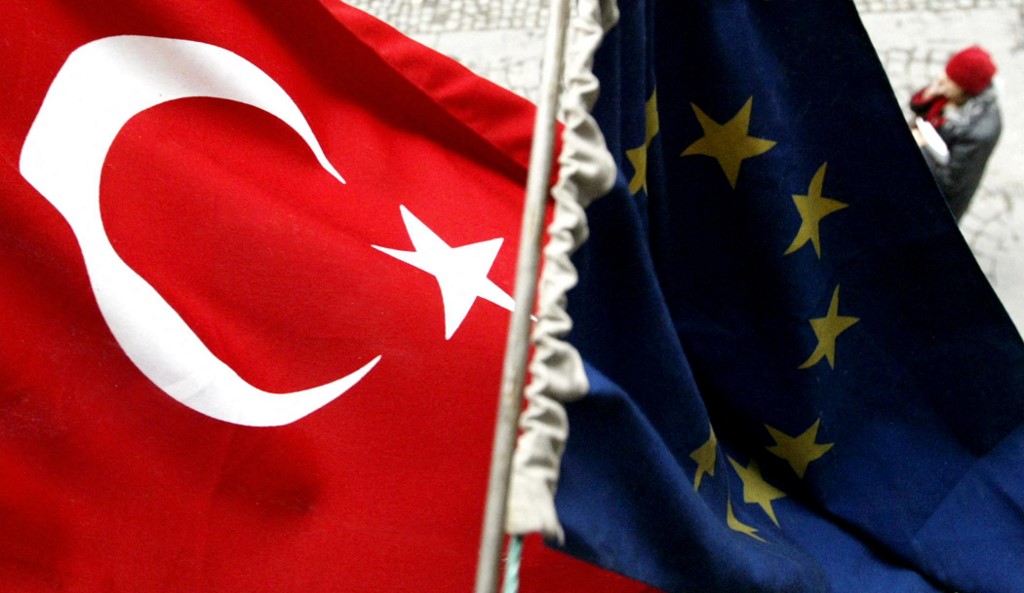

Turkey’s business leaders are pressing for an overhaul of the nearly 30-year-old customs union agreement with the European Union, warning that keeping it limited to industrial goods is costing market share and weakening competitiveness, the Cumhuriyet daily reported.
Industry representatives want the agreement modernized to cover services, agriculture, public procurement and e-commerce. They argue that the current framework leaves Turkish companies treated as “third-country” operators inside the European market and works as an “invisible barrier.”
The Brussels-based instituDE and the Ifo Institute project that an update could boost Turkey’s GDP by as much as 2.5 percent and increase exports to the EU by 15 to 25 percent.
Sector complaints: logistics, agriculture
Turgut Erkeskin, president of the International Transport and Logistics Service Providers’ Associations Federation (UTİKAD), said the update is not only about tariffs.
“Logistics service providers today cannot fully integrate into the European market and face asymmetries in service delivery and establishment,” Erkeskin said, according to Cumhuriyet.
He called for concrete outcomes, including a reassessment of transport quotas, visa exemptions for heavy vehicle drivers and pilots, faster transit and harmonized digital processes. He said mutual recognition of electronic documents and reduced duplication of procedures would improve supply chain efficiency.
Melisa Tokgöz Mutlu, president of the Turkish Exporters Assembly’s (TİM) İstanbul Fresh Fruit and Vegetable Exporters Association, said the sector reached $3.87 billion in exports in 2025, with about 40 percent going to the EU. She said border delays raise costs for exporters and can lead to freshness losses for consumers.
“The unpredictability in documentation density and testing processes puts Turkish exporters at an asymmetric disadvantage against competitors,” Tokgöz Mutlu said. She said modernization should include mutual recognition of laboratory analyses, digital customs clearance and integration into e-certification systems.
Hakan Çınar, president of the Foreign Trade Leaders Association, warned that EU free trade agreements with other partners are leaving Turkey out and producing losses. He said sectors outside the customs union effectively confine Turkish companies to “third-country” status.
“Along with the immediate expansion of the customs union, Turkey must have simultaneous and equal rights in the EU’s trade agreements with third countries and must be part of the decision-making processes,” Çınar said.
Structural flaws cited by researchers
A Chatham House briefing listed 10 design flaws, including what it described as an asymmetry when the EU signs a free trade agreement with a third country. Under that dynamic, the third country’s goods can enter Turkey tariff-free through the customs union, while Turkish goods do not automatically gain access to the third country’s market. Mexico, Algeria and South Africa were cited as examples.
Researchers also point to a decision-making gap. Turkey is required to apply the EU’s Common External Tariff and Common Commercial Policy but has no vote in how they are set. A College of Europe study said the consultation procedure in Decision 1/95, which calls for informal consultation with Turkish experts during EU drafting, has not been properly implemented.
Transport is another bottleneck. The Chatham House briefing said about 60,000 Turkish-registered goods vehicles enter the EU each year at Greek and Bulgarian crossings, where quotas, documentation demands and long lines remain common. It cited queues reaching 17 kilometers at the Bulgarian-Turkish border, with crossing times of up to 30 hours.
The instituDE report said Turkey has about 23 to 24 free trade agreements in force, while the EU has 44 preferential trade agreements covering 76 partners.
Economic case for modernization
instituDE outlined scenarios in which, without modernization, Turkey’s trade imbalance with the EU would grow to negative €20 billion. It said moderate modernization producing a 10 percent efficiency gain would reduce the deficit to €12.5 billion, while full modernization could cut it to €8.5 billion.
The European Commission’s impact assessment, cited in the instituDE report, estimated that an enhanced framework could bring €12.5 billion in welfare gains for Turkey, equal to a 1.4 percent GDP increase, and €5.4 billion for the EU.
instituDE projected that liberalizing agricultural trade could raise Turkey’s agricultural exports to the EU by about 95 percent and that including services could drive long-term service exports growth of up to 400 percent. It also projected €25 to €35 billion in additional foreign direct investment over 10 years, particularly in logistics, advanced manufacturing and digital trade infrastructure.
EU supply chain argument
Turkey is the EU’s fifth-largest trading partner, with bilateral trade at $232.7 billion, and about 70 percent of foreign investment in Turkey originating from EU countries, the Hürriyet Daily News reported.
instituDE said the EU’s push to reduce dependence on China could strengthen Turkey’s role as a “nearshoring” option. It noted that the EU imposed additional anti-subsidy tariffs of up to 38.1 percent on Chinese electric vehicles on top of an existing 10 percent car tariff and said Chinese automaker BYD has established a factory in Turkey to export into the EU via the customs union.
A November 2023 European Commission communication on EU-Turkey relations, known as the Borrell report, argued that modernization with dispute settlement and safeguards could unlock the relationship in the context of green and digital transitions, resilient supply chains and competitiveness, analyst Ayşe Yürekli wrote in an assessment.
Yürekli also wrote that Turkish business council leaders coordinated by the Foreign Economic Relations Board (DEİK) urged EU leaders in an open letter published in the Financial Times to end the stagnation, arguing that Europe’s competitiveness cannot be strengthened through an architecture that excludes Turkey.
Politics still blocks progress
The European Commission proposed modernizing the customs union in December 2016, but the EU Council has not adopted negotiating directives. instituDE said progress hinges on political conditions, including alignment with EU foreign policy and human rights standards. It cited compliance with European Court of Human Rights rulings including the Demirtaş, Kavala and Yalçınkaya cases.
Cyprus remains another obstacle. The EU Council suspended negotiations on eight chapters in 2006 over Turkey’s refusal to extend the customs union to Cyprus. Cyprus and Greece retain veto power over a modernization mandate. Turkish Trade Minister Ömer Bolat has said some member states are blocking the process.
The instituDE think tank also said the Turkish government has violated property rights through confiscations after a coup attempt in 2016. It cited estimates that seized assets total $14 to $40 billion in official data and conservative independent assessments, with some nongovernmental and think tank estimates reaching $80 billion.
Chatham House also linked the political climate to difficulties in public procurement reform, pointing to claims that major infrastructure and construction contracts often go to politically favored companies and that the Housing Development Administration’s (TOKİ) revenue-sharing model lacks transparency.
Still, a February 2026 meeting between EU Enlargement Commissioner Marta Kos and Turkish Foreign Minister Hakan Fidan in Ankara signaled renewed engagement. In a joint statement they said they “shared a willingness to work for paving the way for the modernization of the customs union” and welcomed the gradual resumption of European Investment Bank operations in Turkey, Reuters reported.
Warnings against exiting the customs union
Some commentators in Turkey have floated replacing the customs union with a standard free trade agreement. Analysts cautioned against it.
Nilgün Arısan Eralp, director of the Economic Policy Research Foundation of Turkey’s (TEPAV) EU Studies Center, said shifting to an FTA would bring rules of origin that could impose duties on foreign inputs used in Turkish industrial exports, weakening Turkey’s integration with the EU market and undermining investor confidence, Cumhuriyet reported.
Bahadır Kaleağası, president of the Paris Bosphorus Institute, said customs union talks are tied to democratic reforms and could improve predictability, investment and the shift toward technology products and services. He called the customs union a “trigger” that pushes adaptation and said European private sector support for Turkey’s EU process is also tied to Europe’s competitiveness and strategic autonomy.
The customs union entered into force on December 31, 1995, under the 1963 Ankara Agreement and the 1970 Additional Protocol. It covers industrial goods and processed agricultural products, while services, agriculture, public procurement and digital trade remain outside its scope.
The European Commission requested a mandate in December 2016 to modernize the agreement, but disputes over democratic standards, Cyprus and foreign policy differences blocked progress. The EU General Affairs Council said in 2018 that Turkey was moving away from the EU and that no further work on modernization was envisaged.
Momentum began to rebuild in July 2024 with the first EU-Turkey High-Level Dialogue on Trade in Brussels. In February 2026 Kos and Fidan met in Ankara and expressed willingness to work toward modernization, though council negotiating directives remain pending.
Turkey exported $273 billion in goods last year, with 42 percent destined for the EU. Service exports reached $123.1 billion. Turkey is the EU’s fifth-largest trading partner, with bilateral trade at $232.7 billion.