


Fatma Zibak
Turkey’s main opposition party has said President Recep Tayyip Erdoğan’s decision to appoint Akın Gürlek, İstanbul’s chief public prosecutor, as justice minister confirms its long-held claim that legal cases against opposition figures are politically motivated and could signal a further tightening of pressure on the opposition.
The appointment, published in the Official Gazette early on Wednesday as part of a mini cabinet reshuffle, puts Gürlek at the helm of the justice ministry, replacing Yılmaz Tunç.
Gürlek, 44, is widely known for overseeing investigations targeting opposition politicians, mainly figures from the Republican People’s Party (CHP), and filing lawsuits against them due to their criticism of his actions.
The reshuffle also saw Interior Minister Ali Yerlikaya replaced by Erzurum Governor Mustafa Çiftçi.
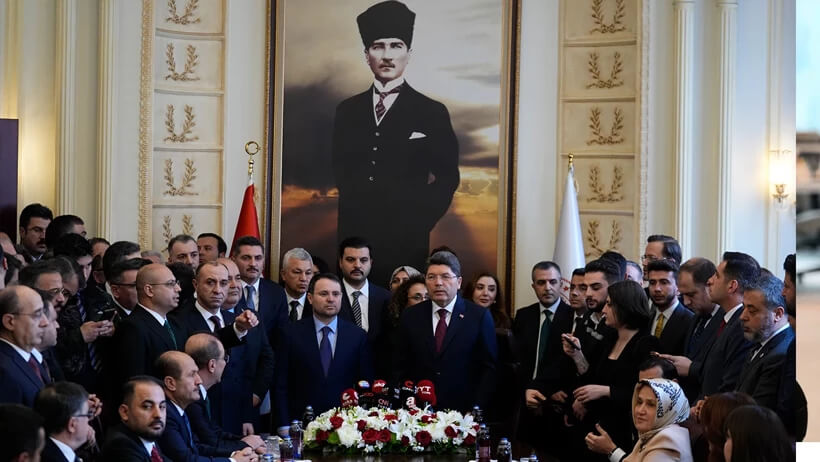
At a ceremony held at the ministry on Wednesday, Gürlek thanked President Recep Tayyip Erdoğan for his appointment and vowed to continue reforms in what the government calls the “Century of Turkey.”
— Yılmaz TUNÇ (@yilmaztunc) February 11, 2026
“We will continue to advance reforms and accelerate judicial process,” he said. “We will strive to demonstrate a stronger rule of law. The justice system is the common guarantee of our 85 million citizens.”
His remarks stood in sharp contrast to the opposition’s reaction. For the CHP, Gürlek’s appointment as justice minister backs what it describes as the political nature of investigations that have swept through opposition-run municipalities for more than a year.
“Someone who was assigned as chief prosecutor in İstanbul to carry out operations against our party is now appointed justice minister,” CHP leader Özgür Özel said at a ceremony in Ankara. “And then they say Turkey is a state governed by the rule of law.”
Özel said the appointment strengthened the opposition’s view that the cases against CHP officials are politically driven rather than impartial legal proceedings, warning that the pressure on the party is likely to intensify in the months ahead.
“Tomorrow will be harder than today,” Özel said, describing the situation as one of the biggest assaults in his party’s political history but insisting it would not “surrender.”
Özel has previously used harsh language in criticizing Gürlek’s record on politically sensitive cases, referring to him as a “mobile guillotine” and the “killer of justice,” as he accused him of acting as a tool in what the opposition describes as politically motivated prosecutions.
Since Gürlek’s appointment as İstanbul’s chief public prosecutor in October 2024, more than 15 CHP mayors have been arrested, most on corruption charges they deny.
Prosecutors have also opened investigations into numerous CHP members on accusations ranging from graft to alleged terrorism links and insulting the president.
Gürlek was also the prosecutor who issued the detention warrant for İstanbul’s popular mayor, Ekrem İmamoğlu, last year. The move came days before İmamoğlu — widely seen as a potential challenger to Erdoğan in the 2028 presidential election — was formally named the CHP’s candidate.
His detention sparked the largest street protests Turkey had seen in more than a decade. He was later arrested and remains entangled in a series of legal cases.
İmamoğlu also reacted to Gürlek’s appointment through the Presidency Candidate Office account on X, managed by his legal team, accusing the government of “willing to risk all forms of unlawfulness out of desperation and fear.”
“Our future is under serious threat,” said a defiant İmamoğlu.
Ya Adalet Ya Sefalet!
Adalet yoksa bereket yok.
Adalet yoksa barış, huzur olmaz.
Adalet yoksa itibar, demokrasi, üretim, kalkınma, geçim, yatırım olmaz.İşsizlik, açlık, yoksulluk, umutsuzluk vardır.
İktidar, içine düştüğü çaresizlik ve korku sebebiyle her türlü hukuksuzluğu…
— Cumhurbaşkanlığı Aday Ofisi (@CAOIletisim) February 11, 2026
CHP Deputy Chairperson Gül Çiftci described Gürlek’s appointment as “a reward” for the operations carried out against the party, while senior CHP lawmaker Murat Emir said it amounted to an effort to shield him from accountability.
Under Turkey’s system, cabinet ministers can only be tried before the Constitutional Court, acting as the Supreme Court, and only with parliamentary approval.
Emir said the appointment allowed Gürlek to take refuge “behind a shield of immunity.”
Criticism extended beyond the CHP. İYİ (Good) Party leader Müsavat Dervişoğlu said promoting a prosecutor who has overseen high-profile cases against the main opposition made the political character of those cases “concrete and official.”
Even some figures previously affiliated with the ruling Justice and Development Party (AKP) voiced concern. Hüseyin Kocabıyık, a former AKP lawmaker who has recently taken a more critical stance toward the government, described the appointment as inconsistent with “state tradition” and suggested it could signal preparations for an early election.
The government has consistently denied claims that cases against opposition politicians are politically motivated, insisting that Turkey’s judiciary operates independently.
Beyond the political backlash, some legal observers pointed to the broader implications of Gürlek’s appointment as justice minister.
Legal affairs journalist Alican Uludağ said in statement on X that Gürlek’s move to the justice ministry dramatically expands his authority since the minister also chairs the Council of Judges and Prosecutors (HSK), the powerful body responsible for judicial appointments and disciplinary proceedings.
“He now has the power to replace chief prosecutors, commission heads, judges and prosecutors across the country,” Uludağ said, adding that control of the prison system also falls under the ministry.
Uludağ also warned that this concentration of authority could enable operations similar to those carried out in İstanbul to be extended nationwide ahead of the 2028 elections.
Former lawmaker and economist Nesrin Nas said the cabinet reshuffle was significant because it involved the justice and interior ministries, which she said play a key role in the government’s legal and security policies.
“Changing other ministers would not have meant much,” Nas wrote on X. “But replacing the justice and interior ministers signals a new wave of lawfare.”
Referring to Gürlek’s record as İstanbul’s chief public prosecutor, she said she expects a much tougher period ahead, warning that “the few remaining doors open to democracy may also be closed.”
Nas expressed concern that Turkey could drift toward a more authoritarian model like the regime in Russia while hoping that her fears will prove unfounded.
Beyond the recent investigations targeting the CHP, Gürlek had previously been associated with several high-profile and politically sensitive cases.
As a senior judge, he presided over the trial in which jailed Kurdish politician Selahattin Demirtaş was sentenced to more than four years in prison on a propaganda charge, a ruling that resulted in a political ban.
He also chaired the court that sentenced former CHP İstanbul chair Canan Kaftancıoğlu over social media posts, a decision later upheld on appeal that barred her from political office.
Gürlek was among the judges who delivered verdicts in the long-running trial over the 2007 murder of Armenian-Turkish journalist Hrant Dink.
In another contentious case, a court he headed declined to implement a Constitutional Court ruling in favor of opposition lawmaker Enis Berberoğlu, a move that sparked debate over judicial independence and compliance with top court decisions.
He also presided over trials involving lawyers, academics and journalists, including cases against members of the Progressive Lawyers Association and signatories of the “Academics for Peace” petition.
He served as deputy justice minister before being appointed as the top İstanbul prosecutor in 2024.