

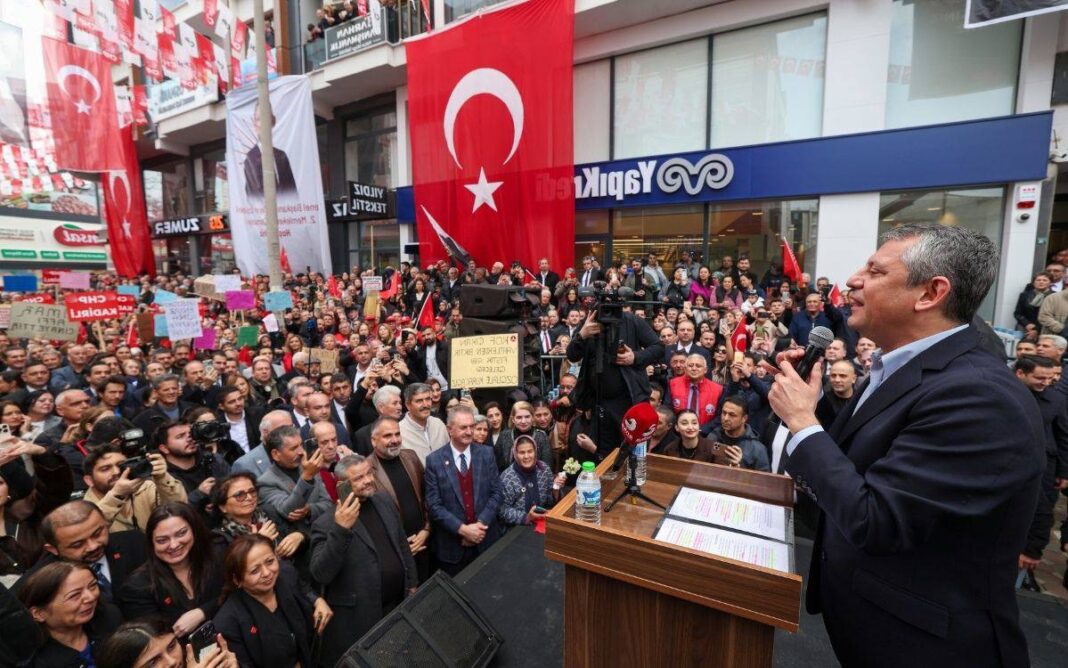

Özgür Özel, Turkey’s main opposition leader, on Monday criticized the government of President Recep Tayyip Erdoğan over what he described as continuing failures in earthquake recovery efforts, saying hundreds of thousands of survivors remain in temporary housing three years after deadly earthquakes struck on February 6, 2023.
Özel, leader of the Republican People’s Party (CHP), on Monday began a week of visits to earthquake-hit provinces, with stops in Osmaniye and Gaziantep ahead of the third anniversary of the quakes, which killed more than 53,000 people in Turkey.
The magnitude 7.8 and 7.5 earthquakes struck 11 provinces in southern and southeastern Turkey on February 6, 2023, killing 53,537 people, injuring more than 107,000 and leaving millions homeless when thousands of buildings collapsed.
Speaking at a public gathering in Osmaniye, Özel said the government had failed to meet its housing pledges for the disaster region, pointing to what he described as significant delays in delivering promised homes.
He recalled that the Turkish government had vowed to build 650,000 housing units within a year, but said only a small fraction had been completed by the first anniversary and about 30 percent by the end of the second year.
“Today marks the end of the third year, and nearly 270,000 of our citizens are still living in container settlements across 11 provinces. This is nothing to boast about. It’s a shameful situation,” Özel said.
More than 39,000 buildings collapsed in the first days after the February 6 earthquakes, and some 518,000 housing units were destroyed or heavily damaged in the 11 provinces. The scale of devastation left more than 2 million people in urgent need of shelter and facing long-term displacement.
Özel also accused the government of being unprepared before the disaster and slow to respond in its immediate aftermath.
“This government did not make the necessary preparations despite having all the resources,” Özel said, also criticizing what he described as delays in deploying state institutions during the first days of the emergency.
Poor construction and failure to enforce building codes even in Turkey’s earthquake-prone areas have been blamed for the extent of the destruction.
Özel also sharply criticized what he described as delays in deploying the military for rescue efforts.
Following the earthquakes, President Erdoğan and his ruling Justice and Development Party (AKP) were accused of poor performance in coordinating search and rescue efforts, mainly failing to mobilize enough people and a lack of coordination among the teams, which resulted in civilians in some regions trying to pull their loved ones from under the rubble themselves and finding them frozen to death although they sustained no critical injuries in the collapse.
Many, including then-CHP leader Kemal Kılıçdaroğlu, said the government failed to mobilize the military in time to take part in the search and rescue efforts in the wake of the quakes.
Özel accused the AKP government of keeping the armed forces in their barracks for three days due to what he called “coup paranoia,” claiming that the delay contributed to further loss of life.
At the time critics widely claimed that Erdoğan was reluctant to mobilize the military out of concern that officers could attempt a coup once deployed.
Later, in Gaziantep’s Nurdağı district, Özel visited a container city and said thousands of people were still living there, calling it evidence that government pledges had not been fulfilled.
The government has said reconstruction is continuing on an unprecedented scale, with officials frequently highlighting the number of new housing units delivered in the disaster region.
According to official data, Turkey’s earthquake housing campaign, carried out under the slogans “Rebuilding the Century,” reached the stage where 455,357 independent units have been completed and were being prepared for delivery to beneficiaries by the end of 2025. The total includes 367,995 housing units, 65,672 village homes and 21,690 workplaces.
Meanwhile, AKP Deputy Chair Hüseyin Yayman acknowledged ongoing problems in Hatay province, including flaws in workmanship and gaps in infrastructure but said the government is working to address them.
The February 6 earthquakes were among the deadliest in Turkey’s modern history, exposing longstanding concerns over building safety, enforcement failures and the government’s disaster preparedness.