

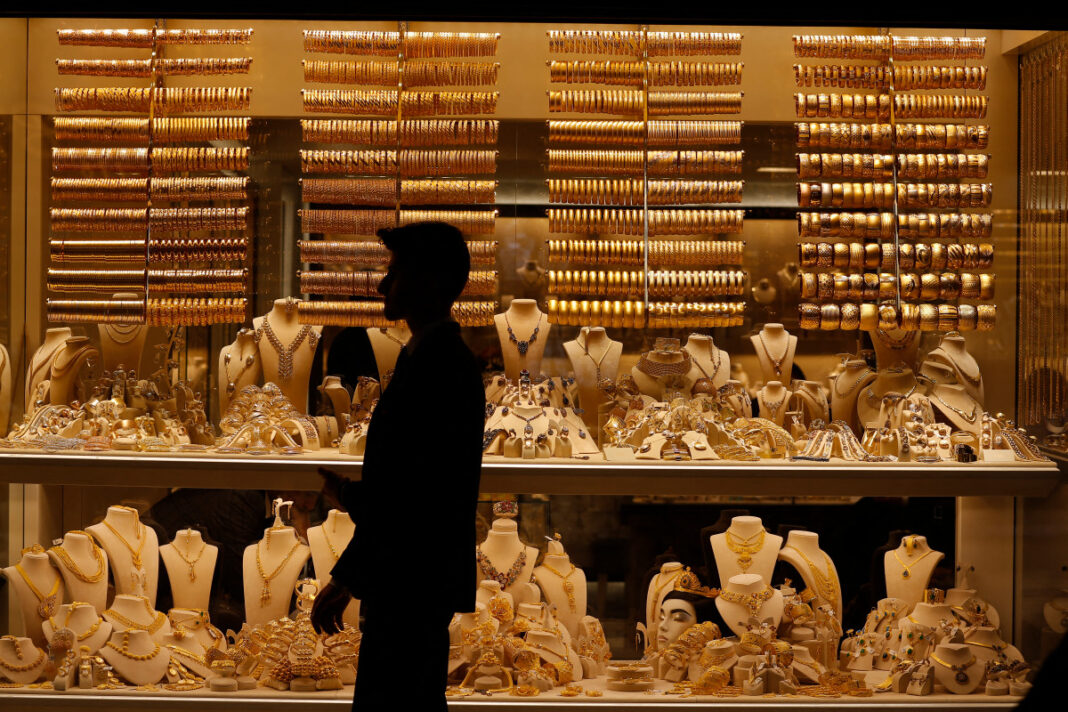

Turkey’s gold and jewelry industry is facing severe losses, with thousands of jobs at risk and hundreds of companies reportedly moving operations abroad, as sector leaders warn that misuse of state incentive programs has pushed the industry to the brink of collapse, according to a report by the Turkish Nefes outlet on Tuesday.
Mustafa Kamar, president of the Jewelry Manufacturers and Exporters Association (TÜİD), said that years of growth have been undone because compliant producers are being punished for the misconduct of companies exploiting government schemes. Addressing Turkish President Recep Tayyip Erdoğan, he said, “Without urgent intervention, we are at a breaking point.”
Kamar told reporters at a press conference in İstanbul’s Kuyumcukent jewelry hub that many workshops now operate only part of each month and that numerous producers have either shut down or relocated abroad, including to China, Dubai and Malaysia.
Industry representatives say the crisis stems from the abuse of two major export-support programs — the Inward Processing Regime (DIR) and a 3 percent currency-conversion bonus.
The DIR allows companies to import raw materials such as gold without customs duties, provided that the finished jewelry is later exported. But according to trade officials, some firms have diverted imported gold to Turkey’s domestic market, gaining unfair profits and undermining exporters that comply with the rules.
The second measure, introduced by the Central Bank of Turkey, grants exporters a 3 percent premium when they convert their foreign earnings into Turkish lira. While intended to strengthen the country’s reserves, the policy has reportedly led to fictitious export records, with newly established firms claiming state bonuses without producing actual goods. Sector observers note a surge in such companies after a 2023 gold-import quota was introduced.
The government’s incentive programs came under additional scrutiny following a criminal investigation into the İstanbul Gold Refinery (İAR).
According to reports by the Kısa Dalga and Halk TV news websites, prosecutors allege that the refinery and affiliated companies conducted fake exports and misused both the DIR and the currency-conversion incentive, mirroring abuses flagged by jewelry manufacturers. The case focuses on whether the companies benefited from tax-free imports and cash bonuses through falsified export paperwork.
Kamar said the industry’s problems are concentrated among a few dominant players. “Look at the top 10 jewelry exporters; only three are genuine exporters,” he said. “The rest are simply moving gold in and out. The whole sector is being sacrificed for these 10 individuals.”
He also warned that the manipulation has distorted domestic prices. One kilogram of gold trades at about $130,000 internationally but around $140,000 in Turkey, he said, discouraging tourists and prompting social media claims that visitors can sell gold in Turkey for a profit.
TÜİD has called on the government to lift the import quota, restore pre-2023 trade rules, introduce a one-time tax amnesty for inventories and impose strict penalties on companies that misuse state incentives. The group also urges a return to inflation accounting based on gold values and tighter oversight of production capacity.