

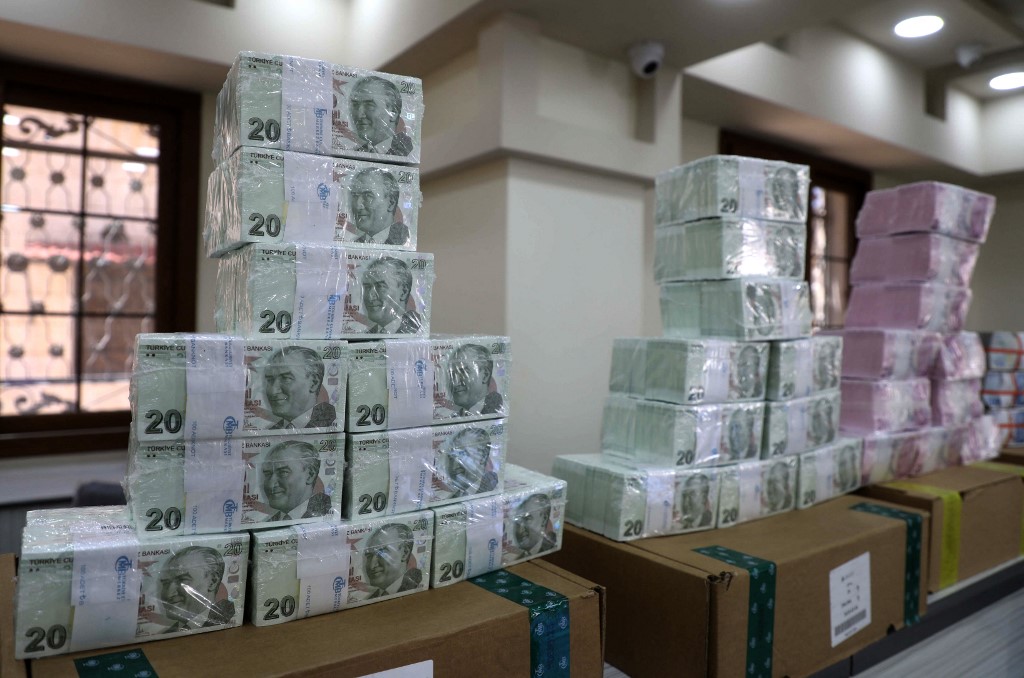
 in the first six months of 2025, marking a sharp increase compared to the same period last year.)
Turkey’s central government budget recorded a deficit of 980.5 billion lira ($24.3 billion) in the first six months of 2025, marking a sharp increase compared to the same period last year, the IHA news agency reported on Tuesday, citing official data.
Big gap between income and spending
Between January and June, the government collected 5.6 trillion lira ($139 billion) in revenue, a 46 percent increase compared to the same period last year. But spending rose almost as fast, up 44 percent, to reach 6.58 trillion lira ($163 billion), leading to a significant budget gap.
In June alone, the government brought in 909.4 billion lira ($22.5 billion) but spent 1.24 trillion lira ($30.8 billion), resulting in a monthly deficit of 330.2 billion lira ($8.3 billion).
Interest payments add to the pressure
One major source of strain on the budget has been interest payments on government debt. In June Turkey paid 275.7 billion lira ($6.8 billion) in interest alone. For the first half of the year, those payments totaled more than 1.1 trillion lira ($27.3 billion), or about 17 percent of all government spending.
Without these interest costs, the budget deficit would have been much smaller, just 54.5 billion lira ($1.3 billion) in June.
Taxes remain the main source of government income. Tax revenues rose by nearly 49 percent year-over-year in the first half of 2025, reaching 4.77 trillion lira ($118 billion). Much of this increase came from higher indirect taxes, such as those on fuel, alcohol and other consumer goods.
Since Finance Minister Mehmet Şimşek took office in June 2023, he has been trying to increase state revenues with new tax measures and savings plans amid a severe economic crisis in the country.
In May 2024 the finance ministry set up a new hotline for informants who report tax evasion.
Inflation and currency decline add to woes
The budget troubles come as Turkish households continue to struggle with rising prices. Official figures show annual inflation hit 35 percent in June, while an independent group of economists known as ENAG put the rate at more than 68 percent.
Meanwhile, the Turkish lira has lost over 75 percent of its value against the US dollar since 2021. It recently fell past 40 lira to the dollar for the first time, making imports more expensive and squeezing consumer purchasing power.
President Recep Tayyip Erdoğan has long opposed high interest rates, once declaring, “As a Muslim, I will do whatever the Islamic rulings require.” Islamic teachings generally discourage interest, viewing it as exploitative.
Despite those pledges, interest payments continue to take up a large share of Turkey’s national budget.
Turkey’s central bank held its key interest rate steady at 46 percent in June.
In April the central bank raised its policy rate to 46 percent from 42.5 percent, reversing an easing cycle that had begun in December following market volatility over the arrest of İstanbul’s opposition mayor, Ekrem İmamoğlu, in March.