

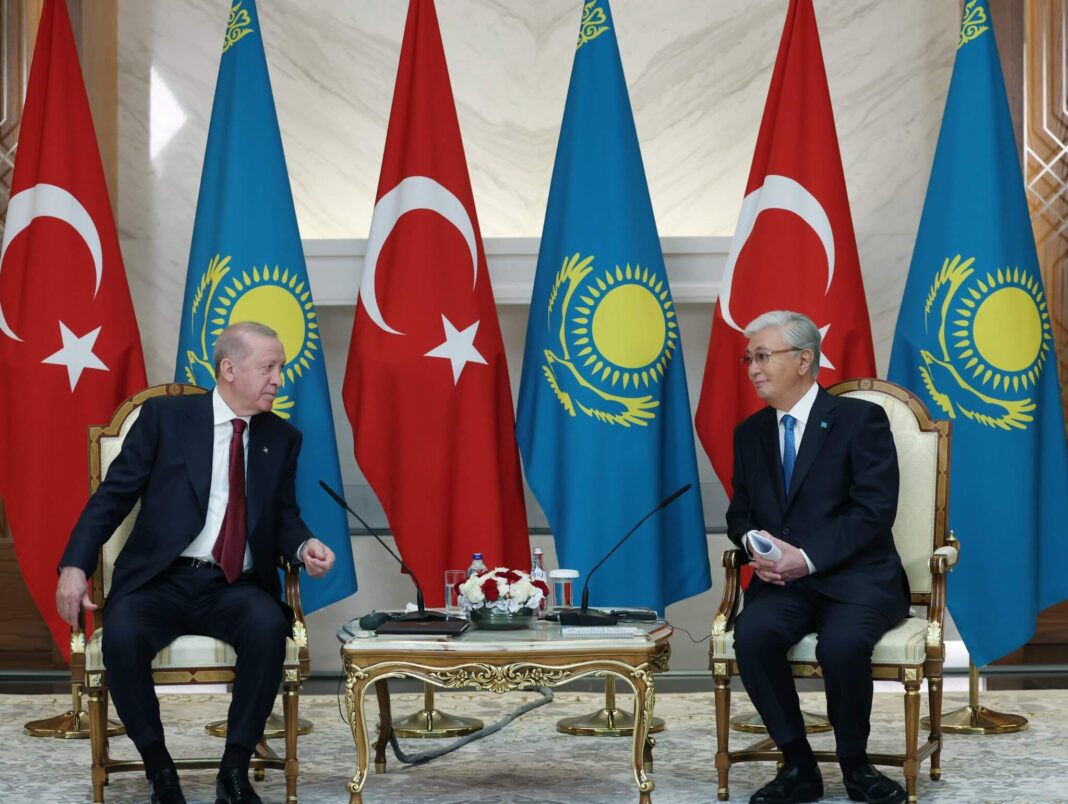

Turkey and Kazakhstan signed a new strategic partnership declaration during President Recep Tayyip Erdoğan’s state visit to Astana on Thursday, setting a target to raise bilateral trade to $15 billion, according to the state-run Anadolu news agency and The Astana Times.
The document, titled the Declaration on Eternal Friendship and Expanded Strategic Partnership, was signed during the sixth meeting of the High-Level Strategic Cooperation Council, co-chaired by Erdoğan and Kazakh President Kassym-Jomart Tokayev.
Yüksek Düzeyli Stratejik İş Birliği Konseyi 6’ncı Toplantısı vesilesiyle Kazakistan’da bulunmaktan büyük memnuniyet duydum. 🇹🇷🇰🇿
Sayın Tokayev ve heyetiyle görüşmelerimizde ticaret, ulaştırma, enerji, sağlık, madencilik, kültür, eğitim, teknoloji ve savunma sanayisi gibi… pic.twitter.com/fqw9OAOeX7
— Recep Tayyip Erdoğan (@RTErdogan) May 14, 2026
Bilateral trade between Turkey and Kazakhstan reached nearly $5.5 billion last year, with both governments aiming to double that figure in the coming years as part of a longer-term goal of reaching $15 billion.
Tokayev said the document “clearly demonstrates the enduring friendship and shared aspirations” of the two countries.
“The talks were productive. We identified new areas that will give fresh momentum to our partnership. We agreed to further deepen political, trade, economic, cultural and humanitarian cooperation,” Tokayev told reporters after talks with Erdoğan.
Erdoğan said implementing a 67-point action plan adopted in Astana would be critical to reaching the new trade target.
The two leaders said cooperation would expand across transport, energy, investment, agriculture, mining, the digital economy and cultural ties.
Turkish companies have invested nearly $6 billion in Kazakhstan over the past two decades, while Kazakh investment in Turkey has reached about $2.5 billion. Nearly 4,000 Turkish-linked companies currently operate in Kazakhstan.
Transport connectivity featured prominently in the talks, with both leaders emphasizing the growing strategic importance of the Trans-Caspian International Transport Route, also known as the Middle Corridor, amid disruptions to traditional trade routes and broader geopolitical uncertainty.
Tokayev said cargo transportation by rail between the two countries had risen by 35 percent this year, while road transportation increased by 5 percent.
“Our countries can be seen as a bridge connecting East and West. We must use these advantages effectively,” Tokayev said.
Erdoğan described the Trans-Caspian corridor as a modern version of the Silk Road and said Turkey, Kazakhstan and their partners viewed the route as more than a cargo transit corridor.
The two countries also agreed to deepen cooperation in the oil and gas sector.
Tokayev welcomed plans by the Turkish Petroleum Corporation to enter the Kazakh market, describing joint energy projects as a priority for bilateral ties.
Erdoğan said Kazakhstan’s growing role in regional connectivity and energy trade had put the country in a strategically important position, adding that Turkey wanted to increase the transportation of Kazakh oil to global markets through its territory.
The relationship between Turkey and Kazakhstan gained new momentum after unrest in Kazakhstan in January 2022, when protests that began over fuel price hikes escalated into deadly violence.
Ankara expressed support for the Tokayev administration, and four major political parties in the Turkish Parliament issued a rare joint statement condemning the violence and emphasizing the importance of Kazakhstan’s stability.
Defense and strategic cooperation between the two countries have since then accelerated, while diplomatic coordination through the Organization of Turkic States has intensified.
Erdoğan and Tokayev were also scheduled to attend an informal summit of the organization in Turkistan following the Astana talks.
Ankara has increasingly promoted the Middle Corridor and the Trans-Caspian route as alternative trade corridors linking Europe and Central Asia.
According to a 2023 World Bank report, freight volumes along the Middle Corridor could triple to 11 million tons by 2030, while travel times along the route could be cut in half.
Regional reports show cargo volumes on the Trans-Caspian route rose from 840,000 tons in 2021 to 4.5 million tons in 2024, with participating countries aiming to exceed 10 million tons by 2030.