


Adem Yavuz Arslan*
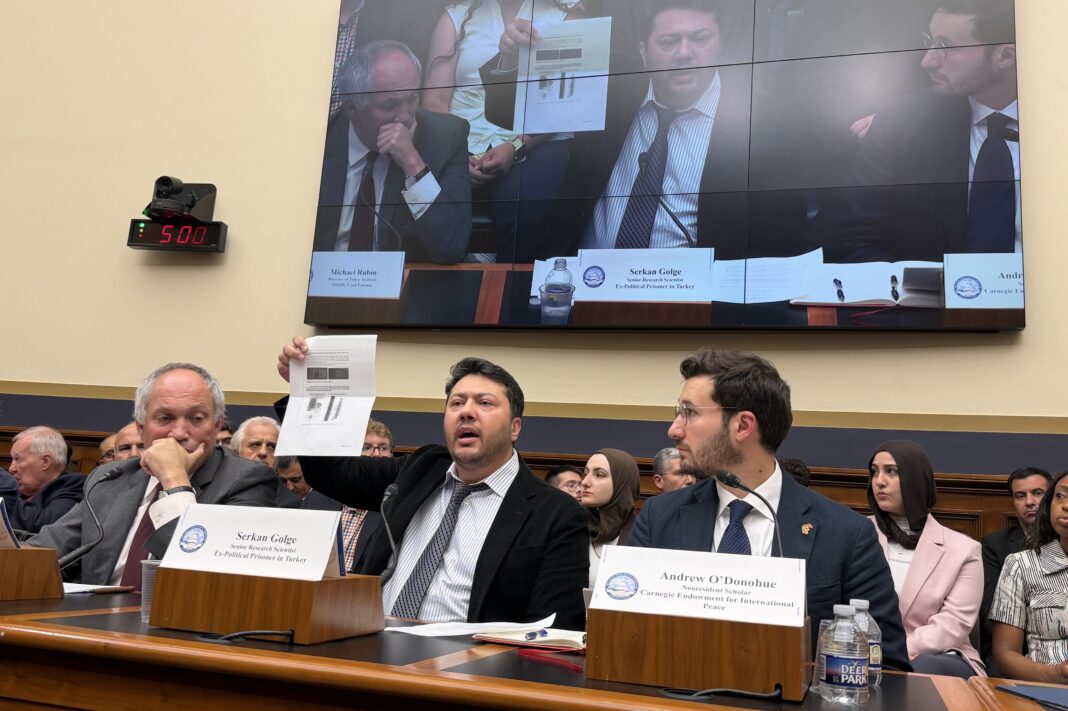
Human rights hearings on Capitol Hill do not directly shape US foreign policy. Yet anyone familiar with Washington knows they often help build the intellectual and political framework for future diplomatic positions, congressional initiatives and policy debates. That is why the Tom Lantos Human Rights Commission’s June 3 hearing, titled “Will Turkey See Freedom Again? Authoritarian Consolidation or Democratic Resilience?” was more than a discussion about recent developments in Turkey. It offered a glimpse into how Washington’s perception of Turkey is evolving.
One of the most striking themes throughout the hearing was that experts no longer view Turkey’s challenges solely through the lens of human rights violations or restrictions on free expression. Increasingly, the discussion has shifted toward what many participants described as a broader regime problem. Andrew O’Donohue of Harvard University and the Carnegie Endowment noted that Turkey has long been categorized in political science literature as a “competitive authoritarian” system, where elections continue to take place but the ruling party enjoys structural advantages. According to O’Donohue, however, recent developments have raised a more fundamental question. The debate is no longer whether elections will be held in Turkey, but whether elections can still lead to a change in power. His assessment was shaped largely by the legal and political pressure surrounding İstanbul Mayor Ekrem İmamoğlu and recent judicial interventions affecting the main opposition Republican People’s Party (CHP).
Michael Rubin of the Middle East Forum directed attention not only toward Ankara but also toward Washington. Rubin argued that successive US administrations and Western governments have failed to respond adequately to Turkey’s democratic backsliding. In his view, this approach contributed to a perception in Ankara that the international costs of repression would remain limited. One of the most controversial sections of Rubin’s testimony concerned the aftermath of a coup attempt on July 15, 2016. Challenging elements of the official narrative, he argued that the government used the events that followed to accelerate Turkey’s transformation into a more authoritarian political system. Rubin also offered a broader critique of Western policy, saying that “Turkey’s democracy and human rights crisis is not only Turkey’s failure; it is also a failure of the West.”
Perhaps the most compelling testimony came from former political prisoner and NASA researcher Serkan Gölge. Recounting his personal experience after the failed coup, Gölge described how legal processes were used against him and how ordinary aspects of his life were later presented as evidence of criminal activity. His testimony gave a human face to a concern frequently raised by international observers in recent years: the erosion of the rule of law in Turkey. More than a personal account, Gölge’s statement became part of the official congressional record, documenting what many human rights advocates view as systemic problems within Turkey’s judicial system.
Turkey expert Henri Barkey argued that the Erdoğan government has moved beyond the traditional model of electoral authoritarianism. According to Barkey, the imprisonment of İmamoğlu, judicial pressure on the CHP, the appointment of government trustees to elected municipalities and the refusal to implement rulings of the European Court of Human Rights should not be viewed as isolated incidents. Rather, they represent elements of a broader transformation in which state institutions are increasingly used to shape political competition. One of Barkey’s most notable observations was that “the opposition in Turkey has not been eliminated, but it has been criminalized.”
From Washington’s perspective, perhaps the most significant outcome of the hearing was the shift in language used by experts. A few years ago, discussions about Turkey centered primarily on “democratic backsliding.” Today, terms such as “authoritarian consolidation” and even “transition toward full authoritarianism” are becoming more common in congressional circles. This shift may not produce immediate policy consequences. Yet in Washington, ideas often precede policy. Concepts discussed in hearings frequently find their way into reports, official assessments and, eventually, government policy.
The broader message emerging from the hearing was clear: Turkey’s human rights record, political prisoners and rule-of-law concerns have not disappeared from Washington’s agenda. On the contrary, a growing number of policymakers and analysts now view Turkey not simply as a country facing human rights challenges but as one confronting deeper questions about the future viability of its democratic system. For that reason alone, the June 3 hearing may prove more significant than it initially appeared.
*Adem Yavuz Arslan is a journalist with over two decades of experience in political reporting, investigative journalism and international conflict coverage. His work has focused on Turkey’s political landscape, including detailed reporting on the 2016 coup attempt and its aftermath, as well as broader issues related to media freedom and human rights. He has reported from conflict zones such as Bosnia, Kosovo and Iraq, and has conducted in-depth research on high-profile cases, including the assassination of Turkish-Armenian journalist Hrant Dink. Arslan is the author of four books and has received journalism awards for his investigative work. Currently living in exile in Washington, D.C., he continues his journalism through digital media platforms, including his YouTube channel, Turkish Minute, TR724 and X.
Disclaimer: The views expressed in this opinion piece are those of the author and do not necessarily reflect the editorial stance of Turkish Minute.