

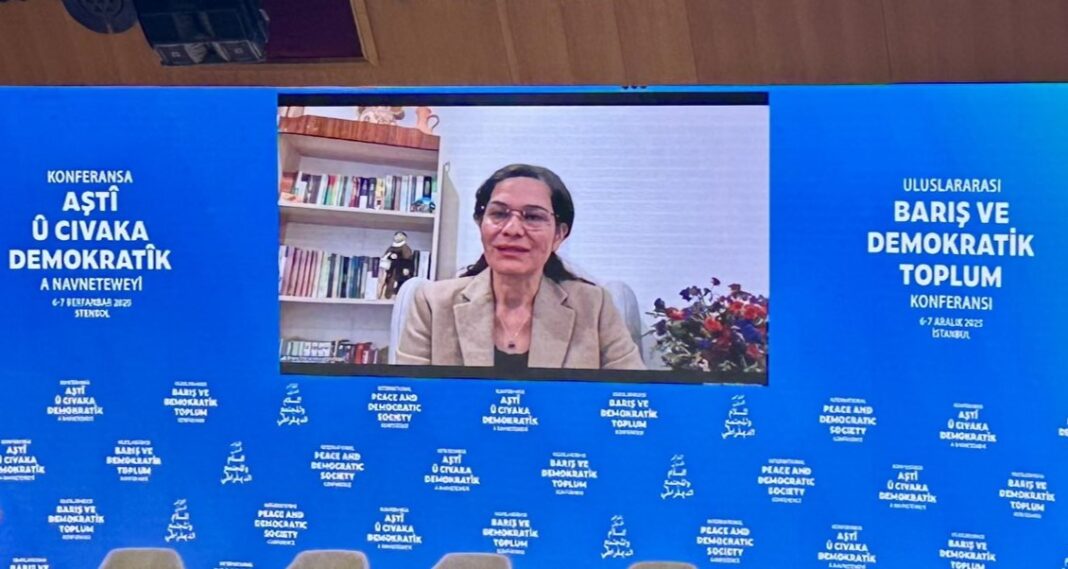

A senior Syrian Kurdish political leader addressed a peace conference in İstanbul by video on Saturday after the Turkish government denied permission for her to enter the country, in a test of a fragile new push to end conflict between Ankara and Kurdish militants.
İlham Ahmed, co-chair of the foreign relations department of the Autonomous Administration of North and East Syria, gave the opening speech at the “International Peace and Democratic Society Conference,” organized by Turkey’s main pro-Kurdish party, from northern Syria instead of taking the stage in person at a venue in the Bakırköy district of İstanbul.
Our Co-Chairs spoke at the opening of the International Peace and Democratic Society Conference
The two-day conference, which began today, opened with speeches by Hatimoğulları and Bakırhan:https://t.co/mzIC4KKQ5f
— DEM Party English (@DemPartyEnglish) December 6, 2025
The two-day conference, held at the Cem Karaca Conference Hall, is built around a February statement by jailed Kurdistan Workers Party (PKK) founder Abdullah Öcalan in which he called for a “peace and democratic society” process and for the PKK to lay down arms and disband.
The PKK is a Kurdish militant group that has fought the Turkish state since 1984 and is designated as a terrorist organization by Turkey and its Western allies.
In her remarks Ahmed thanked Öcalan for his role in past talks between the Turkish state and the Kurdish movement, saying those contacts had started “thanks to Abdullah Öcalan.” She said a just peace in Syria would directly shape Turkey’s own future and urged Ankara to reopen border crossings with the Kurdish-led region across the frontier.
“We are going through a new phase in Syria after the Baath regime,” Ahmed said. “We are trying to build a democratic administration. We need dialogue. We want to be in dialogue with Turkey. We want our borders to open. We want the peace process in Turkey to reach its end.”
Ilham Ahmad at the International Peace and Democratic Society Conference in Istanbul :
We want to build a free SyriaWe need to have the dialogue
Peace inside Syria means peace in Turkey
Without Kurds Syria won’t be free
The Turkish gov is able to support the peace pic.twitter.com/pouTg8Tyep
— Mustafa Al-Ali (@Mustafa_Alali2) December 6, 2025
Ahmed described a social contract in northeast Syria that she said guarantees rights for Kurds, Arabs, Turkmens, Armenians and other groups and sets out equality between men and women. She argued that the relative lack of destruction in the mainly Kurdish region of Rojava, compared with other front lines in the Syrian civil war, came from this system and from joint self-defense against attacks.
“We believe in communal life,” she said. “We are not for the breakup of countries, neither in Syria nor elsewhere. We try to live together with Turkmens, Arabs, Kurds. We want to continue this.”
Ahmed also appealed directly to Turkish public opinion, saying Kurdish and Turkish “mothers” had suffered together and calling for an end to bloodshed. “We want to see ourselves in Turkey and Turkey here,” she said, adding that regional and international actors, including the United States, should support a meaningful peace so that “mothers will not cry and blood will not be shed again.”
Her online appearance followed days of debate over whether she would be allowed to travel to İstanbul for the event. Pro-Kurdish he Peoples’ Equality and Democracy Party (DEM Party) Co-chair Tuncer Bakırhan had publicly invited Ahmed to Turkey and urged the government to “take the hand of friendship” extended from northeast Syria, while the DEM Party’s parliamentary group chair, Ayşegül Doğan, said any “legal obstacle” to her visit was political in nature and called for both Ahmed and Syrian Democratic Forces (SDF) commander Mazlum Abdi to attend.
The SDF is the multiethnic force that led ground operations against the Islamic State in Syria in partnership with the United States. It grew out of the People’s Protection Units (YPG), which Turkey sees as the Syrian branch of the PKK.
Ankara’s sensitivity toward Ahmed stems from that connection. Turkish officials view the Autonomous Administration as a PKK-linked entity on Syrian soil and see its foreign representatives as part of the same security file as the SDF and YPG. Turkey has carried out several military operations in northern Syria and says its aim is to push Kurdish fighters away from the border and to protect Syria’s territorial integrity.
Turkey’s ruling Justice and Development Party (AKP) spokesperson Ömer Çelik rejected DEM Party’s call earlier in the week, saying the issue was not about individuals but about ending “terrorist activities.” Referring to Ahmed, he said she is “someone who says ‘we cannot lay down arms’” and claimed that the official title she uses runs against Syria’s territorial integrity. “Let them give up terrorism, then let them come,” he said.
Cengiz Çandar, a DEM Party lawmaker from Diyarbakır and a veteran columnist who spoke at the conference, told Kurdish media that Ahmed’s physical presence in İstanbul required bureaucratic permission that did not come. He said the refusal, which he linked to the current government’s hesitation over how to deal with the SDF, showed that “the government is not yet ready” to take that step.
Çandar argued that if Ahmed had been allowed to travel, it would have signaled that Ankara was ready to move toward some form of engagement with the Kurdish-led administration across the border. Her ability to join by teleconference, he added, still created the sense that “in the near future” both Ahmed and Abdi could come to Turkey if the PKK talks succeed.