

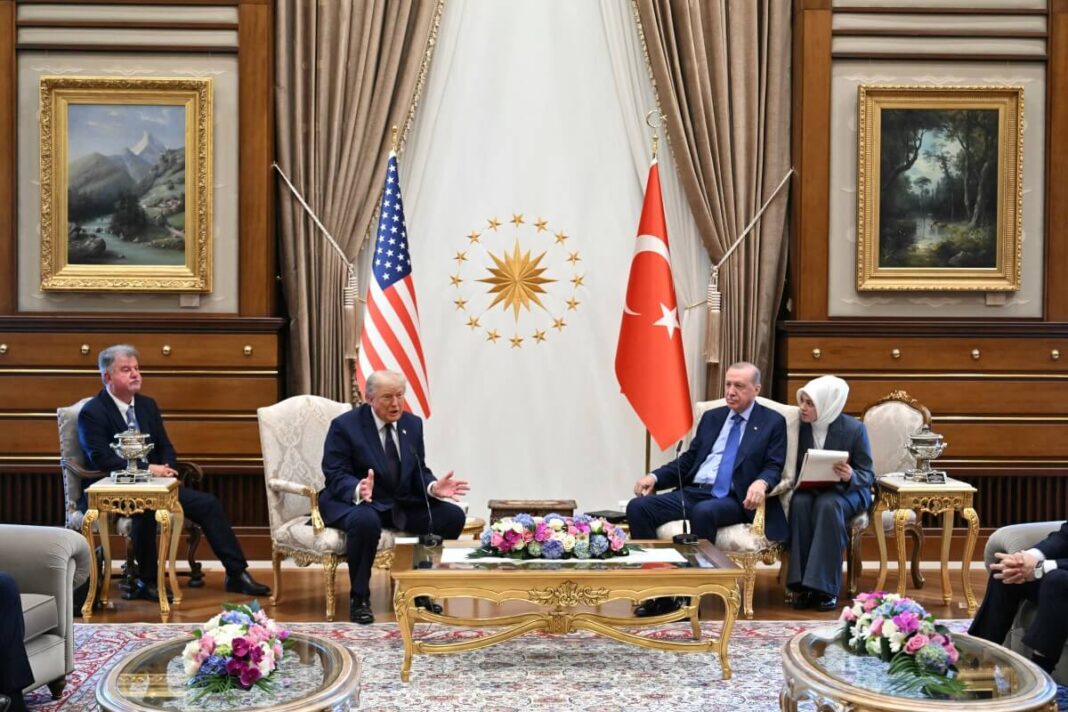

US President Donald Trump’s pledge to lift sanctions on Turkey and consider allowing Ankara back into the F-35 Joint Strike fighter program has attracted opposition from Israel, Greece, former US vice president Mike Pence and members of Congress, but key senators from both parties signaled that Turkey’s return may be possible if Washington’s security concerns over Ankara’s Russian S-400 missile system are resolved.
Trump made the remarks Tuesday during his meeting with Turkish President Recep Tayyip Erdoğan at the Beştepe Presidential Palace in Ankara on the first day of a NATO summit hosted by Turkey.
“We’re going to be taking the sanctions off,” Trump told reporters when asked about measures imposed on Turkey under the Countering America’s Adversaries Through Sanctions Act (CAATSA).
Asked about the F-35s, Trump said it was a decision he would make.
“It’s certainly something we would consider,” Trump said while seated alongside Erdoğan.
S-400 remains the legal hurdle
Turkey, a NATO member with the alliance’s second largest army, was removed from the F-35 program in 2019 after taking delivery of the S-400 air defense system from Russia.
Washington said at the time that Turkey could not have both the Russian system and the US-built stealth fighter because the S-400 could expose sensitive information about the F-35’s capabilities to Moscow.
The United States imposed CAATSA sanctions on Turkey’s Presidency of Defense Industry in 2020, targeting the country’s defense procurement agency over the S-400 purchase.
The dispute became one of the main sources of strain in US-Turkish relations.
Trump’s comments in Ankara marked the clearest US signal in years that Washington may be ready to reopen the issue, but the sale still faces legal, security and political barriers in Congress.
The 2020 National Defense Authorization Act bars the United States from transferring F-35 aircraft to Turkey unless Ankara no longer possesses the S-400 system and the administration certifies that to Congress.
That requirement has turned the focus from Trump’s political willingness to the question of what would count as a credible solution to the S-400 problem.
Senators signal conditional support
Several senators visiting Ankara for the NATO summit said Wednesday morning at a press conference on the sidelines of the summit that they could support Turkey’s return to the F-35 program if the threat posed by the S-400 is addressed in a way that satisfies the United States and its allies.
Sen. Jeanne Shaheen, a Democrat from New Hampshire and the ranking member of the Senate Foreign Relations Committee, said at the press conference that there could be a path back for Turkey if there is an acceptable way to deal with the S-400 and the risk it poses to the F-35.
Shaheen noted that she and Republican Sen. Thom Tillis wrote the legislation that removed Turkey from the F-35 program because of the S-400 acquisition.
“If there is an acceptable way to deal with the S-400 and the threat that that poses to the technology and the F-35 and there is satisfactory agreement on the part of all parties about that, then I think having Türkiye back in the F-35 program would be a positive development, both for Türkiye and for the United States,” Shaheen said.
Shaheen added that lawmakers still had questions about what was being proposed.
Sen. Mike Rounds, a South Dakota Republican, also voiced support for finding a solution during the same press conference, saying Turkey is a major NATO contributor and that strengthening it against Russian pressure in Europe would benefit the alliance.
Rounds said the F-35 was one of the tools that could help Turkey serve that role.
Rep. Mike Turner, a Republican from Ohio and former chairman of the House Intelligence Committee, said during the same press conference that the details shared with lawmakers on the F-35 and S-400 issues appeared promising.
Sen. Chris Coons, a Democrat representing Delaware, sounded a more cautious note at the press conference.
Coons said security concerns would continue even if the S-400 were deployed somewhere else because lawmakers would still need to be assured that F-35 technology could not be misappropriated or transferred to Russia.
House lawmakers press to block sale
Some lawmakers are treating the issue as a question of whether Turkey can meet security conditions, while others are urging Congress to block any attempt to restore Ankara’s access to the aircraft.
In written comments to Jewish Insider published Wednesday, Rep. Mike Lawler, a New York Republican, said selling F-35s to Turkey was not in the US interest and would risk sensitive technology while Erdoğan continues to operate the S-400.
In written comments to the same outlet, Rep. Brad Sherman, a Democrat from California, said lifting CAATSA sanctions or reopening the possibility of F-35 sales would be a mistake and would reward Erdoğan’s conduct toward Israel and his rule at home.
Sherman said Turkey should not be considered for readmission to the F-35 program until it permanently disposes of the S-400 system.
In a statement to Jewish Insider published Wednesday, Democratic Rep. Brad Schneider from Illinois said Turkey remains in violation of CAATSA as long as it has the S-400 and that the sale should not proceed.
Rep. Nicole Malliotakis, a Republican from New York, also urged the administration not to move forward with any F-35 sale to Turkey in a statement to Jewish Insider published Wednesday, citing Ankara’s ties with Russia and Iran, its support for Hamas, its posture toward Greece and Cyprus and its treatment of political opponents and journalists.
New York Democratic Representative George Latimer told Jewish Insider that Congress should be ready to issue a joint resolution of disapproval if Trump moves to return Turkey to the F-35 program.
Lawler and Sherman had also led a bipartisan letter sent to Trump on July 2 urging him to maintain the prohibition on F-35 sales to Turkey.
The letter, released by Lawler’s Washington office, said Erdoğan’s conduct toward US allies and Turkey’s relations with American adversaries made the sale contrary to US national security interests.
A separate group of 18 House Democrats led by Rep. Dina Titus of Nevada sent a letter Monday to House Majority Leader Steve Scalise and House Minority Leader Hakeem Jeffries, urging them to be ready to block any effort to allow Turkey back into the program.
The lawmakers said the administration is required to keep CAATSA sanctions in place until Turkey disposes of the S-400.
They also warned that a reversal would send the wrong message to US partners in the Eastern Mediterranean, citing Greece, Cyprus, Armenia and Israel.
Pallone, Pence criticize Trump’s opening
Rep. Frank Pallone, a New Jersey Democrat and one of the signatories of the Titus letter, also criticized Trump in a Tuesday post on X after the president’s meeting with Erdoğan in Ankara.
It's an upside-down world at this week's NATO summit: Trump is berating our democratic, European allies while praising the authoritarian Erdogan. Under no circumstances should we be sending more weapons to a country that warms to our adversaries and betrays our allies. https://t.co/1EcKtP0Xym
— Rep. Frank Pallone (@FrankPallone) July 7, 2026
Pallone wrote that Trump was praising the “authoritarian Erdogan” while criticizing democratic European allies.
Pallone said the United States should not send more weapons to a country that, in his words, warms to US adversaries and betrays US allies.
Lifting U.S. sanctions imposed after Turkey acquired the Russian S-400 missile system in 2017 and clearing the way to provide Turkey F-35 fighter jets would be a strategic mistake, undermining the security of the United States, Israel and NATO. Mr. President, Please Don’t.🇺🇸…
— Mike Pence (@Mike_Pence) July 7, 2026
Pence also urged Trump not to lift sanctions or clear the way for F-35s in a Tuesday post on X after sharing a Fox News report about Trump’s position.
The former vice president wrote that doing so would be a strategic mistake that would undermine the security of the United States, Israel and NATO.
Israel warns of regional imbalance
The possible sale has also angered Israel, whose officials have long sought to preserve the country’s military edge in the Middle East.
Israeli Prime Minister Benjamin Netanyahu voiced his objection Tuesday during an interview with CNN anchor Dana Bash on “Inside Politics,” which aired after Trump’s remarks alongside Erdoğan in Ankara.
Netanyahu said he had raised the issue with Trump several times.
He said giving F-35s to Turkey would “destroy the power balance” in the Middle East because Turkey has aggressive aspirations.
Hegseth cancels Netanyahu meeting
US Defense Secretary Pete Hegseth canceled a meeting scheduled for Wednesday with Israeli Prime Minister Benjamin Netanyahu to discuss the possible sale of F-35 fighter jets to Turkey, Reuters cited an Israeli source as saying.
The source, who spoke on condition of anonymity due to the sensitivity of the matter, said Hegseth had also been scheduled to meet with Israeli Defense Minister Israel Katz during a trip to Israel and that Iran was expected to feature in the discussions.
Trump said Wednesday that the memorandum of understanding signed to end the conflict the United States and Israel launched against Iran was “over” and that he did not want to engage with Tehran.
Greece raises Aegean concerns
Greece also signaled concern over the possible sale.
Greek Prime Minister Kyriakos Mitsotakis avoided a direct answer Wednesday when asked about the possible F-35 sale as he arrived at the NATO summit in Ankara but said alliance decisions should take into account the sensitivities of all allies.
🇬🇷 Greek Prime Minister, responding at the NATO summit to a question on the possible arming of Turkey with F-35 fighter jets:
“An alliance needs to be based on the fundamental principle of good neighbourly relations. At a time when my country is still faced with an open threat… pic.twitter.com/I5qytKQuOj
— Ictinus ®️ (@ictinus_x) July 8, 2026
Mitsotakis said Greece still faces an open threat of war from Turkey if it exercises what Athens considers its legal right to expand its territorial waters.
Turkey has long opposed a Greek expansion of territorial waters in the Aegean Sea to 12 nautical miles, a move Ankara has warned it would consider a cause for war.
Turkey seeks an end to defense restrictions
Erdoğan has used the NATO summit to call on allies to lift defense industry restrictions on Turkey, arguing that such measures damage alliance unity at a time when NATO is trying to expand its defense capacity.
Turkey was originally a partner in the F-35 program and produced parts for the aircraft before its removal.
Ankara had also paid about $1.4 billion for F-35s before Washington blocked delivery of the jets.
Congress holds the key
The issue now gives Trump a chance to reset defense ties with Erdoğan, but the path remains uncertain.
The president can signal support for lifting sanctions and restarting talks, but Congress retains power over arms sales and can seek to block transfers through a resolution of disapproval.