

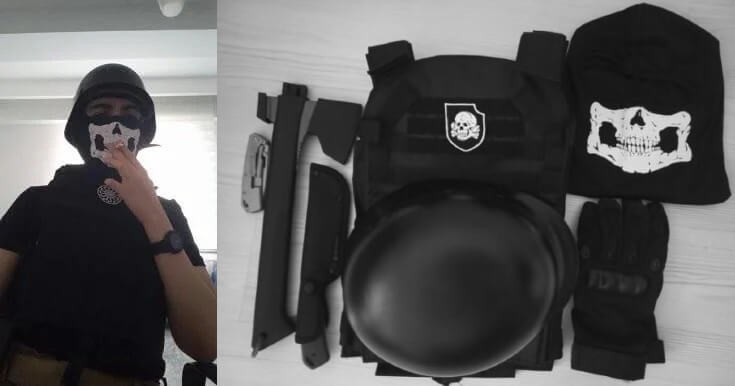

A US terrorism case has tied a 2024 stabbing attack in Turkey’s central Eskişehir province to the Terrorgram Collective, a white supremacist, extremist network that US authorities say encouraged violence across several countries, while Turkish investigators found no evidence linking the attacker to a terrorist organization, the Evrensel daily reported.
The case has attracted renewed attention to the attack carried out by 18-year-old Arda Küçükyetim, who stabbed five people near a mosque in Eskişehir’s Tepebaşı district on August 12, 2024, while livestreaming the assault online.
Turkish media at the time reported the incident as Turkey’s first neo-Nazi-inspired attack, with the perpetrator dressed in military-style gear, including a helmet, bulletproof vest and goggles.
A Turkish court later sentenced him to 75 years in prison.
The US Department of Justice in September 2024 charged Dallas Humber and Matthew Allison, whom prosecutors described as leaders of the Terrorgram Collective, in a 15-count indictment accusing them of soliciting hate crimes, soliciting the murder of federal officials and conspiring to provide material support to terrorists.
Humber later pleaded guilty and was sentenced in December 2025 to 30 years in prison.
According to the Justice Department, she served as a leader of Terrorgram, which it described as a white supremacist, transnational terrorist group that operated through Telegram channels, group chats and digital publications.
US authorities say Terrorgram promoted “accelerationist” violence, a belief that violent attacks can hasten the collapse of governments and societies and lead to the creation of a white ethnostate.
According to the US case, Terrorgram members provided technical, inspirational and operational guidance to people who carried out or plotted attacks in several countries.
The Justice Department cited the Eskişehir stabbing among acts of violence it said were linked to people inspired or guided by Humber and the Terrorgram Collective.
The indictment said Küçükyetim shared or referred to Terrorgram publications before the attack, including materials glorifying previous attackers and encouraging imitation.
The indictment also said Küçükyetim posted a message in a Telegram group before the attack, writing, “Come and see how many people I can clean up,” before sharing a link to the livestream.
“He was 100 percent our guy … we’re still celebrating his attack,” Humber allegedly said in a group chat, according to the indictment.
Prosecutors also said an individual who described himself as a friend of the attacker later broadcast the livestream on X using the account “@HolyTerrorist1,” sharing links to the attack video and related manifesto materials.
According to the indictment, Küçükyetim expressed a desire in his manifesto to be recognized as part of the group’s so-called “Saint” network, a label used in Terrorgram publications to glorify attackers and encourage imitation.
Prosecutors also cited messages in which Humber allegedly praised the Eskişehir attack afterward.
Turkish prosecutors reached a different conclusion.
An indictment prepared by the Eskişehir Chief Public Prosecutor’s Office included statements from Küçükyetim describing contacts with an online acquaintance who discussed carrying out a school attack and encouraged him to obtain weapons or make explosives.
Küçükyetim told prosecutors that he had researched bomb-making materials online and at one point considered carrying out a bombing but abandoned the idea because he could not obtain the necessary materials and believed making explosives at home would be dangerous.
Despite those statements, a report prepared by the counterterrorism department of Turkey’s Security Directorate General found no evidence linking him to a terrorist organization.
Turkish prosecutors therefore treated the attack as a non-terrorism case, charging him with attempted premeditated murder and threatening the public.
The case was also mentioned in the European Union Agency for Law Enforcement Cooperation’s 2025 European Union Terrorism Situation and Trend Report (EU TE-SAT). The report did not analyze the Turkish investigation in detail but said the Eskişehir mosque stabbing was among violent incidents in 2024 that drew the attention of online violent extremists and fueled calls for further action.
Füsun Sarp Nebil, an expert on information and communications systems, said the case shows how online radicalization is testing older definitions of terrorism.
“Today, an attacker can become radicalized through digital propaganda, online communities, manifestos and content glorifying violence without ever meeting a member of an organization in person,” Nebil told Turkish media.
She said platforms such as Telegram and Discord allow extremist networks to reach young people across borders and turn local acts of violence into global propaganda events.
“For that reason, viewing such incidents solely as individual violence or imitation behavior risks overlooking the international dimension of digital radicalization,” she said.
The US State Department in January 2025 designated the Terrorgram Collective and three of its leaders as Specially Designated Global Terrorists, describing the group as a transnational extremist network that promotes white supremacist violence and encourages attacks on perceived enemies, government officials and critical infrastructure.