

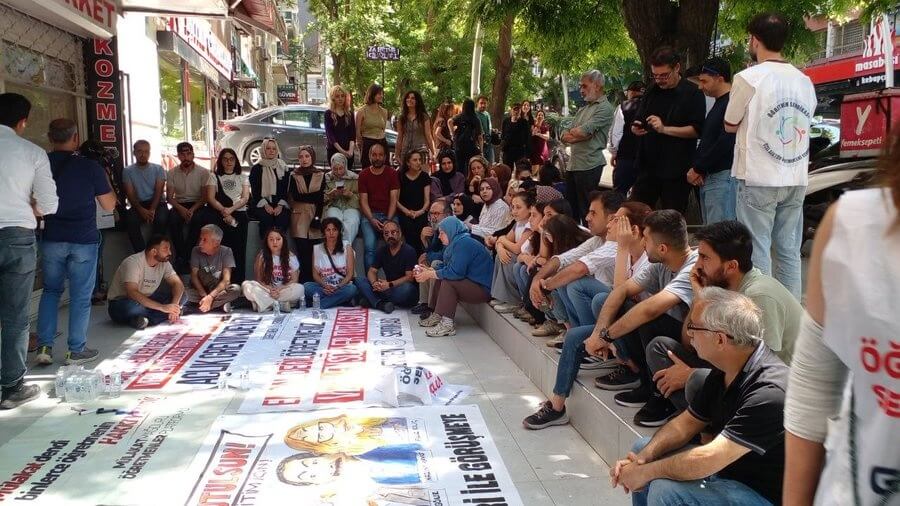

Private school teachers and teacher candidates seeking public school jobs began a hunger strike in Ankara on Monday after police broke up two protests, the T24 news website reported.
The protest brought together two groups with separate grievances. Private school teachers are demanding better pay, job security and a base salary, while teacher candidates say they were unfairly denied public school appointments after oral interviews used in the hiring process.
The Private Sector Teachers’ Union and a platform representing teacher candidates affected by the interview system said they would continue the hunger strike until officials address their demands and keep promises made to teachers.
The Private Sector Teachers Union and the Platform of Teachers Affected by Oral Examinations said they would continue the hunger strike until officials address their demands and keep promises made to teachers.
On Sunday teachers gathered outside the Education Ministry in Ankara and attempted to march to parliament to make a statement to the press.
Police blocked the march and detained 41 people, including union chair Eren Edebali, with the union accusing officers of using force. Injuries were also reported.
The detainees were later released, according to local media reports.
Police intervened again on Monday when the Platform of Teachers Affected by Oral Examinations and the Private Sector Teachers Union tried to issue a press statement at Kurtuluş Park in Ankara.
The union said police used pepper spray and detained three people, including Edebali and Kemal Irmak, chair of the Education and Science Workers Union.
After the police interventions, the Private Sector Teachers Union and the platform representing teacher candidates affected by the interview system announced that they had started a hunger strike.
“We will go hungry until the promises made to us are kept,” the union said in a statement.
“Our struggle in Ankara is not a one-day reaction. It is a determined resistance that we will continue until we win our rights.”
📢Ankara'da öğretmenlerin eylemi sürüyor
🟥Mülakat Mağduru Öğretmenler Platformu ve Özel Sektör Öğretmenleri Sendikası çatısı altında toplanan öğretmenler, Ankara’da yaptıkları eylemin 3’üncü, açlık grevinin ise ikinci gününde sendika genel merkezinin önünde toplandı.
🟥Sendika… pic.twitter.com/2FuWayPM4C— Cumhuriyet (@cumhuriyetgzt1) June 16, 2026
Their demands include secure employment, a base salary for private school teachers and additional appointment quotas for candidates who say they lost public school jobs because of oral exam scores.
The dispute over oral examinations concerns teacher candidates who say they received high scores in the Public Personnel Selection Exam (KPSS), the written exam used for public sector recruitment, but were left out of appointment lists after lower scores in oral interviews.
Turkey introduced oral examinations for public school teacher recruitment through a state of emergency decree in July 2016, shortly after a failed coup.
The rule allowed the Education Ministry to rank contract teacher candidates based on oral exams among applicants called according to their KPSS scores.
Critics say the interview system has allowed the government to favor politically loyal candidates and exclude others despite their written exam scores.
The issue returned to the political agenda during the 2023 presidential election campaign, when opposition leader Kemal Kılıçdaroğlu promised to abolish interviews in public hiring. President Recep Tayyip Erdoğan later made a similar pledge.
The practice continued after the election.
In September 2023 Education Minister Yusuf Tekin said the ministry would conduct interviews “like real interviews,” alarming many teachers waiting for appointment.
In May 2024 the government announced 20,000 teacher appointments. A regulation published the same month made KPSS scores and oral exam scores each worth 50 percent of candidates’ final placement score.
Teacher groups and education unions challenged the regulation at the Council of State, Turkey’s top administrative court.
The court rejected a request to suspend the regulation, while a final ruling has not yet been issued.
The oral exams for the 20,000 appointments were held between July 2 and August 10 in 20 provinces by 245 commissions.
After the results were announced, candidates said the commissions had failed to apply the same standard.
They said some commissions gave candidates several points above their KPSS scores, while others gave scores close to the written exam results.
Teachers affected by the process say even a tiny difference in final scores can change the ranking of hundreds of candidates and that extra points given in some interviews reshaped the appointment lists.
They are demanding additional appointment quotas for candidates who say they lost their place because of the oral exams. They also want appointments to be based on KPSS rankings.
Private sector teachers have long campaigned for a base salary, job security and better working conditions, saying they face low wages and short-term contracts in private schools.
The union has called for legal changes to improve conditions for education workers and protect the teaching profession.