

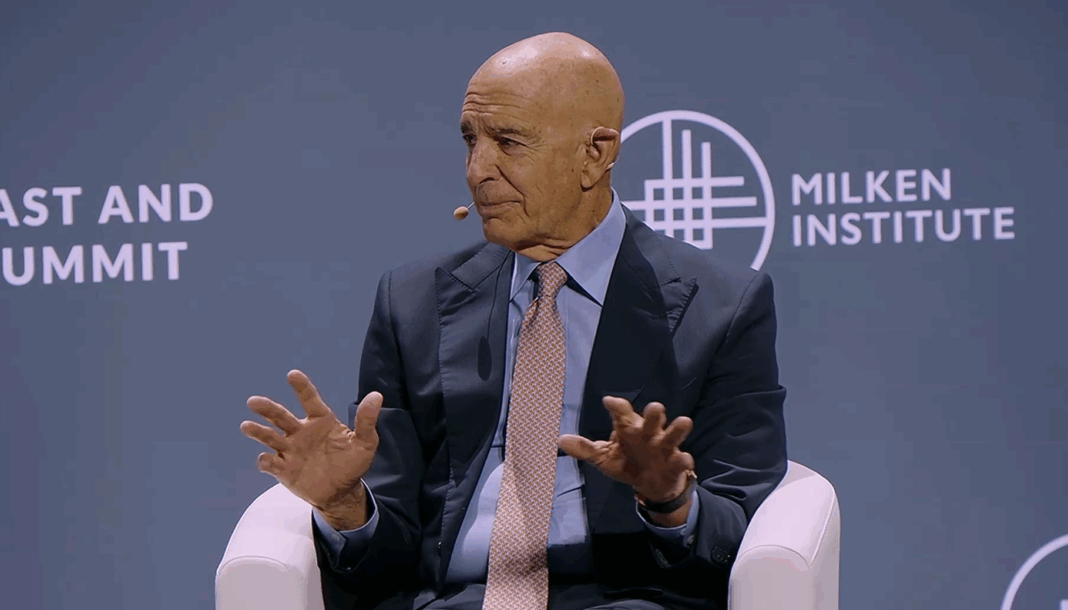

US Ambassador to Turkey Tom Barrack drew criticism from Turkish opposition figures and former officials after saying Washington needed a single point of contact and leverage to balance Turkey, Syria and Iraq, language critics said treated Turkey as part of a US-managed regional design rather than as a sovereign republic.
In the tradition of those who have long studied the Levant and Anatolia — Iraq, Syria, and Turkey remain the strategic fulcrum upon which any enduring Middle East stability must pivot. Balancing these three nations requires a single, consistent point of American contact and…
— Ambassador Tom Barrack (@USAMBTurkiye) June 1, 2026
Barrack, who was recently appointed as President Donald Trump’s special presidential envoy to Syria and Iraq, wrote on X that “Iraq, Syria and Turkey remain the strategic fulcrum upon which any enduring Middle East stability must pivot.”
“Balancing these three nations requires a single, consistent point of American contact and leverage, transcending tribal, religious or sectarian differences,” Barrack said, adding that the mission embraced by Trump sought to align the region toward “order and mutual interest.”
The post triggered a backlash in Turkey, where critics accused Barrack of putting Turkey in the same political category as Syria and Iraq and of using language that suggested US influence over the region’s internal order.
Namık Tan, an İstanbul lawmaker from the main opposition Republican People’s Party (CHP) and a former Turkish ambassador to Washington, said Barrack should understand the country where he serves.
“I would like to remind the ambassador that the citizens of the Republic of Turkey have a deep commitment to protecting their country’s national sovereignty,” Tan said.
Tan said concepts such as national sovereignty, the nation-state and the founding principles of a secular republic might not have been appreciated by Barrack.
“This country’s borders are not the product of an arbitrary imagination or a political fantasy,” Tan said. “These borders were drawn with the blood of countless martyrs and great sacrifices.”
İlhan Uzgel, a CHP figure specializing in foreign policy, also criticized Barrack, asking what he meant by balancing Turkey with its two neighbors.
“Mr. Ambassador, you have equated Turkey with Syria, where you put a leader in power by putting a suit on him, and Iraq, where you interfere in who will become prime minister,” Uzgel said.
Uzgel said the region did not need US help and accused Barrack of taking courage not only from Trump but also from those in Turkey who seek legitimacy from Washington.
“You get your power from the silence of the government,” Uzgel said. “The fate of this region will be determined by the people who live in this region.”
Emin Şirin, a former lawmaker from President Recep Tayyip Erdoğan’s ruling Justice and Development Party (AKP), said Barrack’s framing risked pulling Turkey away from its European perspective and putting it inside Middle Eastern crisis politics.
“Turkey is not just any Middle Eastern country,” Şirin said, adding that Turkey’s geography required it to deal with Iraq and Syria but did not justify defining the country through the same regional crisis framework.
The criticism reflects a wider sensitivity in Turkey, where public debate about foreign policy is shaped by fears that outside powers seek to divide the country. That fear is often linked to the Treaty of Sèvres, the 1920 post-World War I settlement that envisioned the partition of much of Ottoman territory but was replaced by the 1923 Treaty of Lausanne, which recognized the borders of the modern Turkish Republic.
Barrack’s post came after Trump expanded his portfolio, naming him special presidential envoy to Syria and Iraq while keeping him as ambassador to Turkey. Trump said Barrack would operate with the full backing of the US Department of State.
US Secretary of State Marco Rubio had also said Barrack would remain a central interlocutor on Syria and a trusted hand on Iraq.
The latest backlash follows earlier criticism of Barrack from the Turkish opposition over remarks in which he praised strong centralized leadership in the Middle East.