


Abdülhamit Bilici, Washington, D.C.
Has Turkey completed its transition from a flawed democracy to an authoritarian system? Why have the United States and Europe largely remained silent as President Recep Tayyip Erdoğan consolidates power, sidelines political rivals and erodes democratic institutions?
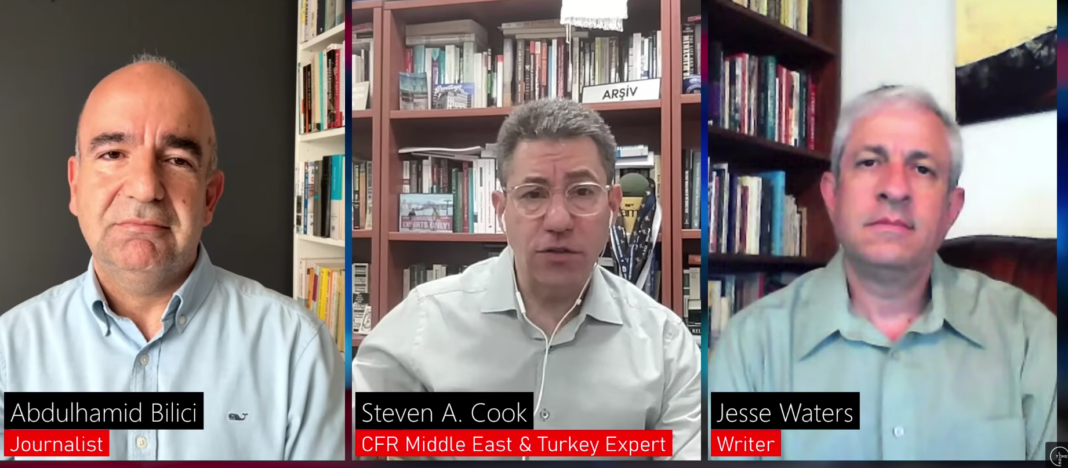
On The Timeline YouTube channel, I joined my co-host Jesse Waters in a conversation with Steven Cook, senior fellow at the Council on Foreign Relations and one of Washington’s leading experts on Turkey and the Middle East.
Cook said Turkey’s membership in NATO makes it extremely hard for countries to punish or sanction Ankara over its domestic politics. He said Turkey’s authoritarian trajectory has been going on for well more than a decade, tracing it back to 2008, while also pointing to the 2013 Gezi Park protests as a key moment.
While putting primary responsibility on Erdoğan, the Justice and Development Party (AKP) and Turks, Cook said the United States and European countries have accommodated themselves to Turkey’s authoritarian trajectory.
The discussion also covered NATO’s role in shielding Erdoğan from pressure, US Ambassador to Turkey Tom Barrack’s remarks on strong leadership and monarchies, Washington’s silence over the takeover of the main opposition party and whether an authoritarian system in Turkey can endure.
The interview has been edited and condensed for length and clarity.
Turkish President Recep Tayyip Erdoğan jailed his main political rival last year, and this week took over the main opposition party through a brutal raid. Turkey is preparing to host a NATO summit in Ankara in July. What makes Erdoğan such an “untouchable autocrat”?
The fact that Turkey is a member of NATO makes it extremely hard for countries that might want to punish or sanction Turkey for its internal politics, its slide toward autocracy, which has been going on for well more than a decade.
I trace it back to 2008. Some people say 2011. I was at the Gezi Park protests in 2013. In fact, my book “False Dawn,” which is about the Arab uprisings, also includes a discussion of Gezi Park and the way in which Turkey used authoritarian institutions in order to snuff out Turkish democratic practices and ideas.
I remember being in meetings with congressional staff and talking about some of the things that President Erdoğan was doing in the aftermath of the Gezi Park protests, arresting activists, bringing people up on charges of terrorism, closing parties, purging Hizmet after the 2016 coup. And they said it’s very, very hard because Turkey is a treaty ally of the United States to figure out ways in which to sanction Turkey and try to change its behavior.
We eventually came up with the CAATSA sanctions. The only way the United States was able to sanction Turkey was not as a result of its internal politics but because it was doing defense business with the Russians.
President Trump really did not want to sanction Turkey. Part of Trump’s reluctance is that he has a good personal relationship with President Erdoğan. He just likes him. He thinks he’s a good guy.
President Obama liked President Erdoğan. He felt that among allies who could be very difficult, once President Erdoğan was convinced to do something, he would follow through. And I think President Obama also had this kind of weird idea about Turkey being a leading Muslim state. I think he sort of drank the AKP and Erdoğan Kool-Aid and his advisers’ Kool-Aid on this because I don’t think Turkey really was going to lead the Arab world after the Arab uprisings.
George W. Bush had an affinity for Erdoğan well before he was the leader of the country because in the aftermath of 9/11, American leaders were looking for that kind of Islamist third way, and Erdoğan seemed to fit the bill.
So you have this sort of NATO shield, almost, that Turkey can wield, and the fact that he has good personal relations with three of the last four presidents, who were reluctant to really talk tough with him. So he’s basically gotten a blank check.
Can we say the West, mainly America, is also responsible for Turkey emerging as an autocracy?
I would say the AKP, President Erdoğan and Turks are primarily responsible for the trajectory of Turkish politics.
But I would say that the United States, which has positioned itself as a beacon of freedom and democracy around the world, and the EU, which should have some leverage with Turkey, have failed to speak out on these things in a forceful way.
The EU constantly expresses its concern or its grave concern or its serious concern or its utmost concern, but there are never really any consequences for Turkey. And there has been a narrative ever since the Russian invasion of Ukraine that Turkey is now more important than ever. So no one should rock the boat about Turkish domestic politics.
During the Biden era, at least for the first year or two, from the podium of the State Department, the State Department spokesman would criticize Turkey and the Turkish government over a variety of things, repression of students and faculty at Boğaziçi University, attacks on the LGBTQ community, a variety of other things. But those things trailed off after time.
Again, I would put the primary responsibility in the hands of Turks. And then I think big countries like the United States and the European countries have essentially accommodated themselves to Turkey’s authoritarian trajectory, which has been going on for quite some time.
Has NATO become sociopolitically bankrupt? Where is the alliance going when countries such as Turkey and the United States seem to be moving toward a more autocratic sense of governance?
When NATO was founded in the early 1950s, there was no particular specific mention in the founding articles of NATO about democracy.
When they looked at Turkey, and Turkey and Greece joined in 1952, they regarded Turkish secularists as democrats, which we know is not actually the case, but they were democrats, they were anti-communist, etc. So that was fine.
After the fall of the Soviet Union, when all these former Warsaw Pact members wanted to come in, there were new provisions about being a democracy and all those good things about freedom and the rule of law, but it didn’t necessarily retroactively cover everybody. It was about becoming a new member, and there’s really no mechanism to throw anybody out of NATO even if they are non-democratic, like Turkey.
I think what’s going on within the alliance right now is President Trump has put a lot of pressure on the alliance because there have been questions in Europe about whether the United States will remain in the alliance.
I think European elites have started to look at Turkey and say, well, Turkey has a large military. It’s allegedly a powerful and effective one. And while we’ve allowed our militaries to atrophy, we need to look to Turkey as a kind of stopgap, and it’s important to NATO while we ramp up our defense production.
I think that’s one of the reasons why Turkey’s gotten a pass on the things that it has done, leading up to and including essentially shutting down the main opposition party, appropriating the main opposition party and putting the former leader of the main opposition party, who’s a loser, never won any election in his life, and reinstalling him as the sort of, I guess, loyal opposition.
This is something that I think NATO is willing to overlook, at least so far. I think it’s a bad bet. Turkey’s policy on Russia and Ukraine tends to be ambiguous.
But again, because it’s a NATO member, with the exception of the CAATSA sanctions, the United States and Europe are not prepared to hold the Turkish leadership accountable for what goes on inside Turkey.
Recently, US Ambassador to Turkey Tom Barrack said strong leadership and monarchies in the Middle East are delivering results. Many in Turkey’s opposition saw that as approval of Erdoğan’s [family] ruling Turkey forever. Is it a green light for Erdoğan and then his son, and for Turkey’s becoming a full-fledged Middle Eastern autocracy?
Yes. I don’t know if it’s that, but I think yes.
I don’t know whether this is a conscious policy of the Trump administration or this is Ambassador Tom Barrack, who has said from the beginning of his tenure as ambassador to Turkey and kind of special representative to Syria and Lebanon, and he’s sort of a Middle East envoy second only to Steve Witkoff.
It’s unclear whether he’s coordinated with anybody in the White House or anybody anywhere. He certainly doesn’t answer to Secretary of State Marco Rubio. He is a friend of the president, but it’s entirely unclear whether he’s coordinating anything with the White House.
Over the course of his tenure, he has said a variety of unfortunate things with regard to Turkey, with regard to Lebanon, with regard to Syria, with regard to Israel. This is the most recent example.
He has been known prior to his time as the ambassador to Turkey to be particularly close to Gulf monarchies who have a particular view that they are benevolent authoritarians and they’re delivering for their people. It seems to me that Ambassador Barrack is very impressed by these things.
He is not, I don’t think, serving the principles and values. He is not serving in a way that upholds the principles and values by which Americans like to live and like to believe that we conduct ourselves in the world. I think he’s been a very unfortunate choice. I think he’s done damage to those in places like Turkey who would like to live in a more democratic and open society and done damage to the United States.
I don’t think that the United States should engage in democracy promotion. I think that failed. I think there are limits to American power. There are limits to the way the United States can engineer another country’s politics from so far away.
But what I also say in the book is I never want a president of the United States to stop talking about freedom and democracy in the world. At least at a rhetorical level, that’s very important.
I think Ambassador Barrack and President Trump have done a disservice to people who’ve often looked to the United States for inspiration.
Have you seen any protest or statement from Washington, the State Department or Congress, about the taking over of the opposition party?
I haven’t seen anything. I haven’t seen anything on it. It’s extraordinary. We won’t see anything about that.
It’s absolutely the perfect situation in which this United States government, this administration, will remain rhetorically hands-off.
The president went to Saudi Arabia and Qatar and the UAE in the spring, and he gave what I thought was actually a pretty decent speech for him in which he said we are not going to try to change the way in which people live. That’s fine.
But when a government takes this drastic step, a country like Turkey taking this drastic step of taking over an opposition party and installing its leader, and for the US government not to say anything, even with a NATO ally, it seems to me that this is out of step with our traditions and out of step with what most Americans think.
I don’t think Americans want us to be active in changing other governments. They’ve had enough of that. But I do think they’d like to believe that we stand for something.
Does silence by omission effectively give permission to Turkey and others to continue such actions?
That’s why I said yes to Abdülhamit’s question. Yes. It absolutely does.
I think there is a genuine belief among Americans that we should conduct ourselves abroad in a way that is consistent with our values.
In Turkey we should be able to say at a rhetorical level that this is wrong, and we think it’s unbecoming of a NATO member and unbecoming of an aspirant to join the European Union, which as far as I know is in the deep freeze but is still there.
I think it would be meaningful, but I don’t think anybody can expect President Trump to say anything about Erdoğan. Like I said, his personal relationship with Erdoğan, and he himself, there are major questions about his own commitment to democratic practices and principles. So I don’t think anybody can expect that, and the State Department has been neutered.
What’s missing here? Congress. Congress is MIA, as we say, missing in action. We haven’t even heard a peep from any leader in Congress, which is, I think, more shocking.
Maybe you could say, well, they’re busy with the Iran war, fighting over the War Powers Resolution, etc. This is an easy thing for Congress to do. They’ve completely fallen down.
You previously said Turkey had become an elected autocracy. After what happened at the main opposition party headquarters, how would you describe Turkey’s current regime?
Let me just clarify. In 2017, I made the observation that at one point Turkey was making a transition to democracy and had become an elected autocracy. I didn’t think that Turkey was transitioning to democracy. I think that kind of ended around 2007, 2008. That’s a marker for me in time, when I think you could no longer talk about a transition to democracy.
By 2017, certainly after the coup and the purges, you were talking about an elected autocracy. You had regular elections and multiple political parties. But there was nothing really, other than that act of staging an election, democratic about the state. The political institutions had all been rigged against having actual democracy.
Now when the government goes in and kind of wholesale takes over the opposition party, my fellow political scientists like to call things illiberal democracies, soft authoritarianism. I don’t think you call Turkey any of those.
Either you’re a democracy or you’re not. Either you’re authoritarian or you’re not. I think there’s no real way to categorize Turkey other than an autocracy.
To qualify Turkish authoritarianism as soft or illiberal democracy seems sillier now than ever before.
So now you call it an authoritarian country?
Yeah. Correct. I mean, is there any other way to describe it?
If I was having this conversation in a political science seminar, I would look at someone like they’re crazy if they didn’t say that Turkey was an authoritarian system.
Is an authoritarian system sustainable in Turkey, given its long tradition of democracy, modernization and being part of the West?
The intellectually honest answer is maybe, maybe not.
The problem with answering this with any kind of precision is what kind of time frame are we talking about?
Authoritarian systems have proven themselves to be more resilient than we actually thought. Actually, it’s funny. We thought they were quite resilient, and then the Arab uprisings happened and Mubarak fell and Zine El Abidine Ben Ali fell, and then we started to revise this. But we didn’t really understand. We were so enamored with the romance of the barricades. We didn’t realize that in Egypt the system prevailed, the officers prevailed. Mubarak left, but there was just a change in leader.
Do I think that Turkish society has some advantages over, for example, Egyptian society? Certainly. There has been a longer history of democratic practices, certainly within some not insignificant number of the population who have internalized these democratic ideals.
But at the same time, the Justice and Development Party and President Erdoğan have used the coercive instruments of the state, have changed the institutions of the state in order to ensure AKP rule, and there’s no telling when it would come to an end.
There are kind of three ways leaders rule. They have a positive vision for the future and people like, yeah, I want to be part of that society. I support this guy. And that was kind of Erdoğan when he first came to power. Coercion is another way in which leaders rule, and basically bribery is another.
The leader that has more positive vision and less coercion and less bribery tends to have a more durable and more stable system. To the extent that Erdoğan has to rely more and more on coercion, it’s more expensive. It’s harder for him to do.
But that doesn’t mean that I have any idea whether it’s three weeks or 30 years from now when the whole thing comes crumbling down.
And certainly from the outside, the profound reluctance of the United States and the European Union to at least criticize does not help those who want to live in a more democratic and open society.
People in Turkey are depressed because of what is going on, and many still expect something from Europe or America. What would you say realistically to those who still aspire for democracy in Turkey?
The realistic approach, yeah, I think that they can forget about the United States saying anything about what’s happened.
There may be a time when members of Congress are prodded to say something about this, either because they get questions from the press or people kind of raise it to them.
I expect the Europeans to express their grave and utmost concern and then go on and do business with Erdoğan because Turkey’s a big power and they’ve got a problem with Russia and they themselves have disarmed over many, many years under the American umbrella.
I am very, very sorry. I have many Turkish friends and so many fond memories of living in Turkey and visiting Turkey. I’m sad to hear that people are depressed, but I think the realistic response is they’re not going to get what they’re hoping they might get from the beacons of democracy in Europe and the United States.
So this will be their own struggle for democracy?
Yeah. I think people should really look at it that way. I mean it’s their own society and their own political system, and it’s really up to them to make the difference.
I think in the margins, the United States and European Union could offer encouragement and say, you know, we disapprove and say that this is unacceptable, do more at least than what we’re doing. But it’s really up to Turks. It’s up to Turks.