

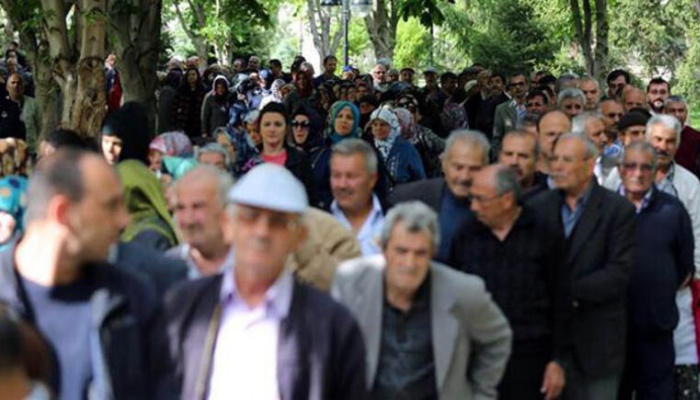

Retirement in Turkey has become a struggle to survive rather than a period of rest for many retirees, according to a new report that cites labor research showing the share of retirees who are working or looking for work had risen from 36.6 percent in 2002 to 65.7 percent by the end of 2024.
The study, titled “Retiree Poverty in Turkey” and released in May, was planned by the Forum Institute for Social Research, with fieldwork carried out by pollster Verita Analitik and support from the Friedrich Ebert Foundation (FES), a German political foundation. It is based on a survey of 400 retirees conducted February 21-26 and 40 in-depth interviews.
The report does not claim to represent all retirees in Turkey. It focuses on retirees who continue working or are looking for work and who link that decision to financial pressure. The researchers say this group reflects one of the clearest breaking points in Turkey’s pension system: being retired but still having to work to survive.
The report says Turkey’s aging population is growing as the pension system comes under pressure. The number of people aged 65 and older reached 9.58 million in 2025, accounting for 11.1 percent of the population, while the old-age dependency ratio rose to 16.2 percent, according to data from the Turkish Statistical Institute (TurkStat) cited in the study.
According to the study, 89.4 percent of retirees surveyed said financial necessity was the main reason they continued working or looking for work after retirement. Another 88.7 percent agreed with the statement, “I can’t stop working; I have to work to make ends meet.”
The findings also show that 88.8 percent of respondents said they could not meet basic needs without working, while 75.8 percent said they would stop working if their pensions increased. The report says this shows post-retirement work is driven mainly by income pressure rather than a voluntary desire to remain active.
The report places the findings against a broader deterioration in pension income. Turkey’s net monthly minimum wage was set at 28,075.50 lira ($620) for 2026, while the lowest pension was raised to 20,000 lira ($440) in January. The report cites parliamentary calculations putting the average pension at around 23,550 lira ($520), meaning the lowest pension equals about 71.2 percent of the minimum wage and the average pension about 83.9 percent.
The study also cites research by DİSK-AR, the research arm of the Confederation of Progressive Trade Unions (DİSK), showing that the share of retirees who were working or looking for work rose from 36.6 percent in 2002 to 65.7 percent by the end of 2024, reaching 7.9 million people.
The report says retiree poverty cannot be measured by monthly income alone. The study examines household size, the number of working people in the household, total household income, pension income, additional regular income and housing security to build a poverty and vulnerability index.
On that index, 43.1 percent of respondents were in the lower-income group and 38.8 percent in the lower-middle group. When those classified as deeply poor are included, about 83.5 percent of the sample falls below the middle-income level, while only 10.6 percent are in the middle-income group.
The average pension among respondents was about 25,600 lira ($565), while average household income was roughly 55,000 lira ($1,215). The report says pensions remain central to household budgets but are often not enough on their own, forcing retirees to rely on work, family transfers, additional income or debt.
One participant, identified as K11, said he received 26,000 lira ($575) a month and still could not survive in İstanbul even though he owned his home. Another participant, identified as K14, a widow in her 70s who rents in İstanbul, said: “If my pension were enough I wouldn’t work, I’d stay home. At 77, what am I doing here? … The pension isn’t enough, isn’t enough.”
The work available to retirees is often insecure. Among those working after retirement, only 38 percent said they were registered with the Social Security Institution (SGK), while 62 percent said they were working without social security coverage.
More than half of working retirees, 56.6 percent, said they worked full time. Another 17.6 percent worked part time, 16.8 percent worked daily jobs and 9 percent worked seasonally. The share of unregistered work rose to 85.1 percent among daily workers and 88 percent among seasonal workers, according to the study.
Housing is one of the main factors separating retirees who can manage from those who face deeper poverty. The study found that 56.6 percent of respondents lived in their own homes, while 30.5 percent were tenants and 11.6 percent lived in someone else’s home without paying rent.
The burden is heavier for women. The share of tenants was 41.9 percent among female retirees compared with 27 percent among male retirees. Among tenants, 72.1 percent strongly agreed that they could not meet basic needs without working.
Heating costs have also become a major burden. The study found that 52.9 percent of respondents said they had great difficulty heating their homes in winter, while 23.3 percent said they had difficulty, meaning more than three-quarters struggled with heating expenses. The report says retirees often have to choose between heating, food and other basic needs.
Health costs add another layer of pressure. The study found that 36.3 percent of respondents had great difficulty accessing healthcare services and 19.7 percent had difficulty, bringing the total facing serious access problems to 56 percent. The report says formal health coverage does not guarantee real access because of appointment problems, co-payments, medicine costs, transport expenses and waiting times.
Debt has become part of everyday survival for many retirees in the study. Some 66.3 percent of respondents said they had debt, with the share rising to 74.2 percent among women. Among those with debt, 98.6 percent had credit card debt, suggesting that borrowing is often used to cover short-term gaps between income and basic expenses rather than large investments or discretionary spending.
The study also found a weak capacity to handle emergencies. Forty-seven percent of respondents said they could not find 20,000 lira ($440) within a month in an emergency such as a health expense or home repair. When undecided respondents are included, the share rises to 56 percent.
Poverty is also pushing retirees out of social life. Seventy-six percent of respondents said they could not attend social activities such as going to the cinema, visiting others or sitting in a tea garden because of financial reasons. The report says this reflects not only lower consumption but also shrinking social ties and weaker participation in public life.
The findings point to widespread anxiety about the future. Some 74.1 percent of respondents said they were worried about the future, including 56.2 percent who strongly agreed with that statement. Among women, the share expressing concern rose to 80.7 percent.
The report says this anxiety is tied not only to money but also to fears of illness, dependency, loneliness and becoming a burden on children. In interviews retirees repeatedly described old age as a period in which they feared losing independence and relying on family members for care.
The crisis has a gender dimension. The study says women’s retirement poverty is shaped by unpaid care work, interrupted employment, lower pensions, widowhood and greater housing insecurity. It calls for pension and social policy tools that account for care-related career breaks and the vulnerability of older women living alone.
The study’s policy recommendations call for the lowest pension to be reset according to basic living costs rather than symbolic increases. It also recommends indexing pensions not only to general inflation but also to costs that weigh heavily on older people, including food, rent, energy, medicine and care.
The report also urges separate policy tools for tenant retirees, including rent support, social rental housing and protections against eviction and excessive rent increases. It recommends targeted energy, water, natural gas and transport support for low-income retirees and measures to reduce debt burdens.