


Adem Yavuz Arslan*
In today’s Turkey, the defense industry is no longer merely about military capability. It has increasingly become one of the government’s most powerful political communication tools.
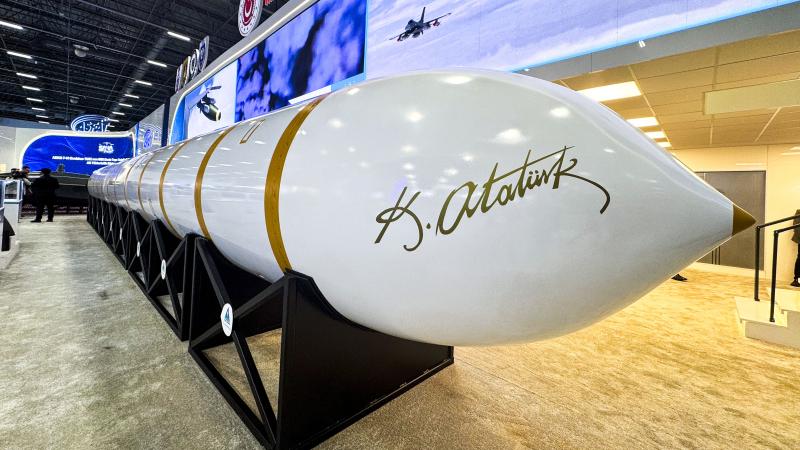
Particularly during election periods, President Recep Tayyip Erdoğan and his allies tend to intensify the narrative of a “national technology revolution.” The unveiling of the so-called “Yıldırımhan” (Lightning) hypersonic missile project at the SAHA 2026 defense expo has once again pushed that debate to the forefront.
The reason is simple: The technical claims surrounding the project appear dramatically disconnected from Turkey’s publicly known missile capabilities.
According to official presentations, Yıldırımhan is supposedly capable of speeds ranging from Mach 9 to Mach 25, powered by four rocket motors and carrying a three-ton warhead. If true, this would represent not merely a breakthrough for Turkey but a seismic shift in global military technology.
Mach 25 territory belongs less to conventional missile programs and more to the realm of intercontinental ballistic missiles and space re-entry systems.
At such speeds, approaching nearly 30,000 kilometers per hour, engineering challenges become extreme. Vehicles traveling through the atmosphere at that velocity require advanced thermal shielding, highly sophisticated composite materials, atmospheric resistance solutions and next-generation guidance systems.
Even global powers continue to struggle with these problems.
The United States has faced repeated delays in its hypersonic weapons programs. Russia’s hypersonic claims remain heavily debated among Western analysts. China has invested billions of dollars over decades to advance its own systems.
Against this backdrop, Ankara’s suggestion that it may have reached this level in a relatively short period, largely through domestic capabilities, has inevitably been met with skepticism among defense experts.
Turkey’s real missile development trajectory has historically been far more modest.
The J-600T Yıldırım project was largely based on Chinese missile technology and operated within the 150–300 kilometer range. The Bora missile system later emerged with an estimated range of around 280 kilometers, becoming one of Turkey’s most ambitious domestically branded missile programs. The Tayfun missile reportedly aims for ranges between 500 and 1,000 kilometers, while the still-developing Cenk project has been associated with targets around 2,000 kilometers.
Yet suddenly, public discourse shifted toward claims approaching the 6,000-kilometer category, essentially nearing intercontinental ballistic missile capability.
That scale requires far more than building a missile.
It demands years of testing, massive industrial infrastructure, advanced thermal protection technologies, complex guidance systems and strategic integration into military doctrine. Programs of this magnitude are also typically impossible to conceal from international intelligence and satellite surveillance networks.
That is why comments emerging from Turkey’s own defense circles are particularly noteworthy.
Some former insiders who previously worked on missile projects reportedly say they had never heard of anything resembling Yıldırımhan until very recently. If the project truly exists at the announced level, it would mean Turkey achieved in just a few years what even major powers have struggled to accomplish over decades.
That has led some analysts to question whether the system is closer to a concept or publicity display than an operational weapon.
Turkey’s previous missile programs have also faced persistent questions regarding foreign dependence. Industry discussions for years centered around the Russian-origin launcher and carrier platforms allegedly used in systems such as Bora and Yıldırım. That detail matters because missile systems are not just about the projectile itself: Launch infrastructure is equally critical.
For Yıldırımhan, however, there is still little publicly available information regarding the launcher platform, its origin or whether foreign components are involved.
Another issue repeatedly highlighted by defense analysts is testing capacity.
Even Turkey’s shorter-range Bora missile reportedly underwent only limited testing, with each launch said to cost roughly $1 million. Industry insiders have long claimed that one of the early Bora tests ended unsuccessfully.
Given that background, the sudden appearance of a near-Mach-25 system naturally raises eyebrows.
None of this necessarily proves that Yıldırımhan is fictional. Defense expos around the world routinely display conceptual systems, prototypes and mock-ups rather than fully operational platforms.
The real issue begins when such projects are transformed into instruments of domestic political spectacle.
The timing of the unveiling is difficult to ignore.
As tensions involving Iran, Israel and the United States pushed ballistic and hypersonic missile discussions to the center of global media coverage, Turkey suddenly launched a massive publicity campaign around Yıldırımhan.
To many observers, the message seemed clear: “We have this capability, too.”
And Turkey has seen similar narratives before.
The Altay tank project became symbolic of endless promises surrounding mass production. The ATAK helicopter program faced engine and export crises. The KAAN fighter jet has been accompanied by extensive media campaigns despite unresolved questions surrounding engines, radar systems and full operational capability.
Previous promises involving a domestic passenger jet and even a lunar mission followed similar patterns: dramatic announcements amplified by intense state-aligned media coverage.
That is why criticism of Yıldırımhan is not merely technical.
It is deeply political.
Critics argue that the Erdoğan government increasingly uses defense projects as tools for nationalist mobilization and electoral consolidation. Amid great economic difficulties, soaring inflation and growing political pressure, the return of “national technology” rhetoric appears anything but accidental.
Because genuine defense breakthroughs usually emerge quietly.
They are tested over the years. They are independently verified. They prove themselves operationally.
Propaganda, by contrast, begins with headlines.
And that is precisely the question now being debated in Turkey:
Is Yıldırımhan truly a strategic technological leap?
Or is it another carefully orchestrated political communication campaign designed for an election season?
*Adem Yavuz Arslan is a journalist with over two decades of experience in political reporting, investigative journalism and international conflict coverage. His work has focused on Turkey’s political landscape, including detailed reporting on the 2016 coup attempt and its aftermath, as well as broader issues related to media freedom and human rights. He has reported from conflict zones such as Bosnia, Kosovo and Iraq, and has conducted in-depth research on high-profile cases, including the assassination of Turkish-Armenian journalist Hrant Dink. Arslan is the author of four books and has received journalism awards for his investigative work. Currently living in exile in Washington, D.C., he continues his journalism through digital media platforms, including his YouTube channel, Turkish Minute, TR724 and X.
Disclaimer: The views expressed in this opinion piece are those of the author and do not necessarily reflect the editorial stance of Turkish Minute.