

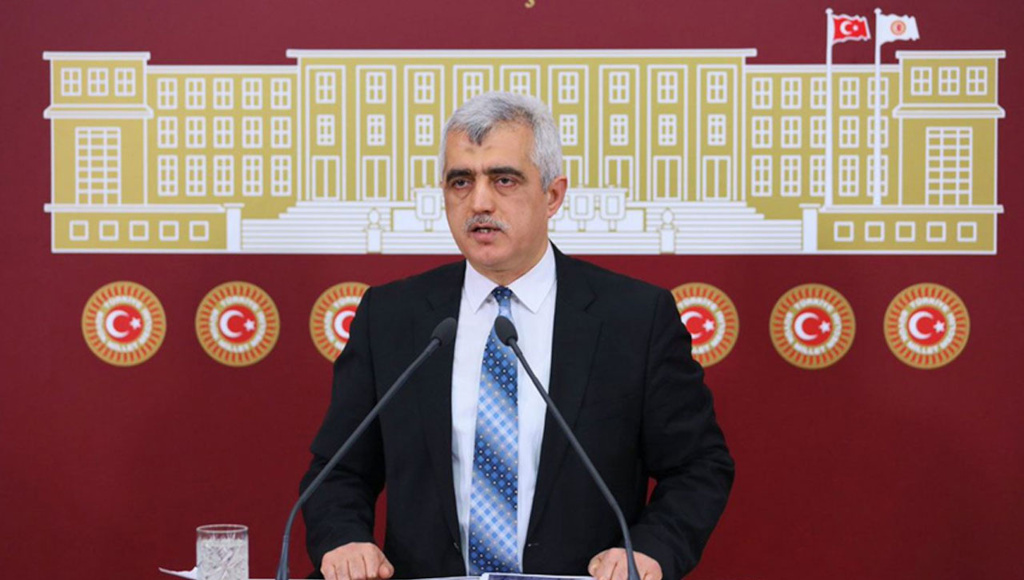

A lawmaker from Turkey’s main pro-Kurdish party has asked Turkish Parliament Speaker Numan Kurtulmuş to explain why a parliamentary inquiry report on a coup attempt in 2016 was never made public, nearly 10 years after the event that reshaped the country’s politics and judiciary.
Ömer Faruk Gergerlioğlu, an MP from the pro-Kurdish Peoples’ Equality and Democracy Party (DEM Party), submitted a 24-question parliamentary inquiry to Kurtulmuş on Thursday.
The inquiry concerns the report prepared by a parliamentary commission created after the July 15, 2016, coup attempt to investigate the abortive putsch, its political, military, bureaucratic and intelligence dimensions and the activities of the Gülen movement, which Ankara accuses of masterminding the failed coup.
The movement, inspired by the late Turkish Islamic scholar Fethullah Gülen, denies involvement.
Gergerlioğlu asked whether the report is currently in parliament’s records, when it was submitted to the speaker’s office and what legal or administrative grounds have been used to keep it from the public.
He also asked whether the full report, its annexes, dissenting opinions, correspondence, rejected motions and meeting records would be released.
The report has long been controversial because it was never officially published despite months of work by the commission, leaving one of the most important official inquiries into the coup attempt outside public scrutiny.
Gergerlioğlu said the public expected the coup attempt to be clarified but that the commission’s work was conducted in a disputed manner, with critical requests by members rejected and the final report withheld from the public.
Among the rejected requests, he listed calls for the commission’s first meeting to be open to the press, for the flight records of senior politicians on the night of the coup attempt to be obtained and for phone traffic records of politicians and key officials to be reviewed.
He also said requests to summon President Recep Tayyip Erdoğan, then-prime minister Binali Yıldırım, then-chief of General Staff Gen. Hulusi Akar and then-intelligence chief Hakan Fidan were rejected.
The question of why those officials were not heard has been central to criticism of the parliamentary inquiry because they held the highest political, military and intelligence posts during the attempted coup.
Gergerlioğlu asked whether failing to hear the top officials of the night had left the investigation incomplete and whether the refusal to extend the commission’s working period had limited its ability to clarify the coup attempt.
He also asked whether parliament would release a chronological note explaining what happened to the report and whether any secrecy decision had been taken to prevent its publication.
In an April 22 press conference at parliament, Gergerlioğlu said he had previously asked the speaker’s office about the report but received no answer.
He said then that nearly 10 years had passed since the coup attempt, that parliament had worked on the issue for months and that the commission’s report was nowhere to be found.
Former commission chairman Reşat Petek, previously a ruling Justice and Development Party (AKP) lawmaker, responded to Gergerlioğlu on social media, saying the commission had completed the report and delivered it to then-parliament speaker İsmail Kahraman.
Petek said parliament’s website later marked the commission as if it had not submitted a report and put responsibility on Kahraman, saying, “The truth is this.”
The 2016 coup attempt set off one of Turkey’s largest crackdowns in modern history.
However, Erdoğan has been targeting followers of the Gülen movement since the corruption investigations of December 17-25, 2013, which implicated then-prime minister Erdoğan, his family members and his inner circle.
Dismissing the investigations as a Gülenist coup and conspiracy against his government, Erdoğan began to target the group.
Erdoğan’s government labeled the group as a “terrorist organization” in May 2016, before the failed coup took place, a designation not recognized by other governments or major international bodies.
Erdoğan intensified the crackdown on the movement following the coup attempt that he accused Gülen of masterminding. The movement strongly denies involvement in the abortive putsch or any terrorist activity.
The movement’s followers, also known as Hizmet (Service) supporters, say they have been unfairly targeted in a campaign of political persecution aimed at silencing dissent and consolidating power. The post-coup purge has seen hundreds of thousands investigated and tens of thousands imprisoned on terrorism-related charges widely viewed as politically motivated.
The unpublished parliamentary report on the coup has remained one of the main gaps in the official record of the coup.
Akar, Turkey’s military chief at the time, sits at the center of the official coup story Ankara has never allowed to be tested in full.
The official account presents Akar as a hostage of the coup plotters, but his former chief adviser Orhan Yıkılkan told a court in 2025 that Akar was still giving orders at military headquarters and called the officer sent to Erdoğan’s hotel in Marmaris to warn him that the president’s guards were ready.
Yıkılkan also said Akar went to Akıncı Air Base, a military airfield outside Ankara that prosecutors described as the coup plotters’ command center, because he thought Erdoğan had been taken there and wanted to speak to him, a claim that undercuts the image of Akar as a powerless captive.
Other material has pointed in the same direction. Draft coup directives obtained by Nordic Monitor in 2019 listed Akar as head of the Peace at Home Council, the name used by the putschists, while Akıncı Air Base commander Hakan Evrim said in court that the attempt looked “planned to fail.”
For critics of the official narrative, Akar was part of a managed operation whose failure was later used to purge the Gülen movement and reshape the Turkish state.