

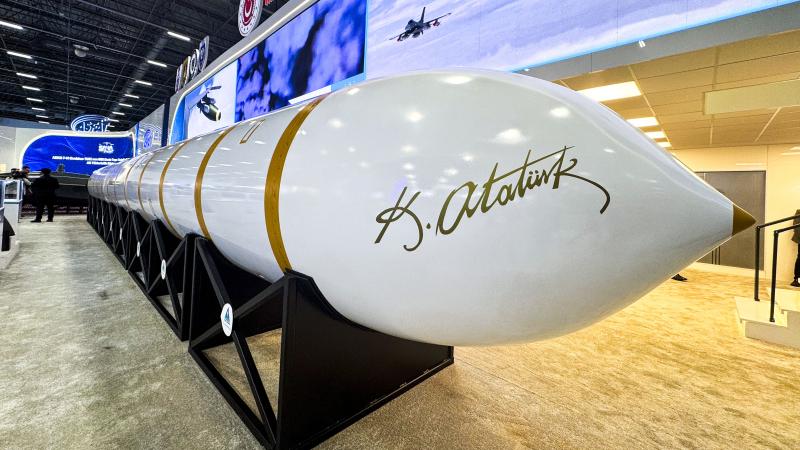
, at the SAHA 2026 defense exhibition in İstanbul, presenting it as the country’s longest-range missile to date with a stated range of 6,000 kilometers, the state-run Anadolu news agency reported.)
Turkey’s Defense Ministry is displaying the model of a new ballistic missile, the Yıldırımhan (Lightning), at the SAHA 2026 defense exhibition in İstanbul, presenting it as the country’s longest-range missile to date with a stated range of 6,000 kilometers, the state-run Anadolu news agency reported.
The exhibition is being held May 5-9 at the İstanbul Expo Center and is organized by SAHA İstanbul, which describes itself as Turkey and Europe’s largest defense, aerospace and space industry cluster.
Turkish and international defense outlets have described the Yıldırımhan as Turkey’s first intercontinental ballistic missile (ICBM), although the claim has not been independently verified through a public flight test or official deployment announcement.
The specifications displayed at the fair and reported by defense outlets list a range of 6,000 kilometers, a speed range of maximum Mach 25, which is 25 times the speed of sound, and a payload capacity of about 3 tons.
The missile was displayed with a liquid-fuel engine configuration.
Turkish Defense Minister Yaşar Güler said the Yıldırımhan was Turkey’s first liquid-fueled missile capable of hypersonic speeds and the longest-range system the country has produced, according to Anadolu.
He also said Turkey would use the missile “without hesitation” if necessary.
The technical data remain limited. No official test footage, flight-test range data, accuracy figures, guidance details or deployment schedule has been made public. Several defense analyses have said the system could be a prototype or technology demonstrator rather than an operational missile.
The 6,000-kilometer range places the Yıldırımhan at the lower end of the ICBM category, although analysts say it is closer in practical terms to long-range or intermediate-range systems than to full-range ICBMs capable of exceeding 10,000 kilometers.
If the stated range is accurate, a missile launched from Turkey could reach parts of Europe, the Middle East, North Africa, the Caucasus and southern Russia, depending on launch site, extending Ankara’s strike range beyond its current short and medium-range ballistic missile systems.
The display comes as Turkey has expanded its ballistic missile programs in recent years. Roketsan, Turkey’s state-controlled missile and rocket manufacturer, introduced the Tayfun Block 4 hypersonic-capable variant at the IDEF 2025 defense fair in July, describing it at the time as Turkey’s longest-range domestically produced ballistic missile.
Cenk, a medium-range ballistic missile also developed by Roketsan, has been reported as another long-range program under development.
Defense analysts have also pointed to the practical challenges Turkey faces in testing longer-range missiles because of limited domestic test-range geography. The International Institute for Strategic Studies noted in April that Turkey’s main missile-test range is on the Black Sea and that the country’s east-west distance is under 1,000 kilometers, creating constraints for longer-range missile testing.
The Yıldırımhan appears to differ from Turkey’s existing missile systems in both declared range and fuel architecture. Defense analyses said the missile appears to use a liquid-fuel design, unlike many modern solid-fuel ballistic missiles, which are generally faster to prepare for launch.
Liquid-fueled missiles can allow thrust control and heavy payloads but require more complex handling and preparation, limiting responsiveness and raising operational risks.
However, he criticized the model on display, saying it looked unrealistic for a missile presented as having a 6,000-kilometer range and did not reflect the seriousness of Turkey’s defense industry and bureaucracy.
Yıldırım said many people in the sector could have produced a more convincing rough design.
“Turkey is not a country that should become a laughing stock,” he said, calling for “seriousness.”
Beyond the debate over the model’s presentation and strategic message, the missile also raises questions about Turkey’s international commitments, although its display or domestic development does not automatically amount to a treaty violation.
Turkey is a member of the Missile Technology Control Regime, an export-control arrangement focused on limiting the spread of systems capable of delivering a payload of at least 500 kilograms to a range of at least 300 kilometers. The regime focuses mainly on exports and technology transfers, not a state’s domestic development of its own missiles.
Turkey is also a party to the Nuclear Non-Proliferation Treaty, which addresses nuclear weapons and related safeguards, not conventional ballistic missiles as such.
The Yıldırımhan has been described in available reporting as a conventional missile, and no official source has said it is intended to carry a nuclear warhead.
Turkey also subscribes to the Hague Code of Conduct against Ballistic Missile Proliferation, a voluntary transparency and confidence-building framework. Under the code, subscribing states make political commitments to provide pre-launch notifications for ballistic missile and space-launch vehicle launches and test flights and to submit annual declarations on relevant policies.
That means the display or domestic development of a long-range ballistic missile does not automatically establish a treaty violation. But any future testing, deployment or export activity could draw scrutiny under export-control rules, transparency commitments and NATO political discussions.
The missile’s NATO implications are sensitive. Turkey is a member of the alliance but does not possess nuclear weapons of its own. A conventionally armed missile with a declared range of 6,000 kilometers would expand Turkey’s deterrence options while also raising questions among allies about escalation management, missile defense integration and strategic messaging.
For now, the main uncertainty is whether the Yıldırımhan is an operational program, an early-stage prototype or a political signal. Without public flight-test data or an official deployment timeline, the missile’s real capability remains unverified.