

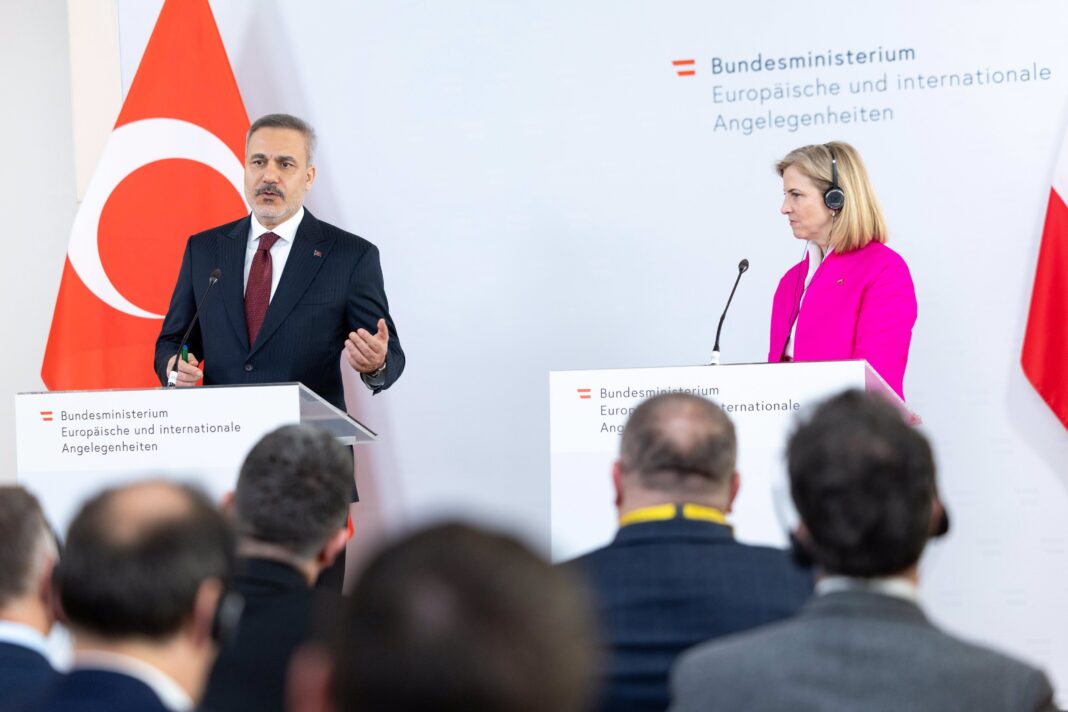

Turkish Foreign Minister Hakan Fidan on Wednesday sharply criticized the European Union over the lack of progress in Turkey’s membership process and the modernization of a customs union agreement, saying Ankara’s strategic and economic value should push Brussels to act.
Speaking at a joint press conference with Austrian Foreign Minister Beate Meinl-Reisinger during a visit to Vienna, Fidan said the war in Ukraine, instability in the Middle East, tensions over the Strait of Hormuz, security in the Balkans, trade and defense cooperation all showed that Turkey and Europe were being forced to work together regardless of the formal state of relations.
“When we look at the Russia-Ukraine war and Turkey’s role there, what is the European Union still waiting for?” Fidan said. “Given the very large geostrategic, geopolitical and geoeconomic benefit Turkey can offer, the question is why this membership process is not happening.”
Turkey began EU accession talks in 2005, but the process has been stalled for years due to disputes over Cyprus, democratic backsliding in Turkey and opposition from some EU member states. Turkey is also seeking an update to its 1995 customs union agreement with the bloc, which covers industrial goods but does not fully include services, agriculture or public procurement.
Fidan said Turkey was not asking to join the EU without meeting membership conditions.
“If you are going to enter somewhere, of course there are conditions,” he said. “These conditions are put before you, and when you comply with them, you enter.”
But he said the EU lacked the political will to accept Turkey as a member even if the country met the criteria.
“The problem is that there is no political will in the European Union saying, ‘When Turkey fulfills the conditions, we accept that it will become an EU member,’” Fidan said.
He blamed former French President Nicolas Sarkozy for killing the political will that had previously existed under former German Chancellor Gerhard Schröder and former French President Jacques Chirac.
Fidan said the lack of political will also affects more practical areas of cooperation, including the customs union.
He said EU officials acknowledge that updating the agreement would benefit both sides but that the bloc is unable to take a step because of internal political obstacles.
“There is a trade volume approaching $250 billion, and it is almost 50-50, with no trade deficit for either side,” Fidan said. “If the customs union agreement is updated, all calculations show that this $250 billion could immediately increase to $500 billion.”
He said both sides want the update but that “somewhere there is a blockage of will.”
Fidan also criticized EU decision-making rules, saying a small member state can block steps that would benefit a much larger Turkey-EU relationship.
“Let’s say 26 of 27 countries, or 400 million people, want something, but the preference of fewer than 1 million people can make it insufficient,” Fidan said, in an apparent reference to Cyprus. “Turkey-European Union relations, meaning 500 million people, can be held hostage by one country.”
Turkey does not recognize the Republic of Cyprus, an EU member state, which controls the southern part of the island, and supports the Turkish Republic of Northern Cyprus (KKTC), which is recognized only by Turkey. Cyprus has long been one of the main obstacles in Turkey’s EU process and in efforts to deepen security and economic cooperation.
Fidan said the same problem affected not only accession talks but also pragmatic steps on European security, critical infrastructure, trade competitiveness and the digital sector.
“This tactical problem blocking a major strategic interest, and the failure to find a solution to it, is another dead end,” he said. “This is, of course, a problem Europe needs to solve within itself.”
Fidan said Turkey’s policy remained that relations with Europe should always be good.
“Our realistic policy is this: Turkey and Europe’s relations must always be good,” he said. “I hope we move our existing relations to a better and more advanced level.”
The remarks come amid renewed debate over EU-Turkey ties after European Commission President Ursula von der Leyen said on April 19 that the EU should complete enlargement so the continent does not fall under “Russian, Turkish or Chinese influence.”
The European Commission later said Turkey is an “undisputed economic and political partner,” while Turkey’s absence from an informal EU leaders’ summit in Cyprus last week added to questions about whether Brussels sees Ankara as part of Europe’s emerging security architecture.