

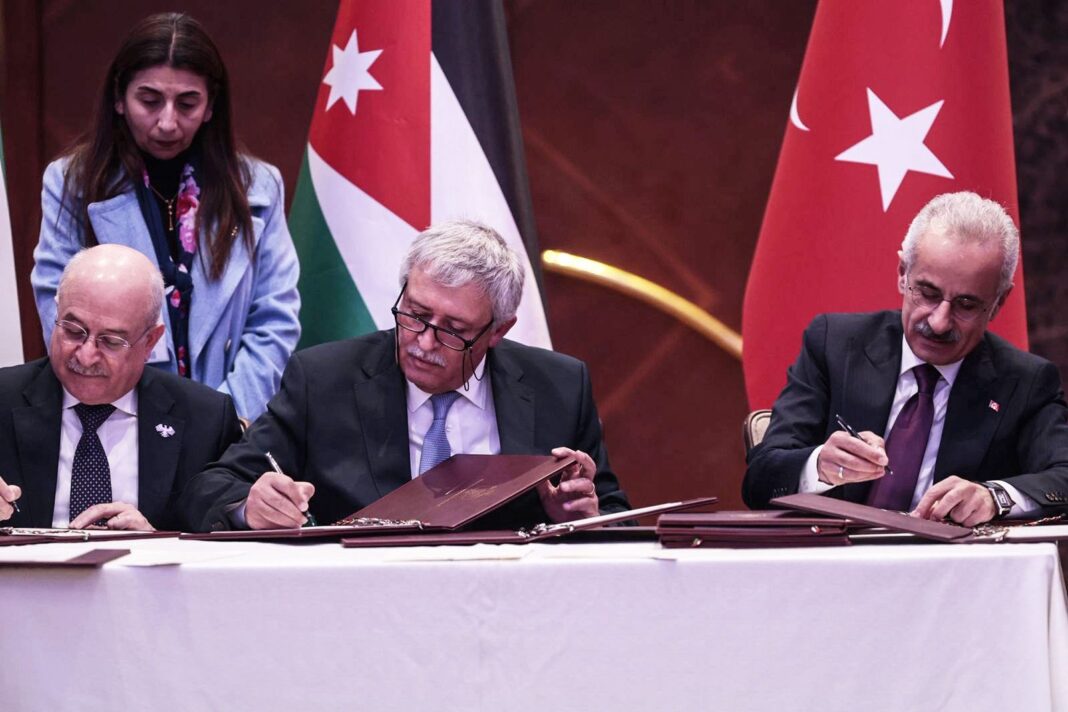

Turkey, Syria and Jordan have agreed to modernize their rail networks with the aim of creating a transport corridor linking southern Europe to the Persian Gulf within four to five years, Bloomberg reported Thursday, citing Turkish Transport and Infrastructure Minister Abdulkadir Uraloğlu.
Uraloğlu said he reached the agreement with his Syrian and Jordanian counterparts at a meeting last week.
The project would connect Turkey’s rail system with Syria and Jordan and later with Saudi Arabia’s railway network, creating a north-south trade route between Europe, the Levant and the Gulf.
Uraloğlu did not provide details on how the project would be financed, saying only that funding talks were ongoing.
The plan also includes improvements to roads leading to Turkey, though the scope of that work has not been finalized, Bloomberg reported.
The agreement marks one of the most concrete steps toward restoring regional transport links after more than a decade of war in Syria, which severed rail and road connections between Turkey and much of the Arab world.
Before Syria’s civil war began in 2011, Turkey used routes through Syria to reach markets in Jordan, Lebanon and the Gulf, but the conflict forced Ankara to rely on costlier sea and land alternatives.
The new plan also revives the idea of a modern version of the Hejaz Railway, an Ottoman-era line built under Sultan Abdulhamid II and opened in 1908 to connect Damascus with Medina through present-day Jordan. The original railway was designed to serve Muslim pilgrims traveling to the holy cities and to strengthen Ottoman control over Arab provinces. It cut the journey from Damascus to Medina from roughly 40 days by caravan to five days by train but was damaged during World War I and eventually fell out of use.
Turkey has framed the revived railway as both a trade project and a symbol of renewed regional connectivity following the change of government in Syria in late 2024.
The plan comes as Ankara seeks a larger role in regional trade corridors at a time when shipping disruptions due to the Iran war and subsequent energy shocks have increased interest in overland routes linking Europe, the Middle East and Asia. Turkey has also been promoting its Development Road project with Iraq, a planned road and rail corridor from the Persian Gulf to Turkey and onward to Europe.
A functioning route through Syria and Jordan would give Ankara another corridor to the Gulf and could support reconstruction and trade in Syria if security and financing conditions allow.
Jordan has also been working to expand its rail links, signing a $2.3 billion agreement with the United Arab Emirates this week for a railway connecting the Red Sea port of Aqaba to mining areas in the country’s south. Jordanian officials have described the Aqaba project as part of broader plans to connect the port to the Mediterranean through Syria and Turkey and to strengthen links with Saudi Arabia and the Gulf.
The success of the Turkey-Syria-Jordan project will depend on financing, security conditions in Syria and coordination among countries whose rail networks have suffered from decades of neglect, war and underinvestment.