

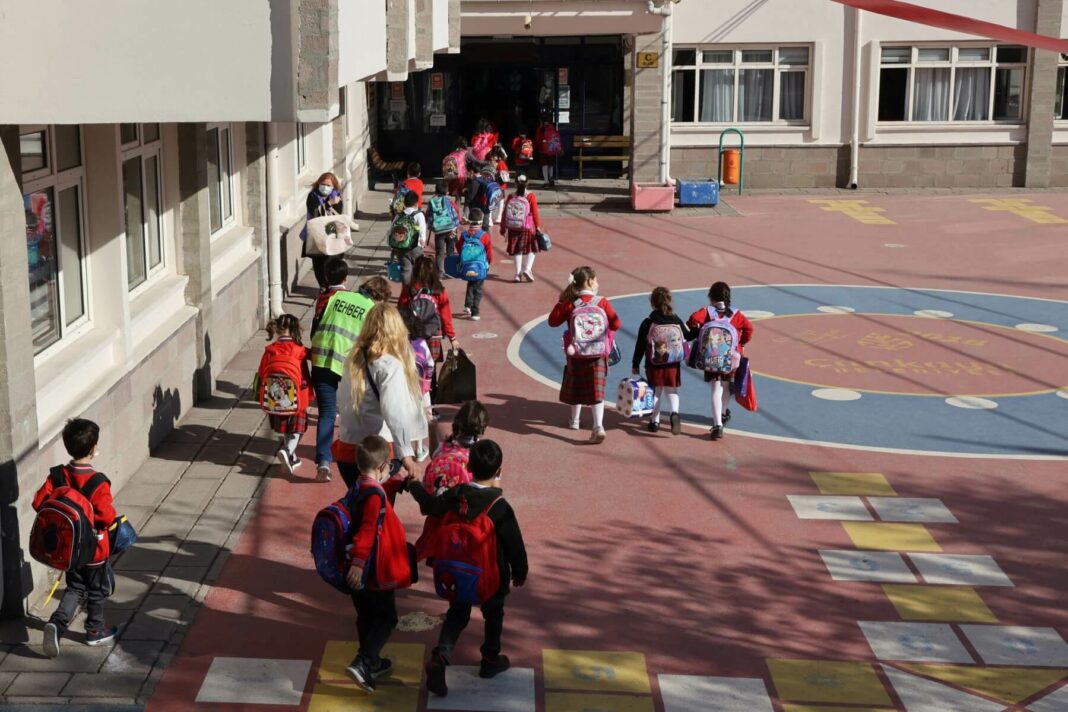
 for the 2026–2027 academic year, according to data reported by the BirGün daily, now close to the cost of elite European boarding schools, a comparison drawn by the Karar daily.)
Private school fees in Turkey have risen above 1 million lira ($22,300) for the 2026–2027 academic year, according to data reported by the BirGün daily, now close to the cost of elite European boarding schools, a comparison drawn by the Karar daily.
The Education Ministry set the maximum increase for entry-level grades at 43.92 percent, with a lower cap of 30.74 percent for intermediate grades. The ceiling was calculated as 1.5 times the average of the December 2025 domestic producer and consumer price indices. Despite this limit, annual tuition fees at several well-known private schools have exceeded the 1 million lira threshold.
At ENKA Schools, a network of elite private schools in İstanbul, tuition for kindergarten reached 1,674,697 lira ($37,400), while primary and first-year high school fees stood at 1,564,047 lira ($35,000).
Bilfen Schools, one of Turkey’s largest private education networks, listed primary education fees at 1,432,000 lira ($32,000).
At TED İstanbul College, primary school first-grade fees rose to 1,068,606 lira ($22,500), while high school entry-level fees reached 1,187,340 lira ($26,500).
TED is a nonprofit education foundation that runs a network of private schools in Turkey.
Turkish tuition fees generally do not include meals, transportation or educational materials. With those costs added, families can pay as much as parents at elite European boarding schools, where fees cover full room and board.
Professor Cem Oyvat of the University of Greenwich’s Greenwich Political Economy Research Centre, a UK-based research institute focusing on economic policy, inequality and political economy, compared the fees to those at Eton College, a prestigious private boarding school in the United Kingdom known for educating generations of British political and social elites, where annual fees stand at around 63,200 pounds, or roughly 3.8 million lira, including boarding, meals and materials.
Schule Schloss Salem, a prestigious private boarding school in southern Germany known for its international curriculum and elite student body, charges between roughly 2.78 million and 3.09 million lira ($60,000 and 67,000, respectively) per year with full room and board.
In France, École des Roches, a private boarding school offering international programs including the International Baccalaureate, lists annual costs between 2.12 million and 2.99 million lira ($47,000-67,000), while Ermitage International, a bilingual International Baccalaureate school near Paris, charges approximately 2.07 million lira ($44,000).
Turkey Private Schools Association head Zafer Öztürk told the BirGün daily that schools were still trying to keep fee increases moderate, adding that more than 200,000 students had left private schools over the past five years and more than 1,000 institutions had closed.
Turkey has experienced double-digit inflation since 2019, making life increasingly expensive for millions of people after President Recep Tayyip Erdoğan pushed for interest rate cuts in a bid to spur economic growth. The policy contributed to a sharp depreciation of the lira, fueling inflation and eroding purchasing power.
In response, the government has maintained tight monetary and fiscal policies for more than two years in an effort to curb price increases.
Although inflation has eased gradually, it remains elevated at around 31 percent annually.
These economic pressures have also driven up costs in the education sector, where private schools face rising expenses for salaries, rent and imported materials, contributing to steep increases in tuition fees.
Meanwhile, data from the Turkey Private Schools Sector Report show that the number of private schools has increased by 700 percent over the past 25 years, rising from 1,887 in the 2001–2002 academic year to 14,700 in 2024–2025.
Private schools now account for nearly one in five schools in the country, up from 3.72 percent to 19.85 percent of the total. The share reaches 41.22 percent in preschool education and 24.81 percent at the high school level. Private institutions now employ 177,738 teachers nationwide.