

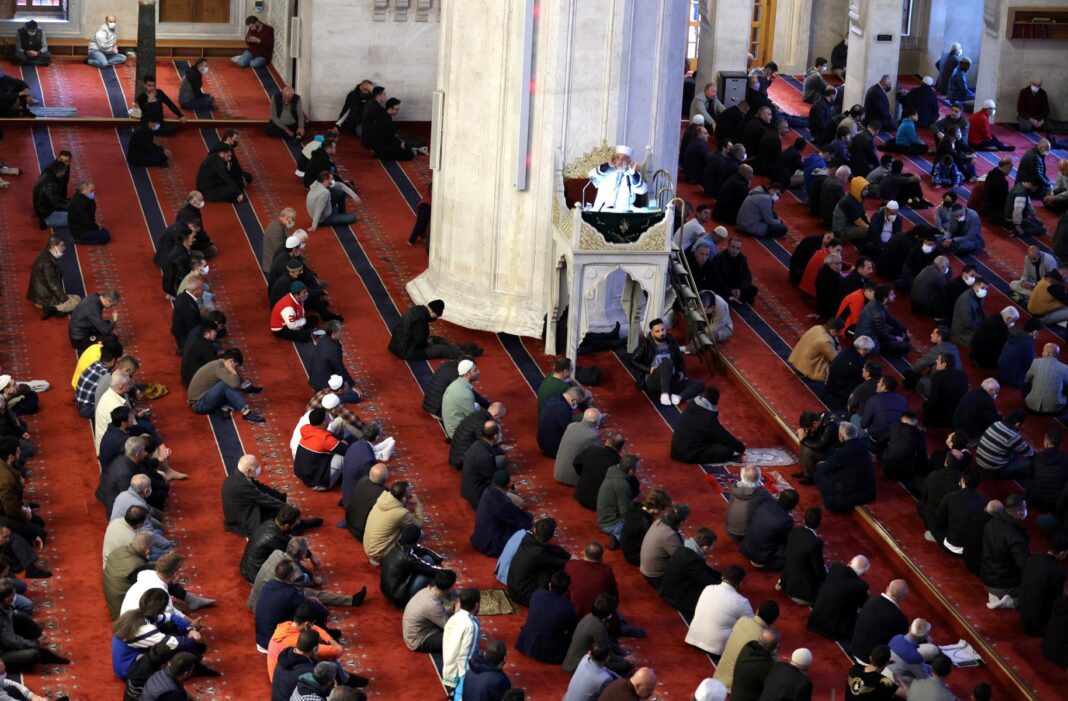

A new survey on religion in Turkey found that belief in God remains widespread, but daily Muslim prayers are practiced by a smaller share of the population, with 40 percent of respondents saying they perform the practice regularly.
The findings come from “Belief and religiosity in Turkey: TGSS 2024,” a report published in April by İSAR Publications and based on the Turkey General Social Survey (TGSS). The fieldwork was conducted from May 17 to June 2, 2024, using a nationally representative sample of 2,615 people across 26 provinces and 12 statistical regions. The survey used a multistage probability sample and included respondents from dense urban areas, smaller urban centers and rural areas.
According to the report, 94.05 percent of respondents said they believe in God, and 94 percent also said God is important or very important in their lives. Yet only 40 percent said they perform the five daily Muslim prayers regularly, while 36 percent said they never pray or pray rarely and 24 percent said they pray only sometimes. The gap suggests that personal belief in Turkey is far more widespread than strict daily observance.
Other religious practices were much more common. Among men, 76 percent said they regularly attend Friday prayers, the main weekly congregational prayer in Islam. Across all respondents, 76 percent said they fast regularly during Ramadan, the Muslim holy month of fasting.
The survey found that women reported higher rates of religious practice than men in several areas: 49 percent of women said they perform daily prayers regularly, compared to 32 percent of men, while 81 percent of women said they fast regularly during Ramadan, compared to 71 percent of men.
The report also found that 67 percent of respondents described themselves as religious or very religious, while 10 percent said they were not religious and 23 percent placed themselves in a middle category, saying they were neither religious nor nonreligious. That middle ground was more common among younger people and the well educated.
Among respondents 65 and older, 73 percent described themselves as religious, compared to 57 percent among those ages 18 to 24. In that youngest group, 31 percent chose the middle category. Among respondents with a postgraduate education, the share identifying as religious fell to 43 percent.
Daily prayer also varied sharply by age and education.
Only 26 percent of respondents ages 18 to 24 said they pray five times a day regularly, compared to 55 percent among those 65 and older. Among people with a postgraduate education, the regular daily prayer rate fell to 22 percent, while 63 percent in that group said they never pray or pray rarely. Rural respondents were more observant than city dwellers, with 44 percent in rural areas reporting regular daily prayer, compared to 40 percent in dense urban areas and 38 percent in mid-sized urban areas.
Regional differences were also sharp. The Aegean region on Turkey’s western coast had the lowest regular daily prayer rate at 23 percent, while the northeastern part of the country recorded the highest at 68 percent.
Regular fasting during Ramadan was also lowest in the Aegean at 56 percent and highest in northeastern Turkey at 97 percent. Women’s use of headscarves, one of the most visible markers of public religiosity in Turkey, stood at 54 percent overall, but dropped to 24 percent among women with a postgraduate education.
At the same time, the report points to broad support for secular principles. It found that 84 percent of respondents agreed that religion can be practiced freely in a secular country, and 82 percent said religion and politics should be kept separate.