

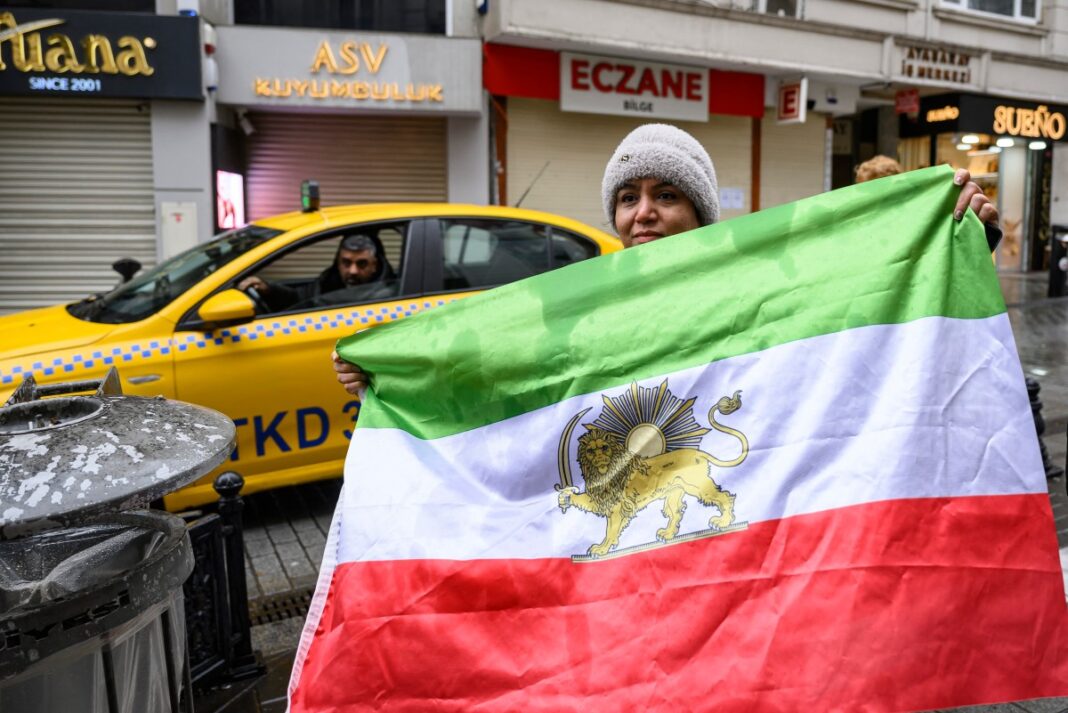

Iranians living in exile in Turkey say they are worried for relatives back home, but some are also hopeful after the United States and Israel began air strikes on Iran, according to interviews conducted by Agence France-Presse in İstanbul.
“War is no good, but it’s better than the regime killing our children,” said a 39-year-old Iranian in İstanbul, confessing he was “happy” that US and Israeli warplanes were attacking Iran.
Like many Iranians living in exile in neighboring Turkey, Reza, who did not want to give his surname, said he had been glued to his phone since news broke that Israel and the United States had begun air strikes on Iran.
Despite worrying about their families, most exiles in Turkey’s largest city told AFP they were happy with the strikes, which US President Donald Trump had threatened in January over Iran’s protest crackdown that left thousands dead.
“America is attacking the military bases, the people who 40 days ago were killing our children, so they are helping us. This war is no good, people will die, but I’m happy,” Reza, a student, told AFP.
Ali, a film director who like almost all the Iranians interviewed by AFP did not give his surname, agreed.
“Now people in Iran are full of hope and they are very, very happy,” Ali said.
“Iranians have been counting the minutes until America came to destroy the regime.”
Over the past few weeks, Trump has sent warships and dozens of fighter planes to the Middle East, raising fears of a US strike, even as US and Iranian diplomats held indirect talks on Iran’s nuclear program.
Early Saturday the tensions came to a head as Israeli and US warplanes began hitting targets in Iran, with Trump urging Iranians to stand up to their government and telling them, “The hour of your freedom is at hand.”
Turkey, which shares a 500-kilometer (300-mile) border with Iran, currently hosts more than 74,000 Iranians with residence permits and some 5,000 refugees.
While the unrest has raised fears of an influx of people, there have been no reports of unusual activity at the Turkey-Iran border so far.
“I’m both worried and happy, hoping for Iran’s freedom,” said Sepideh, a former teacher, who told AFP she managed to speak to a few friends in the morning, despite Iran cutting off all internet access.
Even with the internet shutdown, Mehdi, an engineer from the northern Iranian city of Tabriz, said he had managed to reach his family on Friday night.
“Everyone was aware of the possibility of war, so they have been saving fuel and storing enough food. They are planning to move to rural areas,” he said.
“We never wanted war in our country. It is the mullahs’ brutal theocracy that has put us in this situation,” he said.
“We don’t support Trump or Israel, either, we want freedom and democracy, but this will not come easily. There will be very difficult days ahead, but Iran will get through this period. We will survive.”
Some are hoping the strikes will bring people back into the streets in another show of mass protest that could ultimately bring down Iran’s government.
“People are full of anger, many thousands of people died in the protests and they are waiting like a wolf for an opportunity for revenge. This is their best chance,” said Reza.
Nina, a young woman in her 30s from Tabriz, said she also hoped the strikes would bring people back into the streets.
“If we don’t manage to overthrow the regime now, there will once again be massacres,” she warned.
Others were already looking to a future transition, with some putting their hopes in Reza Pahlavi, the exiled eldest son of Iran’s last shah, who rose to prominence during recent protests.
“Every Iranian is ready: as soon as Prince Reza Pahlavi gives the order that we can return, we won’t stay away a minute longer,” said Amir Hossein, a singer from Tehran.
“We will all come back to build a magnificent Iran.”
© Agence France-Presse