

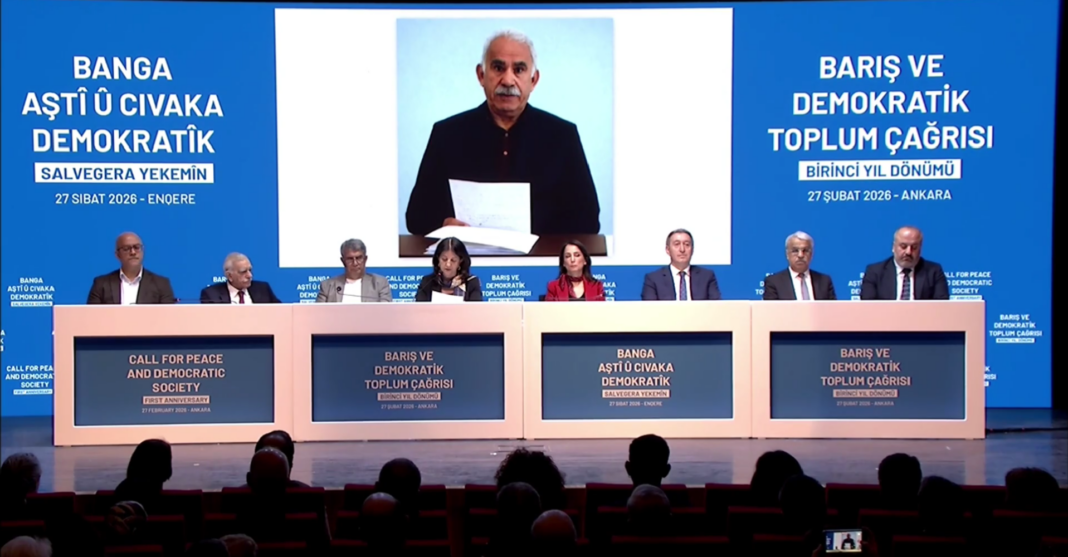
 founder Abdullah Öcalan said Friday that Turkey and its Kurdish population could be entering “a new political era,” marking one year since his call to end the group’s armed campaign and shift the Kurdish struggle for recognition into democratic politics.)
Jailed Kurdistan Workers’ Party (PKK) founder Abdullah Öcalan said Friday that Turkey and its Kurdish population could be entering “a new political era,” marking one year since his call to end the group’s armed campaign and shift the Kurdish struggle for recognition into democratic politics.
“The door is opening to a new political era and strategy,” Öcalan said in a written statement from the İmralı prison island, where he has been held since 1999 under strict conditions. He said the aim was to close “the era of violence-based politics” and open a process grounded in “democratic society and the rule of law,” calling on all parts of Turkish society to engage.
Öcalan’s February 27, 2025, appeal triggered a sequence of steps that culminated in the PKK, which is designated as a terrorist organization by Turkey and its Western allies, deciding to disband and renounce armed conflict. The PKK’s insurgency began in 1984 and has killed tens of thousands of people.
Since the call, the group has staged symbolic gestures meant to underscore the shift away from armed conflict, including a ceremony in which weapons were destroyed, and it says its fighters have withdrawn from Turkish territory.
On the state side, Turkey’s parliament has begun laying out a legal path for the process. A cross-party parliamentary commission last week published a report aimed at providing the legal groundwork, including plans to reintegrate former PKK members into civilian life. The report is expected to be brought before parliament next month, likely after the end of Ramadan, and would amount to Ankara’s first concrete legislative step if adopted.
Öcalan, 76, said his appeal a year ago was meant to “break the mechanism that feeds on bloodshed and conflict,” but he warned that progress would depend on Turkey strengthening democratic safeguards.
“The transition to democratic integration needs laws of peace,” he said, arguing that many of Turkey’s crises stem from weak rule-of-law standards and calling for strong legal guarantees that protect democratic politics.
Despite repeated calls from Kurdish politicians and rights advocates to ease his prison conditions, Öcalan’s detention situation has not fundamentally changed, although he has had increased access to family members, lawyers and a limited number of lawmakers from the pro-Kurdish Peoples’ Equality and Democracy Party (DEM Party), who have played a role in contacts linked to the process.
The parliamentary report has also attracted criticism from some lawmakers involved in drafting it, with concerns that it does not explicitly mention “the Kurdish question,” a common term used in Turkey for the long-running dispute over Kurdish rights, representation and conflict. Others have pointed to the absence of any reference to the “right to hope,” a term used in European human rights debates about whether prisoners serving aggravated life sentences should have a realistic prospect of release, an issue tied by many to Öcalan’s possible release.
With reporting by Agence France-Presse