

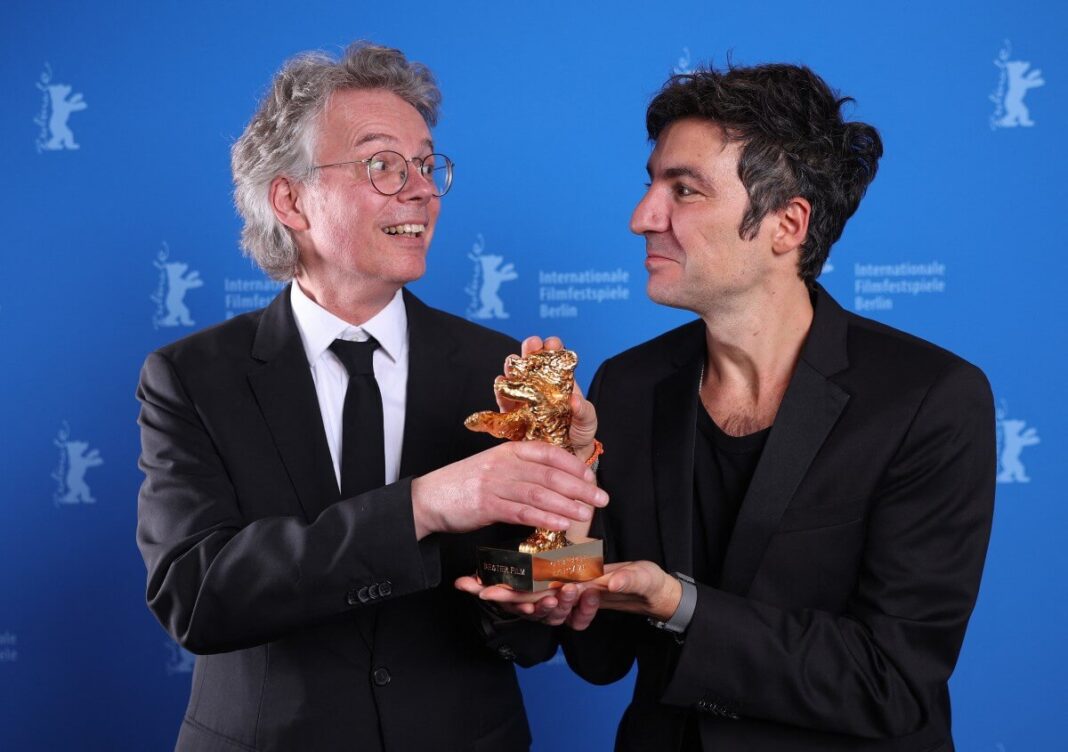

A political drama set in Turkey claimed the top honor at the Berlin International Film Festival on Saturday, as the event unfolded against a backdrop of heated debate over Gaza and the role of cinema in political discourse.
“Yellow Letters,” directed by German filmmaker İlker Çatak, won the Golden Bear for best film at a ceremony marked by pointed political statements from several winners.
The film tells the story of a Turkish director and his actor wife who are abruptly barred from working because of their political views, a storyline that resonates with longstanding concerns over freedom of expression in Turkey.
Jury president Wim Wenders described the film as “a terrifying premonition, a look into the near future that could possibly happen in our countries as well,” reflecting its broader warning about democratic backsliding.
Although the story is set in Turkey, the production was filmed in Germany, a choice Çatak has described as emphasizing that threats to artistic and political freedoms are not confined to one country.
The festival’s Silver Bear Grand Jury Prize went to “Salvation” by Turkish director Emin Alper, who used his acceptance speech to express solidarity with opposition figures imprisoned in Turkey, including jailed İstanbul Mayor Ekrem İmamoğlu.
Alper’s film, inspired by a true story, depicts a violent land dispute between two clans in a remote mountain village, offering an allegorical look at power, justice and social fracture.
In his remarks, Alper also voiced support for “the people of Iran suffering under tyranny,” “Kurds in Rojava and the Middle East struggling for their rights for almost a century” and “the Palestinians in Gaza living and dying under the most terrible conditions.”
Festival director Tricia Tuttle acknowledged that this year’s Berlinale had been “emotionally charged,” following days of debate over how directly filmmakers and organizers should address political crises, including the war in Gaza.
The strong presence of Turkish-themed stories and the outspoken comments from filmmakers placed Turkey’s political climate at the center of one of the world’s most prominent film festivals, highlighting ongoing international scrutiny of artistic freedom and opposition politics in the country.
Impassioned speech
Alper was not the only award-winner to express support for the Palestinians.
Syrian-Palestinian director Abdullah Al-Khatib won Best First Feature Award for “Chronicles From the Siege.”
He accepted the award with a keffiyeh draped over his shoulder and gave an impassioned speech in which addressed the German government, saying, “You are partners in the genocide in Gaza by Israel.”
He received cheers for his words but also prompted some heckling, reflecting the tension over Gaza that overshadowed this year’s event.
Speaking at a press conference at the beginning of the festival last week, Wenders answered a question about the German government’s support for Israel, responding, “We cannot really enter the field of politics.”
At the same press conference, he had said that films had the power to “change the world” but in a different way from politics.
But his comments in response to the question on Israel prompted a storm of outrage.
Award-winning Indian novelist Arundhati Roy, who had been due to present a restored version of a 1989 film she wrote, pulled out of the event, branding Wenders’ words “unconscionable” and “jaw-dropping.”
On Tuesday, an open letter signed by dozens of film industry figures, including actors Javier Bardem and Tilda Swinton and director Adam McKay, condemned the Berlin festival’s “silence on the genocide of Palestinians” and accused it of being involved in “censoring” artists who oppose Israel’s actions.
Tuttle has firmly rejected the accusations.
Wenders addressed the controversy on Saturday.
“The language of cinema is empathetic. The language of social media is effective,” he said.
Addressing political activists, he said, “All of us applaud you. You do necessary and courageous work.”
“But does it need to be in competition with us? Do our languages need to clash?”
‘Queen at Sea’
Other award winners on Saturday included German actress Sandra Hueller, who received the Silver Bear for Best Performance for her title role in Markus Schleinzer’s “Rose.”
The black-and-white drama tells the story of a woman passing herself off as a man in rural 17th-century Germany to escape the constraints of patriarchy.
“Queen at Sea” by American director Lance Hammer, which stars Juliette Binoche as a woman caring for her mother with dementia, picked up two awards.
The film portrays the devastation Alzheimer’s disease inflicts on a patient’s loved ones.
Tom Courtenay, 88, and 79-year-old Anna Calder-Marshall, who plays the ailing mother in the film, shared the Silver Bear for Best Supporting Performance.
The film also received the Silver Bear Jury Prize, considered the third most prestigious award.
Grant Gee took the Best Director award for “Everybody Digs Bill Evans,” his black-and-white biopic of the legendary jazz pianist.
© Agence France-Presse