

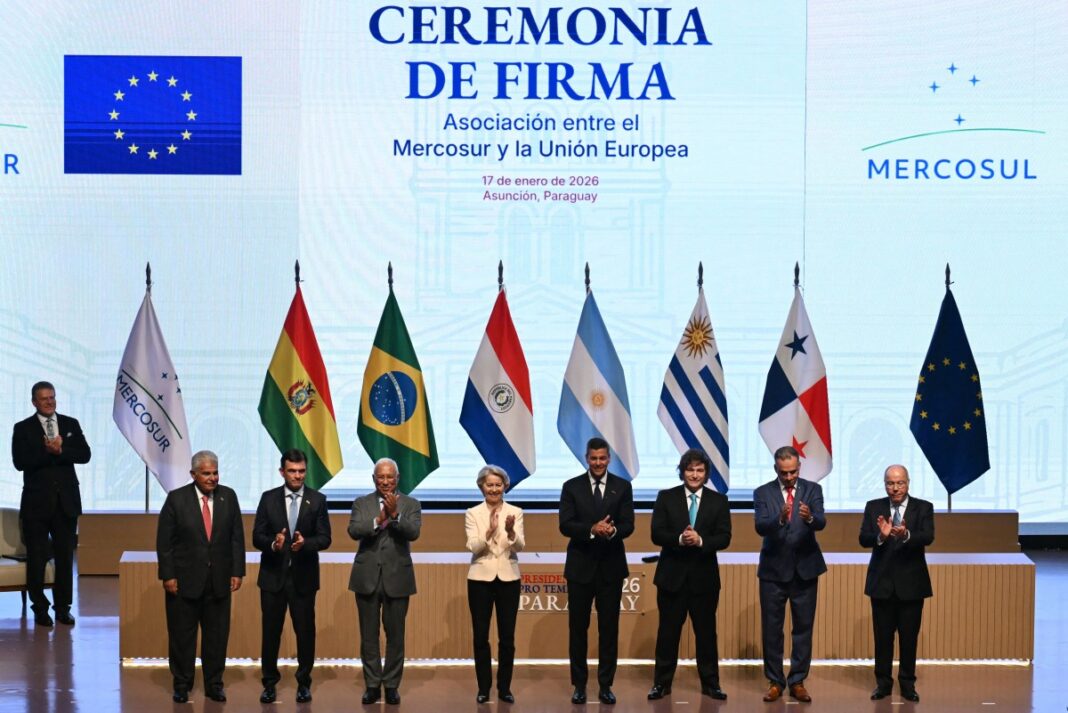

The European Union and the South American trade bloc Mercosur signed a long-negotiated free trade agreement in Asunción, Paraguay, on January 17, 2026, a move that could increase competitive pressure on Turkey’s exporters in the EU market, Deutsche Welle’s Turkish edition reported.
The agreement links the EU’s 27 member states with Mercosur members Argentina, Brazil, Paraguay and Uruguay, forming one of the world’s largest free trade areas and covering more than 700 million people. EU officials say the deal will eliminate tariffs on more than 90 percent of goods traded between the two blocs.
European Commission President Ursula von der Leyen and European Council President António Costa attended the ceremony in Asunción along with Argentine President Javier Milei, Paraguayan President Santiago Peña and Uruguayan President Yamandú Orsi. Brazil was represented by Foreign Minister Mauro Vieira.
The deal still requires approval by the European Parliament and ratification by national parliaments, a process expected to take years.
Why Turkey is affected
Turkey is directly affected by EU free trade deals because of its customs union with the EU, in force since 1996. The arrangement removes tariffs on industrial goods between Turkey and the EU and requires Turkey to align with the EU’s common external tariff.
That means when the EU opens parts of its market to third countries through trade agreements, Turkey can face new competition in the EU market without being able to shape the negotiations or secure the same access for its own exports.
Turkey’s customs union does not cover agriculture, services or public procurement, which experts often describe as creating an uneven structure.
Under the new EU-Mercosur agreement, Mercosur exporters are expected to gain improved access to the EU market, especially in agriculture. Turkey, however, will continue to face tariffs and other barriers when selling to Mercosur markets unless it reaches a separate deal with the bloc.
Ayhan Zeytinoğlu, president of the Kocaeli Chamber of Industry and the Economic Development Foundation, told DW that the imbalance between the EU’s trade network and Turkey’s has become more visible over time.
“The EU has close to 80 free trade agreements, while Turkey has only 24 in force,” he said, adding that EU companies will gain barrier-free access to Mercosur markets while Turkey will not enjoy the same rights.
Sectors under pressure
The EU accounts for about 41 percent of Turkey’s total exports, making shifts in market conditions especially important for Turkish manufacturers.
Analysts told DW that Turkish companies could face tougher competition in sectors such as textiles, chemicals, food products, glass, cement and durable consumer goods as Mercosur producers gain more favorable terms in the EU.
Zeytinoğlu said agriculture is particularly vulnerable because large-scale producers such as Brazil and Argentina could undercut Turkish exporters once their products enter the EU market under preferential terms. Mercosur countries are major global suppliers of soybeans and beef, products that have long been politically sensitive in parts of Europe due to concerns from farmers.
The impact is not expected to be immediate, but Zeytinoğlu said competitive pressure could increase in the medium term as tariff reductions and quota arrangements begin to reshape supply chains.
Calls for a policy response
Kader Sevinç, president of Brussels-based Forward 1919 Global Strategic Consultancy, told DW Turkish that major EU trade moves have direct implications for Turkey because of the customs union.
“This agreement is a strategic issue in terms of industrial competition, market access and geopolitical positioning,” she said. “It is time for a proactive vision.”
Zeytinoğlu said Turkey’s most durable solution would be an update of the customs union, arguing that Ankara should seek a framework that better reflects today’s trade realities.
While EU and Mercosur negotiators worked for more than 25 years to reach the agreement, Turkey now treats modernization of the customs union as a top trade priority.
Background
The customs union, which entered into force in 1996, was designed as a transitional step toward Turkey’s full EU membership. But accession talks have been stalled for years, leaving the trade framework in place far longer than originally planned.
President Recep Tayyip Erdoğan raised the issue of updating the customs union during von der Leyen’s visit to Ankara on December 17, 2024. Formal negotiations have not yet begun.