


Turkey is debating how an unidentified unmanned aerial vehicle was able to approach the country’s capital before being shot down by F-16 fighter jets earlier this week, reigniting concerns over its airspace security and transparency in official explanations.
The drone was downed on December 15 between Ankara’s Elmadağ district and the neighboring province of Çankırı. The Defense Ministry said the device had “lost control” after approaching Turkish airspace from the Black Sea and was destroyed “in a safe area outside a populated zone.”
Efforts to recover debris and determine the drone’s origin are continuing.
Flight operations at Ankara’s Esenboğa Airport were briefly disrupted on Monday, with some flights diverted as a precaution following a warning from the Defense Ministry.
The ministry has not disclosed who operated the drone or how it managed to penetrate so deeply into Turkish airspace before being intercepted.
Turkey’s opposition and some experts are looking for answers.
The main opposition Republican People’s Party (CHP) has submitted a parliamentary inquiry seeking answers on the drone’s flight path, when it was first detected by radar and air defense systems and how it was allowed to advance as far as Ankara.
The inquiry, submitted by CHP spokesperson and MP Zeynel Emre and addressing Defense Minister Yaşar Güler, also asked what findings had been obtained from the wreckage to determine the drone’s identity and whether early interception capabilities were fully employed from the moment the drone was first detected to the time it was neutralized.
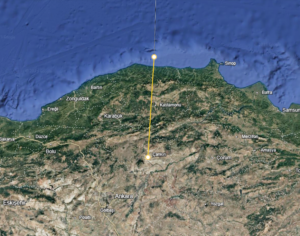
The lawmaker further questioned whether the incident was assessed as a possible reconnaissance mission, probe or provocation, given rising tensions and security risks in the Black Sea.
The incident comes amid heightened tensions in the Black Sea linked to the Russia-Ukraine war. President Recep Tayyip Erdoğan has warned about the region becoming an area of confrontation, citing what he described as a “worrying escalation” following recent attacks on vessels, including damage to a Turkish ship near Ukraine’s port of Odessa.
Turkey, which borders the Black Sea and has maintained ties with both Kyiv and Moscow since Russia’s full-scale invasion of Ukraine in 2022, has sought to avoid direct involvement while warning against spillover risks.
The parliamentary inquiry also asked whether Turkey’s air defense and counter-drone measures to protect Ankara’s airspace and critical facilities were reviewed after the incident and whether a formal assessment report was prepared.
Yankı Bağcıoğlu, a retired rear admiral and the CHP’s deputy chair responsible for defense issues, said the downing of the drone along the Çankırı–Elmadağ corridor had revived long-standing debates over Turkey’s air defense.
He said in a statement on X that criticism was necessary to expose failures by responsible authorities but warned against speculation and rhetoric that could undermine the morale of Turkish Armed Forces (TSK) personnel.
Calling transparency essential, he urged the Defense Ministry to clearly explain, at its next weekly briefing, how the drone was detected, what steps were taken after its detection and what corrective measures were adopted.
He warned that without clear information, misinformation and confusion would persist.
Journalist Murat Yetkin, in an article on his personal website on Wednesday, also raised questions about the drone’s possible ownership, asking whether it could have belonged to the TSK and gotten out of control, or whether it may have been operated by another NATO country active in the Black Sea, aside from Russia or Ukraine.
The journalist also questioned why the drone was not detected and downed over the Black Sea and asked whether there had been “a delay in the chain of command” in authorizing the interception.
Retired diplomat Namık Tan pointed to the presence of strategic locations near the area where the drone was downed — the village of Karacahasan — close to major defense industry facilities, despite official references to a safe area.
Tan asked whether radar systems were sufficient and if Turkey’s air defenses were “unable to detect an intruding drone in time.”
He also criticized official narratives about readiness, saying the public was being reassured with “comforting stories” while serious gaps remained in air defense preparedness.
The Defense Ministry is expected to answer all these questions at its weekly press briefing on Thursday.
The incident also came at a time when debates over Turkey’s acquisition of the Russian-made S-400 air defense system and its planned “Steel Dome” air defense project were intensifying.
Washington removed Turkey from the multinational F-35 consortium in 2019 after Ankara took delivery of the Russian missile system despite objections from its Western allies.
The United States argues that the S-400 poses a security risk to NATO technology and could compromise sensitive data on the stealth aircraft.
Turkey is seeking to rejoin the F-35 program, but the US requires that Turkey stop operating and possessing the S-400 system to move forward.
As for the Steel Dome project, it is an integrated, multi-layered air defense system designed to protect Turkish airspace. It uses domestic technology, including artificial intelligence, to counter threats from drones to ballistic missiles.
Turkey, a NATO member, unveiled Steel Dome in August 2024 as part of a plan to build a multi-layered air defense system to protect its airspace, modeled on Israel’s Iron Dome. Unlike Israel’s version, Turkey’s is designed to counter a wider range of threats, including drones, cruise missiles and aircraft.
The system officially entered TSK service on August 27, with the delivery of initial vehicles, radars, and electronic warfare assets.
Government officials say the projects are intended to strengthen Turkey’s deterrence and support the country’s ability to field and export indigenous air defense systems.