

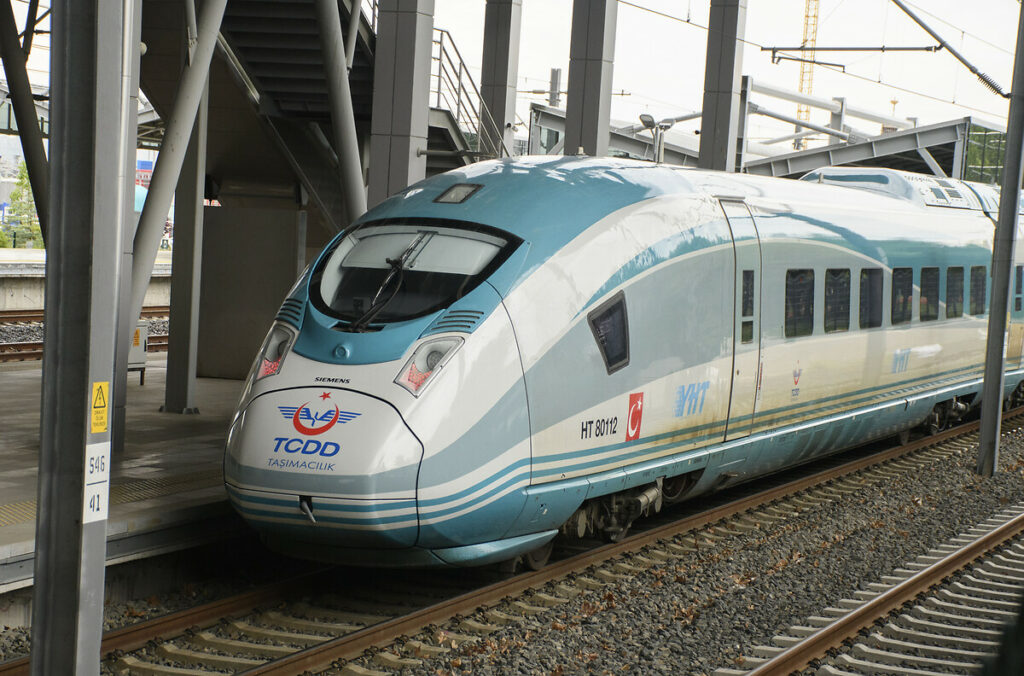

Turkey has secured €350 million in external financing from the Asian Infrastructure Investment Bank (AIIB) to modernize and maintain the country’s rail network, the stater-run Anadolu news agency reported, citing the Ministry of Treasury and Finance.
The loan will support the State Railways of the Republic of Turkey (TCDD) under the “Railway Maintenance and Modernization Project,” which aims to expand the network, upgrade existing lines and purchase high-capacity equipment for inspection and maintenance.
Officials said the financing is part of ongoing efforts to access favorable external funding for major infrastructure projects.
With the latest loan, Turkey’s project-based external financing has exceeded $15 billion so far in 2025. Funding directed specifically to transportation projects has also surpassed $5 billion. The ministry noted that total financing obtained from the AIIB this year has reached $800 million, including the new TCDD loan.
Treasury and Finance Minister Mehmet Şimşek announced the news on X on Tuesday, saying that strengthening transportation infrastructure contributes to trade, tourism and regional development and stressing the broader economic implications of railway modernization.
Demir yolu altyapımızın modernizasyonu için 350 milyon avro dış finansman sağladık. Böylece proje finansmanı amacıyla bu yıl temin edilen dış kaynak 15 milyar dolara ulaştı.
Demir yolu yatırımları; rekabet gücümüzü artıracak, karbon ayak izimizi azaltacak ve AB Sınırda Karbon… https://t.co/RyshwLSYLR
— Mehmet Simsek (@memetsimsek) December 9, 2025
“Developing our railway infrastructure will boost competitiveness, reduce our carbon footprint and help us align with the EU Carbon Border Adjustment Mechanism,” Şimşek said, adding that Turkey continues to work closely with international financial institutions and that external lenders remain confident in the government’s economic program.
Turkey moved to open its rail sector in 2013 with the passage of a liberalization law that formed part of wider transport reforms and was intended to ease pressure on road freight while aligning the country more closely with EU standards as part of Turkey’s now-stalled EU bid.
The reform required the state rail operator, TCDD, to restructure its activities by separating infrastructure management from train operations, creating a new state-owned company, TCDD Taşımacılık, to run passenger and freight services.
Although the legal monopoly ended with the 2013 law and private operators were granted the right to enter the market, competition remains limited in practice and TCDD continues to dominate the sector.