

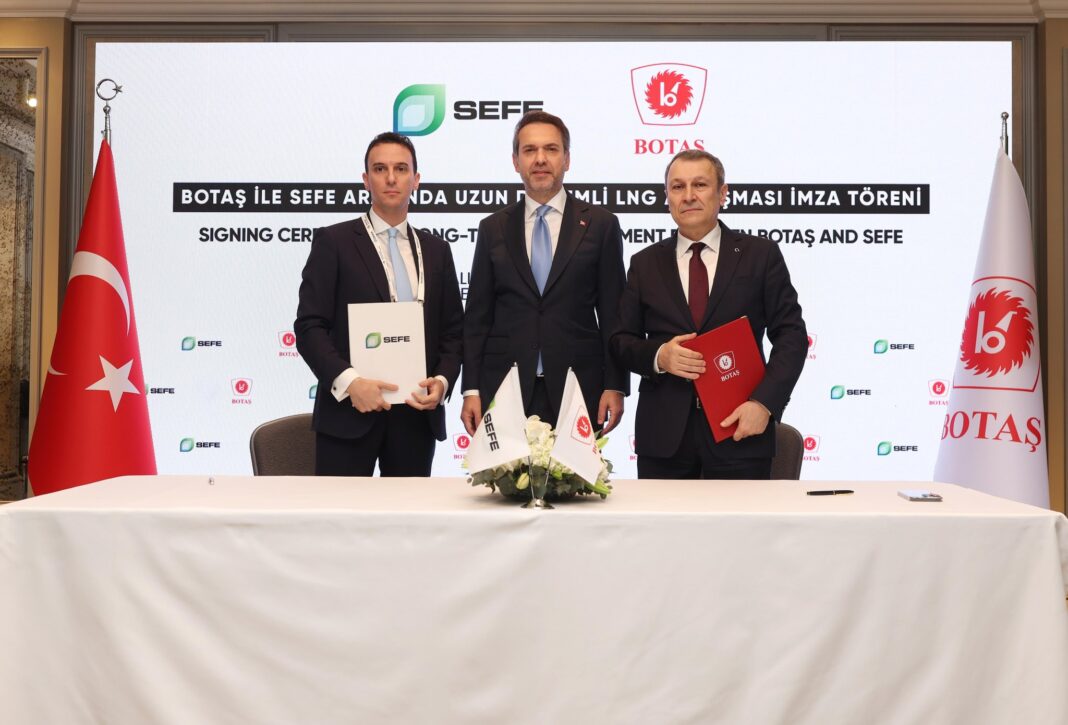

Turkey’s state pipeline company BOTAŞ signed long-term liquefied natural gas supply agreements with German energy company SEFE and Italy’s ENI on Wednesday as Ankara works to diversify its gas sources ahead of key Russian contract expirations in 2025.
The deals were signed at the World LNG Summit in İstanbul by BOTAŞ General Manager Abdulvahit Fidan, SEFE Vice President Jean Manuel Conil-Lacoste and ENI Global Natural Gas and LNG Portfolio Director Cristian Signoretto.
Energy and Natural Resources Minister Alparslan Bayraktar said Turkey had secured long-term LNG supply agreements totaling 106 billion cubic meters in 2025 and that contracts signed since September 2024 brought the total above 155 billion cubic meters. He described the new deals as part of a broader effort to secure supplies at prices that are more competitive than pipeline gas.
LNG gazlaştırma kapasitemizi çok kısa bir sürede yaklaşık 5 kat artırarak 161 milyon metreküpe ulaştırdık.
⁰Uzun dönemli LNG anlaşmaları ile tedarik kanallarımızı çeşitlendiriyor ve arz güvenliğimizi güçlendiriyoruz. ⁰ ⁰Millî şirketimiz BOTAŞ bugün bu anlaşmalara yenilerini… pic.twitter.com/SKvpp2J0ZM— Alparslan Bayraktar (@aBayraktar1) December 3, 2025
Under the agreements SEFE will supply Turkey with 6 billion cubic meters of LNG over 10 winter seasons beginning in 2028. ENI will deliver 5 billion cubic meters over 10 years starting the same year. ENI separately confirmed that its contract with BOTAŞ would take effect in 2028 as part of its global LNG expansion.
Russia remains Turkey’s largest single supplier, covering less than 40 percent of its gas needs in 2025, down from more than 50 percent in 2018. Turkey imports 22 billion cubic meters per year under Gazprom contracts whose original terms expire on December 31, 2025.
According to Reuters, BOTAŞ and Gazprom have already agreed to a one-year extension for 2026 covering roughly the same volume, which officials described as a temporary arrangement.
Russian pipeline gas is generally estimated to be 30 to 50 percent cheaper than LNG, although the gap depends on global prices and contract terms. LNG also carries added costs for liquefaction, transport and regasification. Turkey consumed about 50 billion cubic meters of natural gas in 2024, and analysts say shifting a significant portion of that demand from Russian pipeline gas to LNG could raise Turkey’s annual energy bill by $5 billion to $10 billion, depending on market conditions. These figures are economic estimates, not precise forecasts.
The diversification push comes as the United States and the European Union increase pressure on Ankara to scale back energy cooperation with Moscow. US media reports say American officials have urged Turkey to reduce its imports, and the United States has sanctioned Gazprombank, the main channel for Turkey’s gas payments. Bayraktar has said Turkey cannot abruptly halt imports from Russia, telling reporters in October that the country has binding contracts and needs sufficient supply for the winter season.
Turkey is also positioning itself as a regional gas hub for southeastern Europe and Ukraine. Bayraktar told Middle East Eye that Turkey aims for a maximum export capacity of about 10 billion cubic meters. He said the connection with Bulgaria, which carries 3.5 billion cubic meters, is a bottleneck and that doubling it would ease flows to Europe.
Turkey has a regasification capacity of 32 billion cubic meters per year, with an estimated 10 to 15 billion cubic meters likely to be available as excess capacity in 2026. Ankara plans to add two floating storage regasification units to its current fleet of three.
Bayraktar said Turkey is exploring upstream gas investments in the United States and has had talks with Chevron and Exxon. He said Turkey expects to receive about 1,500 LNG cargoes from the United States over the next 10 to 15 years under existing agreements.
BOTAŞ has also expanded its LNG supply portfolio in recent years. A 20-year agreement with Mercuria announced in September will deliver about 4 billion cubic meters per year beginning in 2026, for a total of roughly 70 billion cubic meters. A preliminary deal with Australia’s Woodside Energy covers 5.8 billion cubic meters over nine years beginning in 2030. A 10-year agreement with TotalEnergies will supply 1.6 billion cubic meters per year starting in 2027.
SEFE, which was formerly Gazprom Germania, continues to import Russian LNG under long-term contracts signed before Germany ended Russian pipeline gas imports. It remains one of the main buyers of Russia’s Yamal LNG, along with France’s TotalEnergies and China’s CNPC.